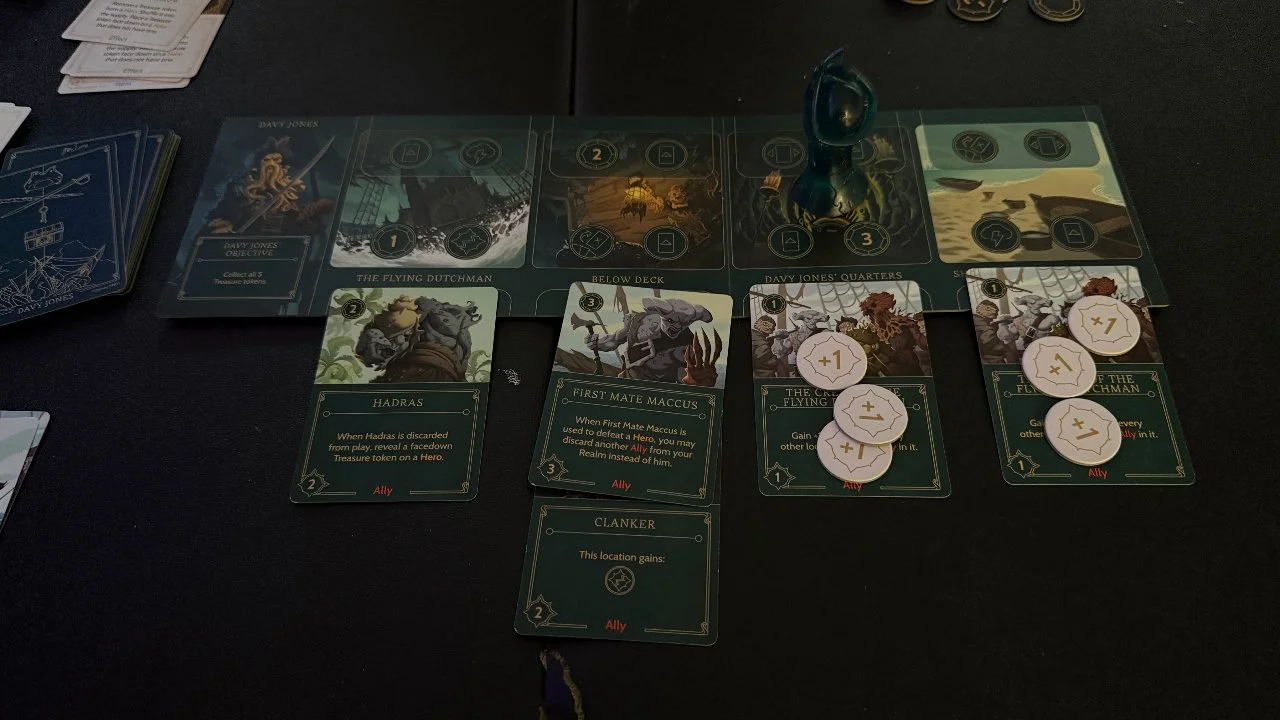
Ravensburger has recently shifted away from including three characters in each Disney Villainous expandalone. While this change might not thrill longtime fans, it seems to be a strategic move to allow for more frequent releases. Let’s call it a compromise. Treacherous Tides is the latest entry in the series and introduces two new villains—Tamatoa from Moana and Davy Jones from Pirates of the Caribbean, marking the debut of the game’s first live-action villain.
Tamatoa
He’s so SHINY! As the secondary antagonist in Moana, Tamatoa lives to collect treasure, and his in-game objective reflects that. To win, he must steal Maui’s Hook and the Heart of Te Fiti and bring them back to his lair. At first glance, this goal might seem a bit too straightforward—and to be honest, it kind of is.
But that’s likely by design. In these two-villain expandalones, there’s often a pattern: the cover villain usually has a more complex goal, while the secondary character (in this case, Tamatoa) has a simpler one. It’s a smart approach. If you’re picking this up to play with a friend who’s newer to the game, having one character be less mechanically demanding can keep things more fun and balanced.
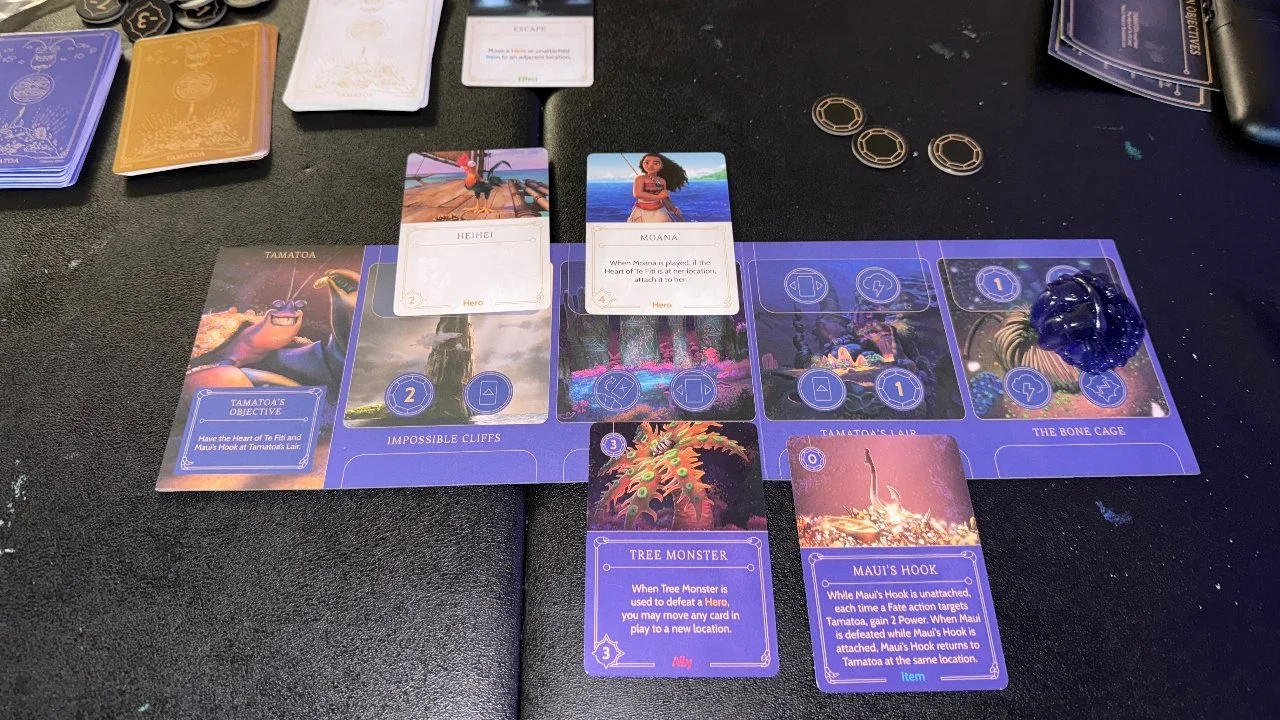
That said, Tamatoa isn’t without his quirks. He introduces a third deck—the Maui Deck—in addition to the standard villain and fate decks. This extra deck contains 10 cards and acts as a double-edged sword. Some cards purely benefit Tamatoa, while others slow him down, and a few offer both benefits and drawbacks. It’s a neat mechanic that mirrors the Moana scene where Maui’s identity and confidence are shaken as Tamatoa toys with him.
Tamatoa’s objective is split between his villain and fate decks. Unlike older characters whose victory conditions often boiled down to “defeat a hero to claim an item,” Tamatoa’s split-objective design actually makes him easier to win with. You can find Maui’s Hook fairly quickly in your villain deck, and the game offers plenty of tools for self-fating to draw the Heart of Te Fiti from the fate deck. Unless opponents are relentlessly targeting you with fate actions to keep Maui locked in your realm, Tamatoa tends to have a pretty smooth path to victory.
Thematically, his design is spot-on. Playing as Tamatoa genuinely feels greedy—you’re constantly cycling cards back into your deck, mimicking the sensation of hoarding treasures. That attention to detail goes a long way in making his character feel true to the source material.
Davey Jones
Now for the cover villain: Davey Jones. As I mentioned earlier, his gameplay is a bit more complex. Instead of simply collecting an item, Davey Jones must gather five treasure tokens. The process takes a few steps—first, he needs to attach a facedown treasure token to a hero. This is done using cards from his villain deck, including a condition card that can only be played when an opponent discards two or more cards. Once a treasure is attached, Davey must then defeat the hero holding it. At that point, the token is flipped over, triggering its unique flip effect—and let me tell you, some of these are downright nasty.
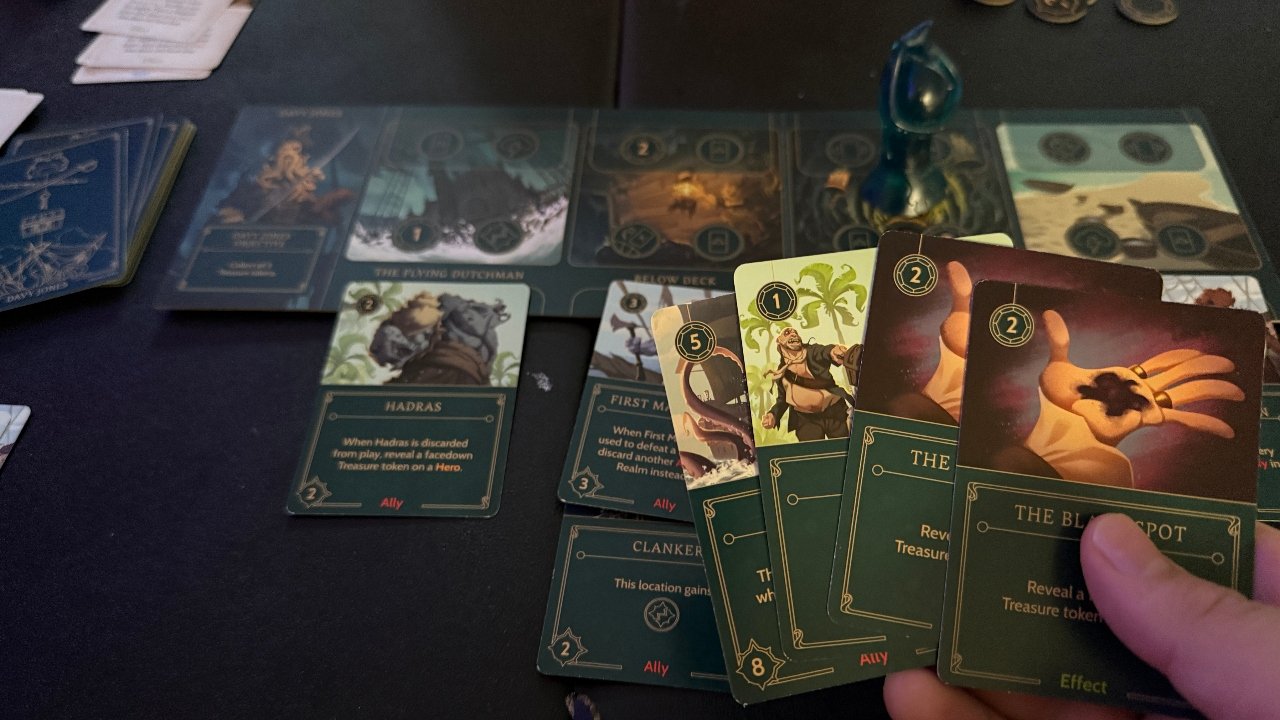
Each treasure comes with its own effect, and unlike Tamatoa’s Maui deck, every single one of them is negative for your opponents. I actually enjoy Davey Jones’ gameplay for this reason. I like when allies serve a purpose beyond just clearing heroes from your realm. And with Davey’s treasures packing more powerful effects, pulling off a win feels incredibly satisfying.
In terms of theming, Davey’s design is a bit more literal than Tamatoa’s. One thing I appreciated about Tamatoa was the more playful interpretation of his goal, but with a pirate like Davey Jones, it just makes sense—of course you’re going to be collecting treasure.
Better Villain?
When it comes to choosing between Davey Jones and Tamatoa, both villains stand out in different ways, making the comparison more nuanced than it first appears. Each has a very clear win condition, so neither one feels bogged down by overcomplication or constant rule-checking. Still, the experience of playing them is very different. Davey Jones comes with a steeper challenge; he requires more careful play and relies heavily on timing, with greater variability in how each game can unfold. Tamatoa, on the other hand, benefits from a much more consistent win rate since his objective is more straightforward.
Mechanically, Tamatoa’s deck has tighter synergy — nearly every card pushes him closer to victory, and the greed baked into his mechanics makes sense thematically since he barely spends any power. Davey Jones, while less efficient, actually benefits from being fated, giving him an edge in handling opponent interference. Where Tamatoa can be stalled hard by the wrong Fate card at the wrong time, Jones has tools to weather that storm and keep pushing forward. The trade-off is that Jones often feels underpowered compared to the roster, while Tamatoa leans toward the dominant side of balanced.
Theme and fun factor play into this comparison just as much as mechanics. Tamatoa nails his personality — you really feel like a greedy collector, hoarding items and reveling in the shine of your collection. Davey Jones, by contrast, is more of a slow-burn villain, offering greater replay value thanks to the difficulty of his win condition, though he can be more frustrating to play. In longer games, especially with four players, Jones has the breathing room to shine. Tamatoa, while often more fun in the short term, can feel a little too easy, which dampens the excitement of winning.
All told, it depends on what you’re looking for. If you want a villain who is consistently strong, dripping with theme, and easy to pick up, Tamatoa is the better choice. But if you’d rather take on a challenge with more variability and higher payoff when you succeed, Davey Jones might be the one worth mastering.
Feedback
One of the biggest takeaways from comparing Davey Jones and Tamatoa is how uneven their difficulty feels. Tamatoa’s objective is so straightforward and consistent that he can come across as almost too easy, while Davey Jones often feels a bit underpowered, however this does lead to great satisfaction when you do successfully complete the objective. Aligning their difficulty more closely would create a fairer balance — making Tamatoa’s path just a bit less automatic and giving Davey Jones a slight boost so his victories feel less like an uphill battle. Both villains are fun, but the gap in challenge can make them feel like they’re from two different ends of the spectrum.
Verdict
Treacherous Tides is a solid addition to Disney Villainous, even if its two villains land on opposite ends of the difficulty spectrum. I really enjoy Davey Jones’ playstyle — his treasure-hunting mechanic adds depth and makes his victories feel earned, even if he does sometimes feel a touch underpowered compared to the roster. Tamatoa, by contrast, is thematically perfect and easy to win with, but he can come off as a bit of a one-trick pony since his strategy rarely changes from game to game. Overall, I like this expandalone a lot, but both villains could use some fine-tuning: Davey deserves a little more strength to smooth out his challenge, and Tamatoa could benefit from just a bit more resistance to keep him from feeling automatic.
Disney Villainous: Treacherous Tides is available now at Target and other select retailers.