How Loonio Works in Canada: Casino Games, Studios, and Banking
The gaming industry's biggest stories aren't about the games themselves. Sure, AAA releases get a fair amount of press, but the stories that truly go viral tend to involve things like studio acquisitions, storefront issues, the occasional leak (GTA 6, anyone?), or disputes over project funding and backing. These matter more because they tie into the movement of money. The truth is that who builds the games, and who controls the player economics, has a disproportionate effect on what appears on our screens.
iGaming is the same story. If you didn't know, that's the industry term for regulated real-money gaming. It's the same story there because it runs on much of the same machinery: development studios, catalog acquisitions, licensing, and payment backends. This article is more about the latter. In Canada, most people currently lean on the national Interac e-Transfer rails when making payments. The largest gaming storefronts somehow don't support Interac, however. This is strange in a country where Interac processed 1.4 billion e-Transfer transactions worth $554 billion in 2024.
And since we said the flow of money is what really drives gaming news, the same holds in iGaming. Online casinos can't accept a standard e-Transfer directly (not easily at least), so they rely on local payment gateways to act as the valves on that river. That's where companies like Gigadat, Payper and Loonio enter the market, and become newsworthy. Loonio casinos in Canada handle these payments bank-to-bank through the customer's own online banking session.
Loonio Casinos in Canada: Where the Service Is Accepted
The current availability mostly sits within one corporate group of Kahnawà:ke-licensed brands: Baytree Interactive Limited. Five of them listed Loonio at their cashiers at the time of writing:
- Spin Galaxy: A recent addition carrying 550+ titles from the Games Global catalog alongside Pragmatic Play and NetEnt, with live tables from Evolution and OnAir.
- Gaming Club: One of the oldest online brands in the sector, operating since 1994 on the Microgaming catalog now owned by Games Global; lists Loonio for both deposits and withdrawals.
- Grizzly's Quest: Launched in 2025 as the group's newest release, carrying a 2,000+ title catalog under Kahnawà:ke and Alderney licences; Loonio deposits here run through the standard bank-login flow with near-real-time settlement.
- River Belle: A smaller legacy brand running since 1997, built on the same Microgaming-heritage catalog; payouts as well as deposits can move over the Loonio rail.
- Spin Palace: A heritage name from the early 2000s that spent years folded into its twin site Spin Casino before relaunching on its own in 2025; supports Loonio for deposits and withdrawals, with payout requests gated behind account verification.
These brands operate in Canadian regions where they're lawfully available and aren't directed at residents of Ontario or Alberta; players must be 19+ (18+ in Quebec and Manitoba). If play stops feeling like something you control, ResponsibleGambling.org can help. This article is reader-supported.
An iGaming Primer: Who Actually Builds Casino Games?
Just like in the gaming industry, casino games are produced by development studios with catalogs, licensing agreements and consolidation cycles. And their internal dynamics often make the news.
One of the biggest recent stories received little attention from mainstream gaming outlets. In 2022, Games Global completed its acquisition of Microgaming's distribution business and the Quickfire platform. The deal consolidated a major catalog associated with one of the sector's oldest developers. We're talking about a company that had been releasing titles since the mid-1990s, and it's a catalog that long-running brands like Gaming Club still draw from today.
Quickfire is an aggregation platform: the layer that allows operators to access games from multiple studios through a single integration. That made the transaction less like acquiring one development studio. It was more like buying part of a storefront's supply chain. Games Global inherited thousands of titles, along with established progressive-jackpot networks that pool across operators, immediately making it one of the sector's largest content owners.
Alongside Games Global are multi-market content houses such as NetEnt and Pragmatic Play. These companies develop and license titles to operators in much the same way that middleware companies license engines and other technology. In regulated markets, each title must also be independently certified before going live.
Live (dealer) games operate through a different type of production business. Companies such as Evolution, Ezugi and OnAir Entertainment run physical studios with sets, cameras, presenters and shift schedules. They broadcast table games in real time to operators like Spin Galaxy. The model has more in common with television production than traditional software distribution, and it is where much of the sector's capital spending now goes.
Where players actually meet this machinery is the operator layer: the casino brands that license these catalogs, assemble a game library from them, and run the accounts and cashiers on top.
Who Licenses and Audits These Games for Canadian Players?
The oversight layer is older than many people assume. Based in the Mohawk Territory of Kahnawà:ke, the Kahnawà:ke Gaming Commission has licensed and regulated interactive gaming operators since the 1990s. That makes it one of the longest-running bodies of its kind.
The Commission issues different permit classes for operators and their hosting arrangements. It also maintains a public register of permit holders, which is the primary document for checking whether an operator is genuinely licensed rather than simply claiming to be.
Canada's regulatory map matters as well. Gaming regulation is handled provincially. Ontario operates a separate, closed market through its provincial bodies, while Alberta recently launched its own system. Ontario players are therefore served by provincially licensed operators, and internationally licensed brands tend to direct their services toward the rest of Canada instead.
For readers, the practical point is straightforward: "licensed" always means licensed somewhere specific, and that jurisdiction should be independently verifiable.
Independent testing adds another layer of oversight. eCOGRA, a London-based testing agency, audits participating operators' games and payout behaviour, then issues certifications that operators can display and link to. Regulated operators also publish return-to-player figures (called RTP), the long-term percentage that a game is designed to return, which provides a level of transparency with few direct equivalents elsewhere in digital entertainment.
None of this amounts to a safety guarantee however, nor is it intended to. It is a paper trail: a licence that can be looked up, an auditor that can be verified. A later section explains how to check that paper trail in practice.
What Is Loonio and How Does It Work?
Loonio is a Canadian pay-by-bank service operating on Interac's payment rails. Instead of entering card details, customers choose their financial institution at a participating checkout. They sign in through their own online banking and authorize a pre-authorized debit agreement, the same PAD framework used for recurring bill payments.
The service connects with more than 100 Canadian financial institutions, from the Big Five to Desjardins, Tangerine and Simplii, plus dozens of credit unions. Most major Canadian banks support Loonio without any special setup. Settlement is near-real-time, similar to the national Interac e transfer speeds.
Under the hood it functions as an Interac gateway rather than a wallet brand. A generic Interac e-Transfer starts with a money request, a notification, and often a round of security questions. Loonio's API removes those manual steps by connecting the checkout directly to the online banking login, which is why the experience feels closer to tapping a card than to sending a transfer.
Its scale is not insignificant either. Industry reporting places Loonio at more than 10 million customers, and its expansion extends beyond entertainment. Through a partnership with SimplePin, its infrastructure is also used to process insurance premium payments.
The design also has a less obvious security implication. Because authorization takes place inside the customer's online banking environment, neither card numbers nor banking credentials are stored by the merchant. This means your own online banking data never leaves the bank's systems. The session effectively carries bank grade security because the authentication is the bank's own. That leaves one fewer merchant database from which payment details could be exposed.
The most accurate way to describe Loonio is as a payment rail rather than a wallet. It does not hold a stored balance, provide a card number or require funds to be topped up. What Loonio offers is a direct account-to-account transfer between the customer's bank and the merchant, which creates its own set of practical trade-offs.
What Does Loonio Look Like at a Casino Cashier?
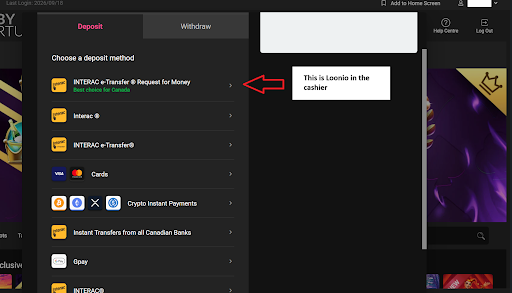
At a casino cashier, Loonio appears as a payment option alongside cards and e-wallets. At Baytree brands, it is listed as "best choice for Canada". Selecting it opens a list of participating Canadian banks and credit unions. The sign-in happens inside a secure bank environment, the same screens as your regular online banking. No account details, no security questions and no online banking data pass to the casino site; the operator only learns that the payment cleared.
Funding a casino account like this settles in near-real time. This is most of the reason Loonio caught on for casino play in the first place. Loonio withdrawals run in reverse where an operator supports them (note that sometimes casinos use hybrid routing through something like eCashout or Gigadat, still Interac based). In any case, the platform routes withdrawals back to the same account (note again that casino approval steps and weekend verification windows can affect cashout speeds). Players who withdraw winnings this way still get fast access to funds compared with a card refund cycle.
Does Loonio Charge Fees?
For players, usually not. Cashiers with modern Loonio support generally show zero fees on deposits. Canadian banks and credit unions treat the pre-authorized debit like any other account activity rather than a billable service. The economics of the payment method run like card processing in reverse. The merchant absorbs the cost rather than passing it on, which helps explain why the option spread across the Canadian market so quickly.
There is also no wallet layered on top with its own fee schedule. Because everything happens inside the bank's secure environment, Loonio works as a pass-through between the account and the merchant. The flow behaves the same whether that account sits with one of the major banks or a small credit union.
Two caveats. Any charge that does apply must appear on the payment screen before you confirm, so that screen outranks anything written here. And where a platform imposes its own withdrawal charges, that policy belongs to the casino, not the rail. Loonio deposits stay instant deposits either way; where fees exist, they never buy speed.
Can You Use Loonio on Steam or the PlayStation Store?
No. Neither Steam nor the PlayStation Store currently provides a direct Loonio option at checkout, and the same is true of the major key resellers.
That's not unique to Loonio, though. Large gaming storefronts have generally been slow to adopt Canadian bank-payment rails, something we have felt since digital purchases became the default way this audience buys games.
The card systems those storefronts do accept also come with their own issues. The Merchant Risk Council's 2024 benchmarking placed average e-commerce rejection rates at approximately 6% of orders. PYMNTS research separately found that 56% of consumers had experienced a false decline, a bank rejection of a legitimate purchase, during a three-month period.
For bank-first customers, the practical workaround is indirect: gift cards. PlayStation Network and Steam wallet cards are available through Canadian retailers whose checkouts run on Interac rails. A customer can therefore fund a storefront account without entering card details, although it requires two transactions instead of one.
It is a clumsy solution, but marketplaces have paid a price for taking shortcuts with payments before. The G2A chargeback saga demonstrated what can happen when money movement and accountability begin to drift apart.
If the major gaming storefronts are not where Loonio operates, where can Canadians actually use it?
Where Canadians Can Use Loonio for Casino Play
Loonio's footprint follows Canadian e-commerce more broadly. It appears at online retail checkouts and handles insurance premium payments through the SimplePin integration. It is also an established payment option at licensed online casinos, where bank rails have become standard cashier fare.
The pattern is consistent across those categories. Loonio appears where merchants want greater settlement certainty. Going by Reddit threads and player communities, it has quietly become a preferred payment method for people who want their casino payments running through a bank, though it remains niche next to its competition. Among Canadian online casinos, Loonio acceptance is concentrated in the options listed earlier. Sister brands from the same group, such as Ruby Fortune, follow the same cashier pattern.
On licensed platforms, there is another reason the model fits. Operators already verify customer identities as a condition of their licences. A payment arriving directly from a named Canadian bank account can fit into that verification process more cleanly. At least more cleanly than a card that might have been issued anywhere in the world. Also, Canadian casino players get a cashier that speaks the same language as their bank.
What Are the Trade-Offs?
The directness of pay-by-bank payments is also their principal limitation. Card networks include an established dispute system. Canada's Bank Act caps consumer liability for unauthorized credit card use at $50. Chargebacks also provide a routine remedy for disputed card transactions.
A completed Loonio payment, by contrast, is effectively irreversible. The PAD framework allows unauthorized debits to be disputed within 90 days, but the process is slower and its outcome less certain than a conventional card chargeback. Money sent through the service should therefore be treated as money sent.
Several other limitations are structural to the payment method. Loonio is restricted to Canada, so it does not travel in the way a card does. It requires active online banking with participating banks and credit unions, which covers most Canadian players but not everyone.
It is also not available at every checkout. Its e-commerce coverage is broad and expanding into other sectors, but anyone relying primarily on bank payments may still need a card or gift-card alternative for the major gaming storefronts discussed above.
How to Check a Loonio Casino Is Legitimate
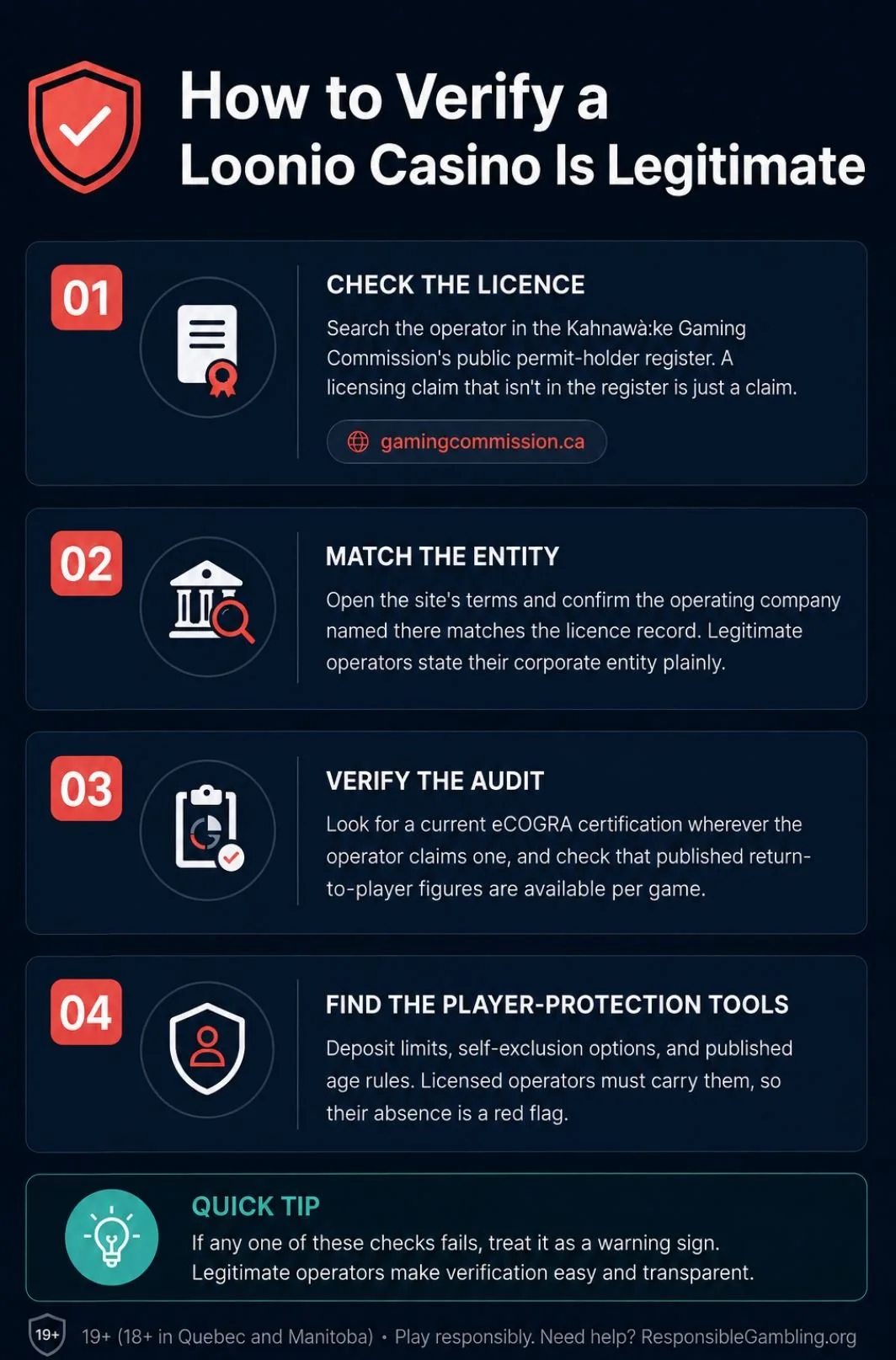
Verifying casinos that accept Loonio takes approximately five minutes and relies on the paper trail described earlier.
First, search for the operator in the Kahnawà:ke Gaming Commission's public permit-holder register. A licensing claim that does not appear there remains just that: a claim.
Second, open the platform's terms and confirm that the named operating company matches the entity shown in the licence record. Legitimate operators should identify their corporate entities plainly.
Third, check for a current eCOGRA certification wherever an operator claims to hold one.
A fourth indicator does not require any specialist knowledge. Licensed operators must provide player-protection controls, including deposit limits, self-exclusion options and published age restrictions, the practical tools that let people play responsibly. The absence of those controls can be as revealing as a missing licence.
The Bottom Line
Viewed as an industry, the regulated real-money sector operates through dynamics that should be familiar to any gaming reader. Studios consolidate catalogs, production companies build live formats, and regulators maintain permit registers.
Loonio's role within that system is narrow but important. It provides a Canadian bank-payment rail that works where licensed operators offer compatible cashiers. As a payment method, its trade-off is equally straightforward: speed and directness in exchange for weaker recourse.
For Canadian players, the checklist is short. Before money moves, understand who built the game, who licensed the operator and how the payment will travel from the bank account to its destination. Knowledge is power. If you understand the market dynamics end-to-end, you are more likely to make informed decisions as a player.