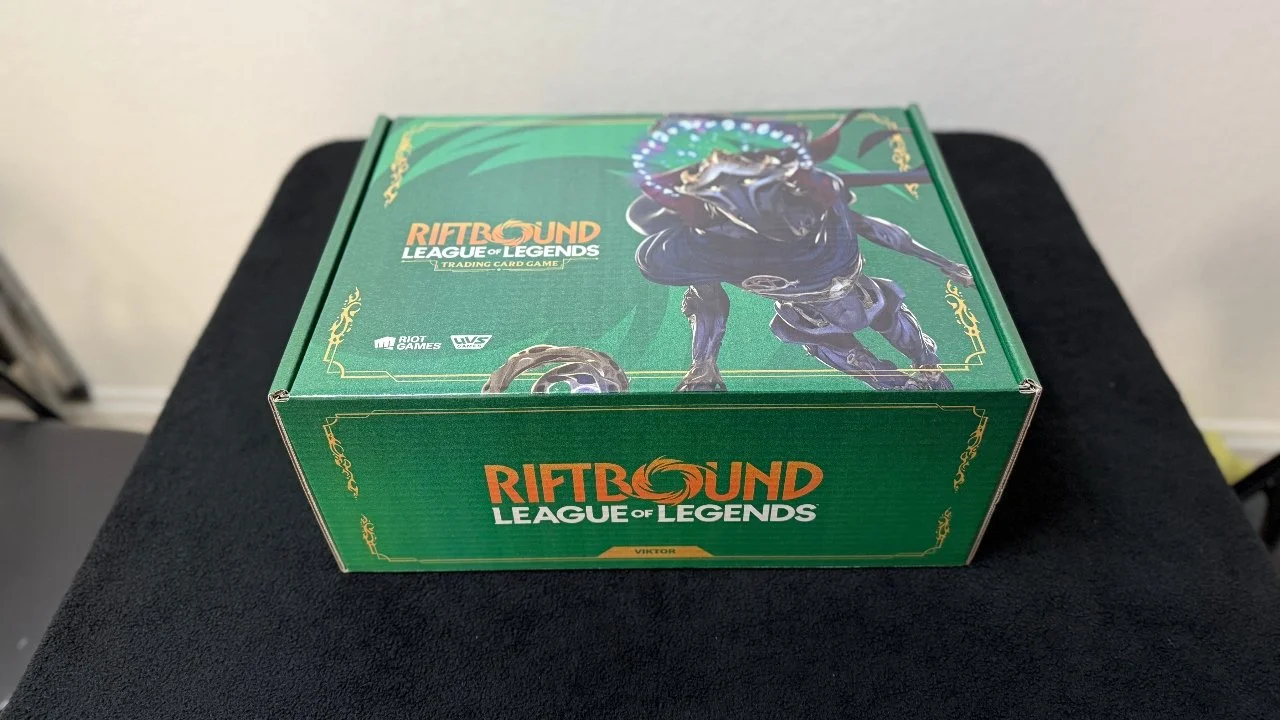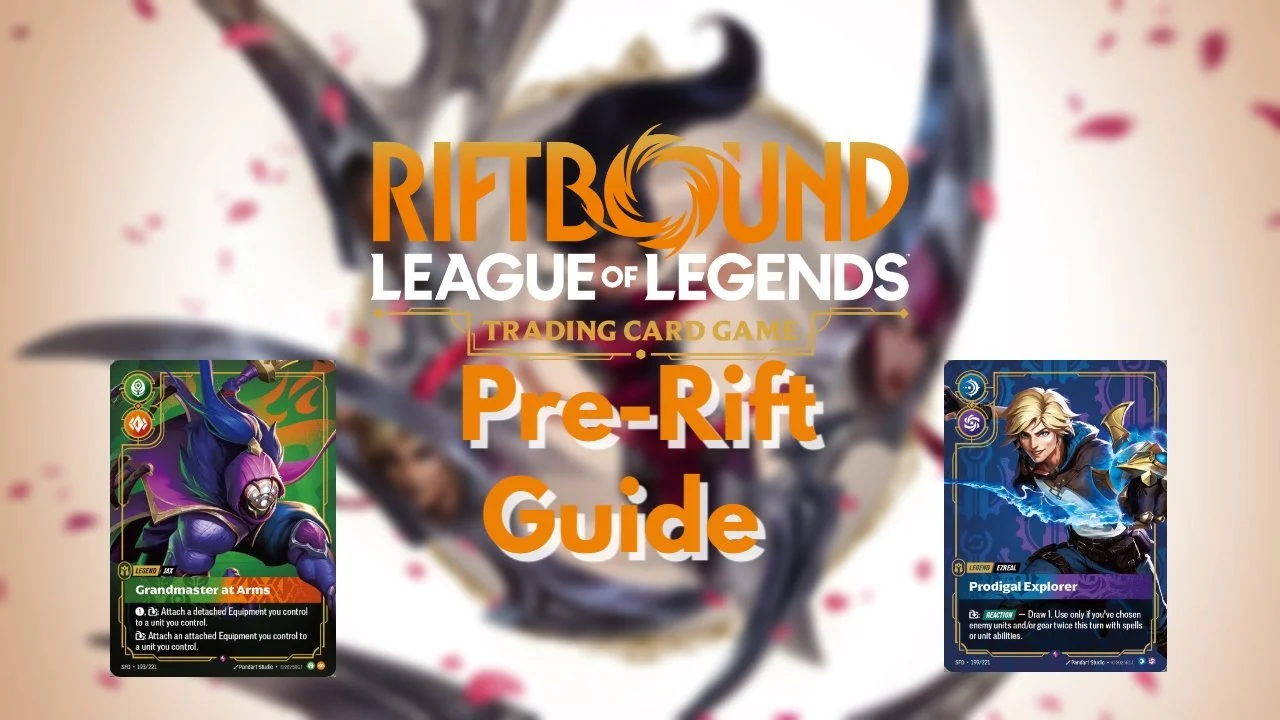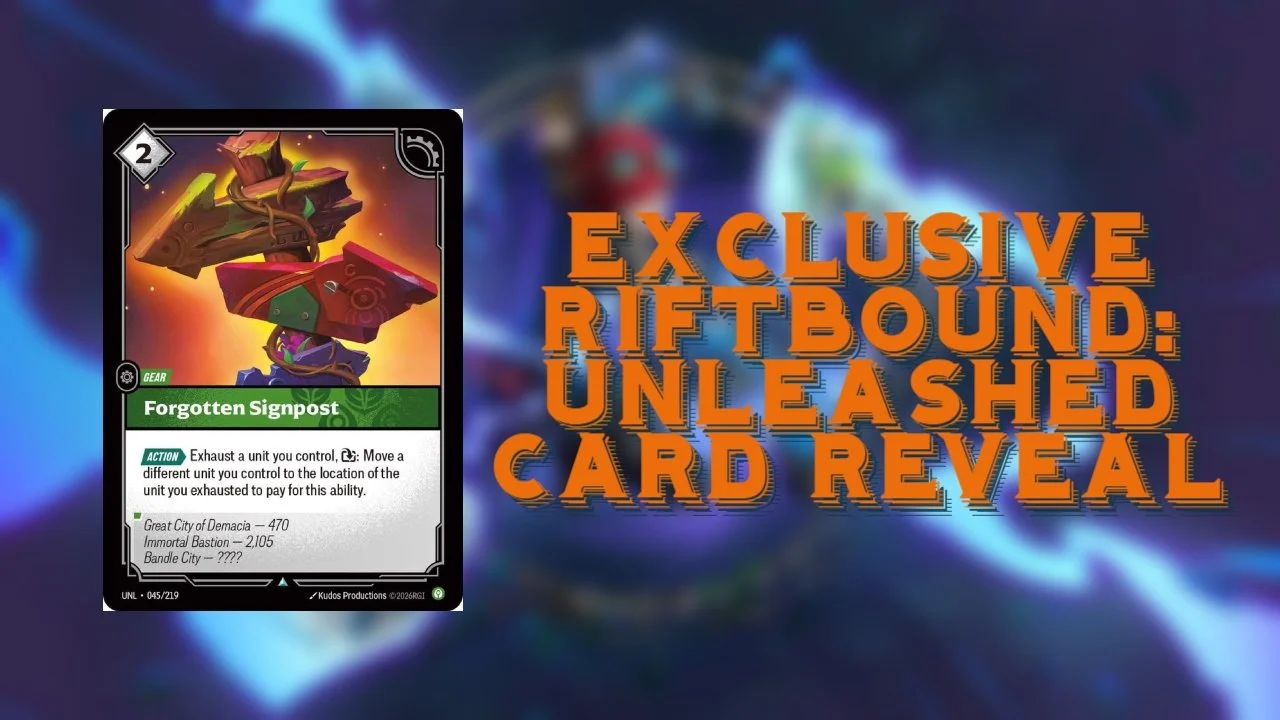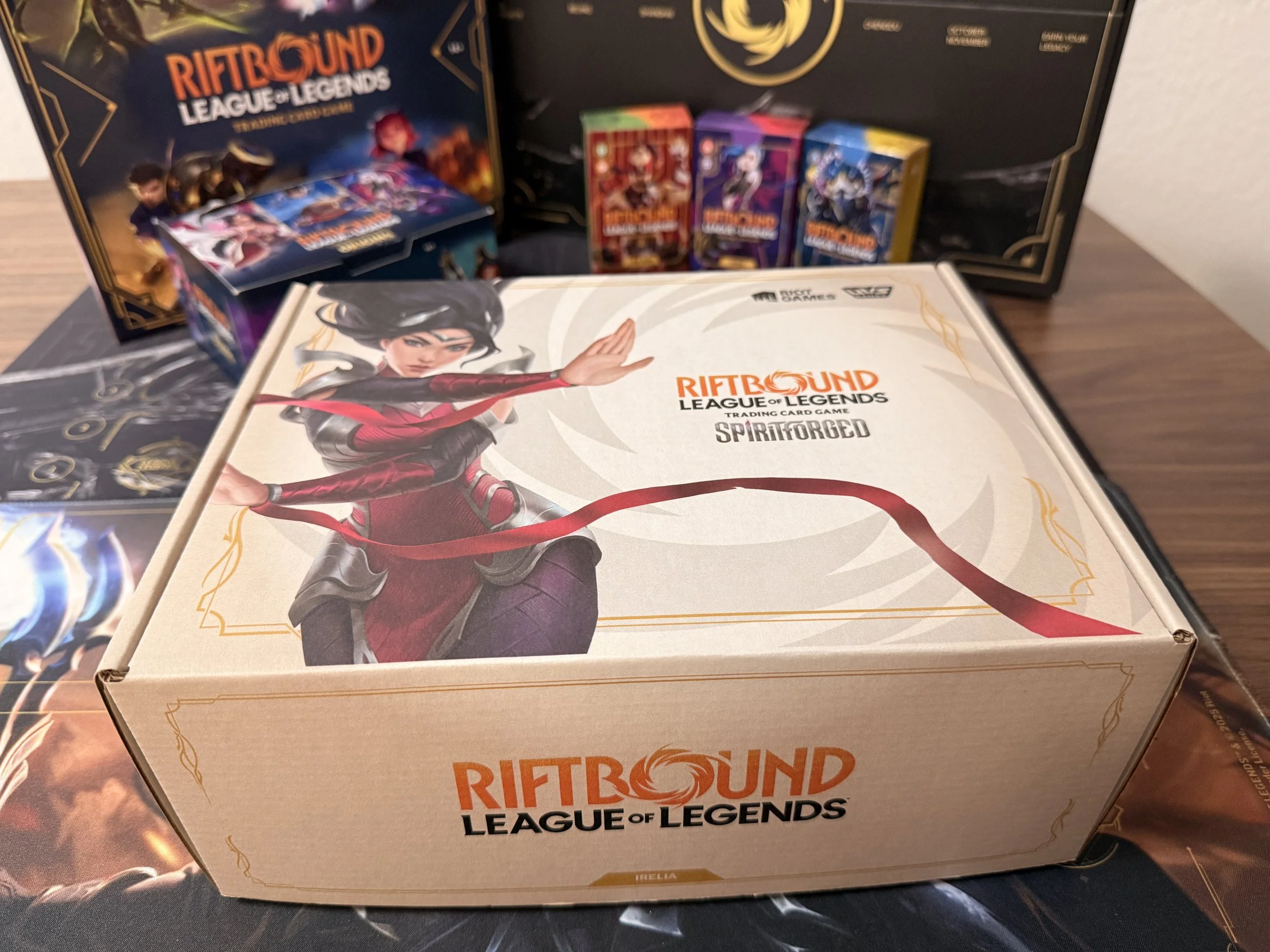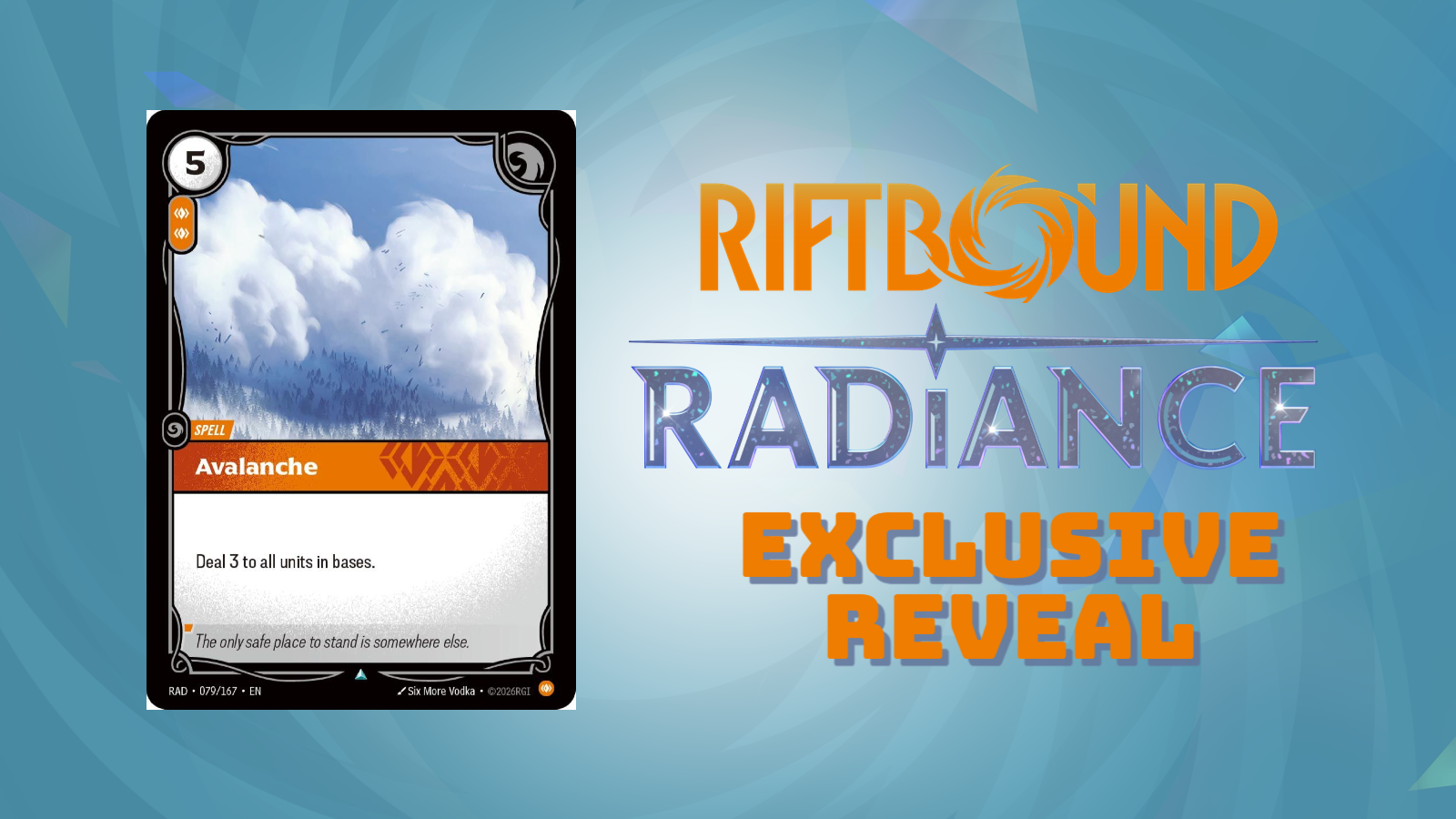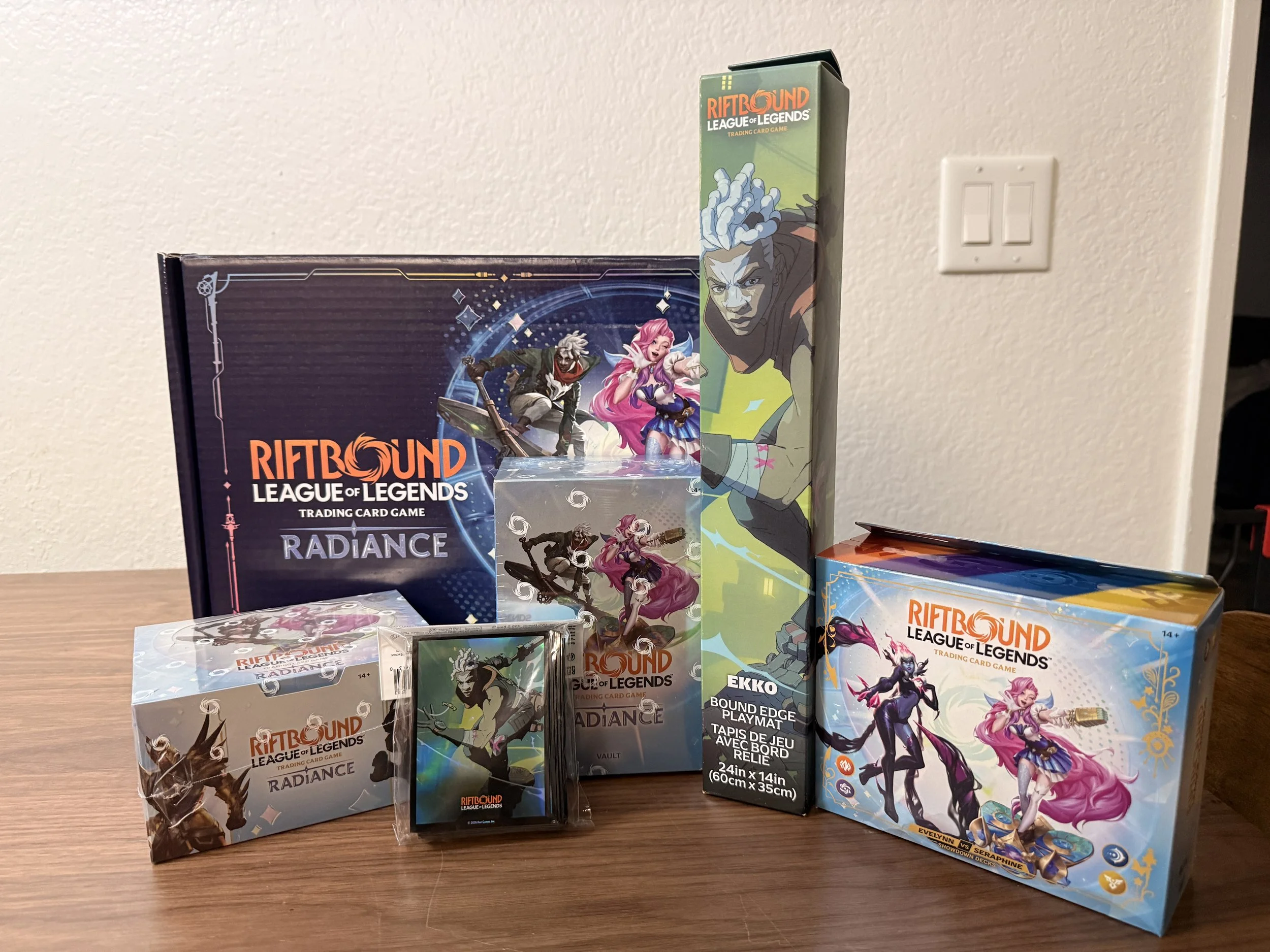
Riftbound has been moving at a pretty impressive pace, and with each new set, Riot Games and UVS Games continue to explore just how much room this trading card game has to grow. From new mechanics to increasingly creative Legends, each release has brought something new to the table. Riftbound: Radiance is no exception, and this time around, some of the new cards are looking particularly powerful.
Radiance feels like a set that is really starting to push the boundaries of what Riftbound can do. The new Legends have some incredibly interesting abilities, the preconstructed decks feel stronger, and the addition of three new mechanics opens up even more possibilities for deckbuilding. Not every mechanic lands quite as well as the others, but there is still plenty to be excited about.
One thing that immediately stands out to me is just how much support Chaos and Body receive in this set. Both domains get some fantastic new tools, and I wouldn't be surprised to see quite a few new decks built around them. That said, Radiance isn't exclusively about making these two domains stronger. There are plenty of interesting additions for players who prefer other playstyles, especially if you're willing to experiment with some unconventional strategies.
What Is Riftbound: Radiance?

Radiance is the fifth main set for Riftbound: League of Legends TCG, and this time around, the spotlight is on music, performance, and some of Runeterra's most recognizable performers. The set features nine new Legends, including Riven, Evelynn, Ekko, Jarvan IV, and Ziggs, alongside plenty of new cards designed to support both existing and entirely new strategies.
Thematically, Radiance takes a different direction from previous releases. Rather than focusing heavily on a particular region or conflict, this set celebrates the musical side of League of Legends, with groups like K/DA and HEARTSTEEL helping establish its identity. The artwork is vibrant, the showcase cards are particularly appealing, and the whole set has a personality that makes it stand apart from the releases that came before it.
Mechanically, Radiance introduces Deploy, Show Off, and Disarm, alongside some interesting new interactions involving Gear and battlefield control. These additions give players more ways to manipulate combat, establish board presence, and approach familiar strategies from different angles.
New Mechanics in Riftbound: Radiance
Three new mechanics make their debut in Radiance: Deploy, Show Off, and Disarm. Each one approaches gameplay differently, but I think two of them stand significantly above the third in terms of their overall impact.
Deploy
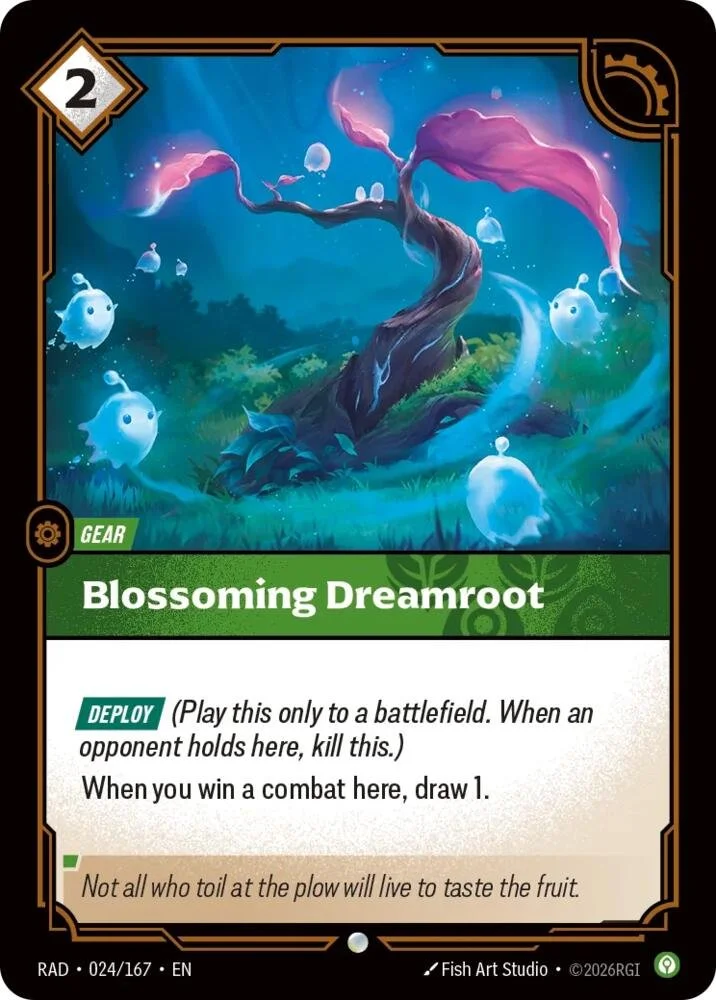
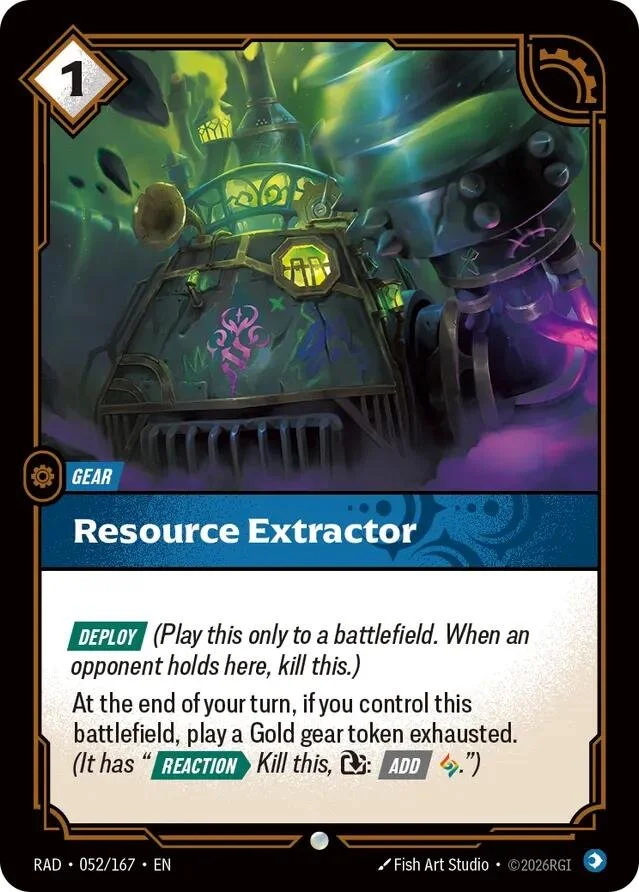
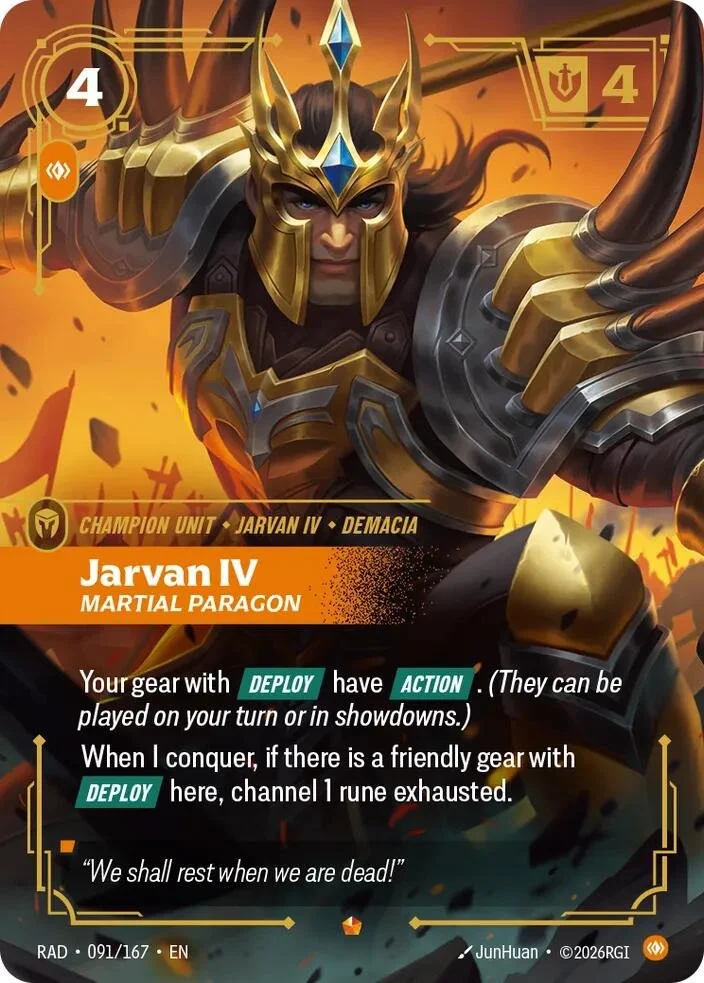
Deploy is easily one of my favorite additions to Radiance, primarily because it introduces another layer of strategy to battlefield control.
Unlike traditional Gear cards that sit in your base, Gear with Deploy is played directly to a battlefield. These cards provide benefits while they're there, but they come with an important drawback: if an opponent holds that battlefield, the deployed Gear is killed.
That creates an interesting dynamic where players have to think about more than just controlling a battlefield for points. Now, holding a battlefield can also remove an opponent's resources, making certain locations significantly more important to contest.
Deploy also has some great synergy with the new Legends, particularly Jarvan IV and Ziggs. Whether you're using Gear to establish a stronger battlefield presence or leaving Bomb tokens behind to punish opponents, the mechanic creates plenty of interesting decisions.
What I particularly enjoy about Deploy is that it feels like a natural extension of Riftbound's core gameplay. Battlefield control has always been the foundation of the game, and Deploy makes those decisions matter even more.
Show Off
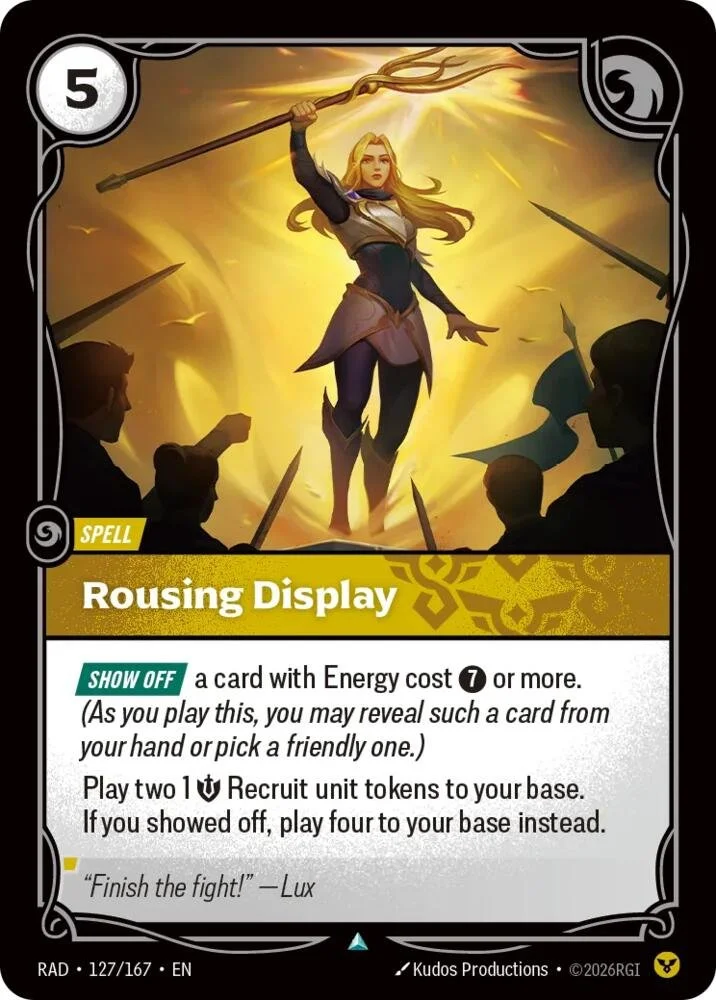
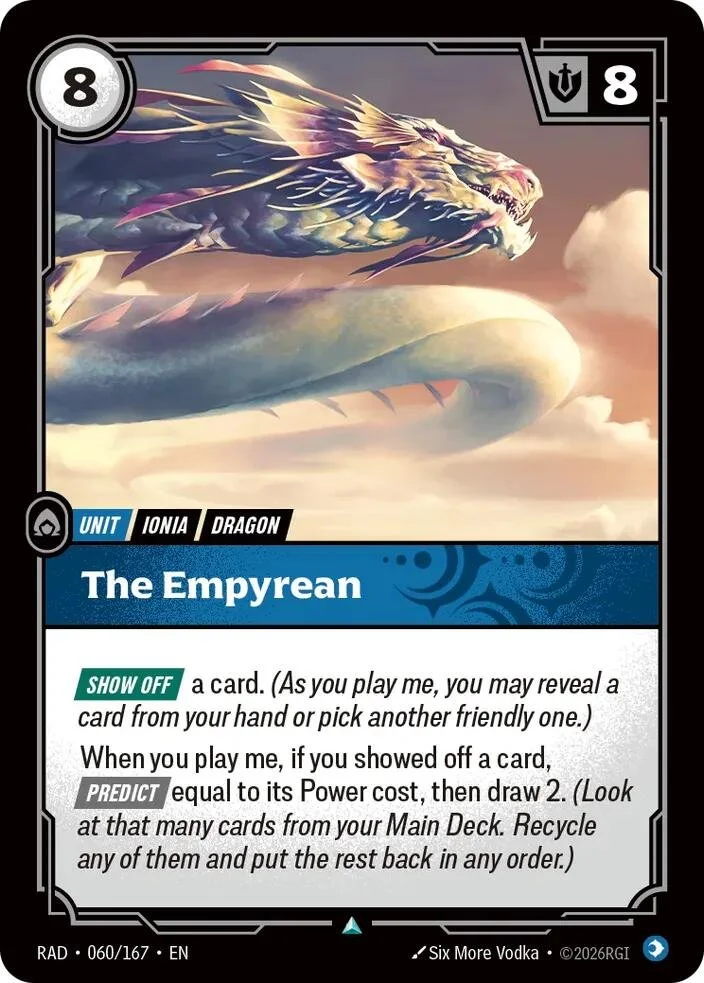
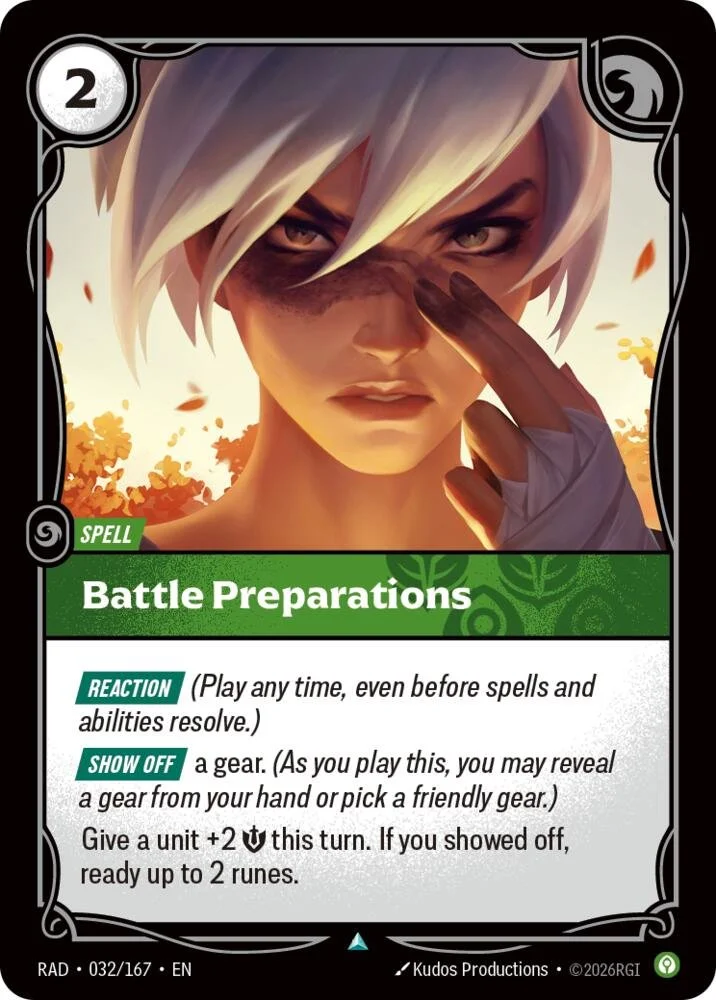
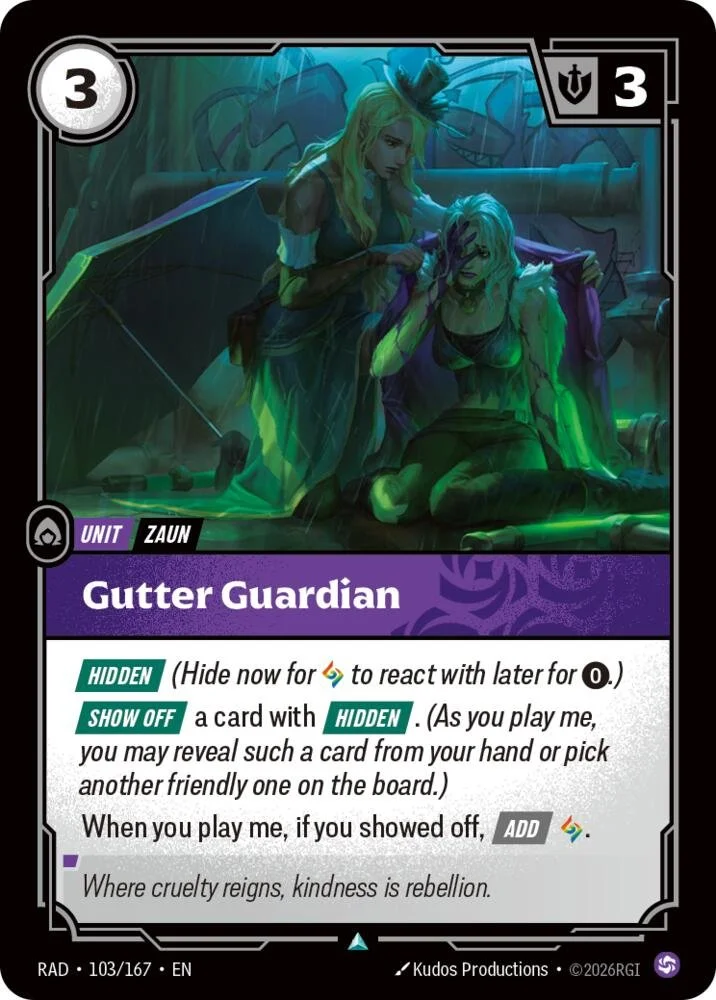
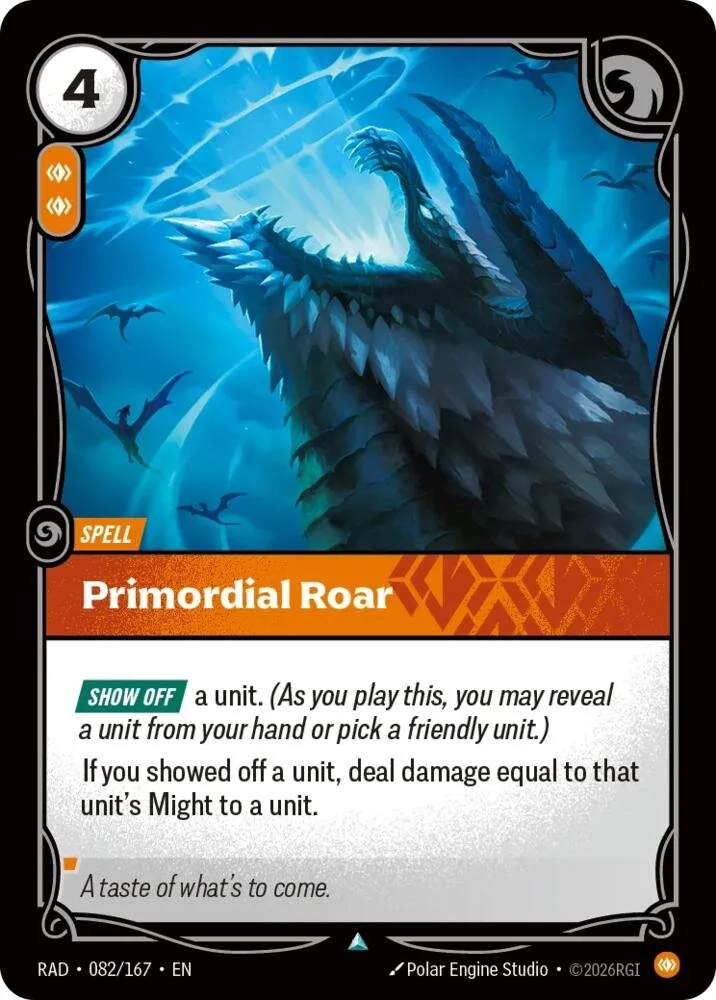
Show Off is probably the weakest of the three new mechanics, although that doesn't necessarily mean it's bad.
The concept is pretty straightforward. When playing a card with Show Off, you can reveal a qualifying card from your hand or choose one already on your board to unlock an additional effect.
There is definitely some interesting potential here, especially when you're able to activate the bonus without giving your opponent any new information. However, revealing cards from your hand can also tell your opponent exactly what you're planning, which isn't always a worthwhile tradeoff.
My biggest issue with Show Off is that it feels a little more conditional than the other two mechanics. Deploy and Disarm can actively influence how you approach the board, whereas Show Off often feels like you're simply trying to meet an additional requirement to get the most out of a card.
There are absolutely situations where Show Off will be useful, and I wouldn't be surprised to see some creative decks take advantage of it. However, compared to the immediate impact of Deploy and Disarm, it falls a little behind.
Disarm
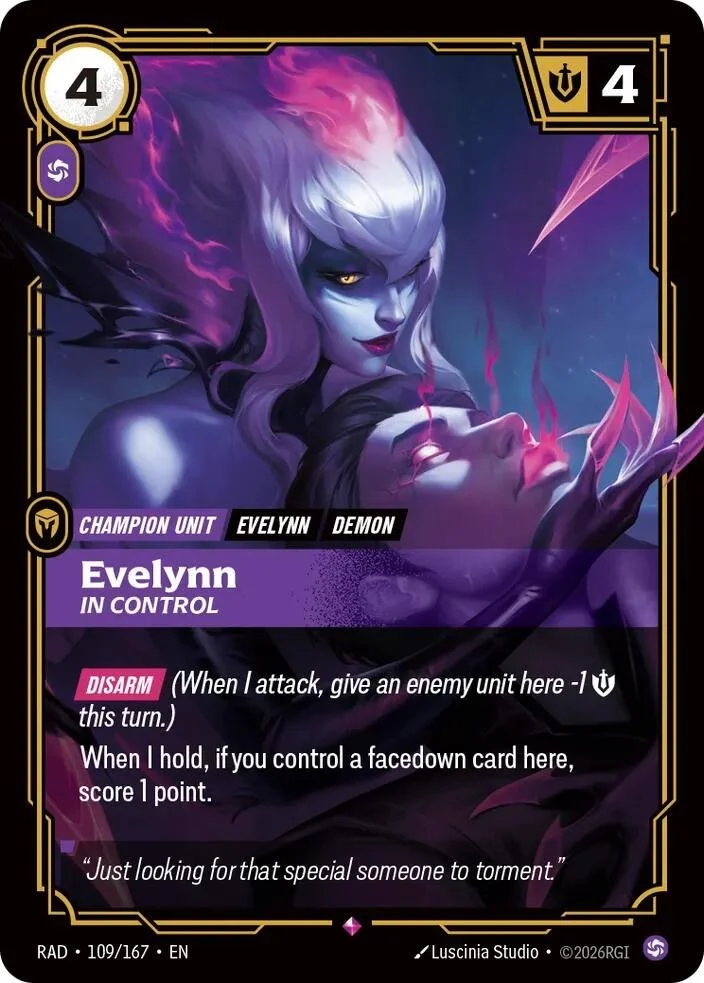
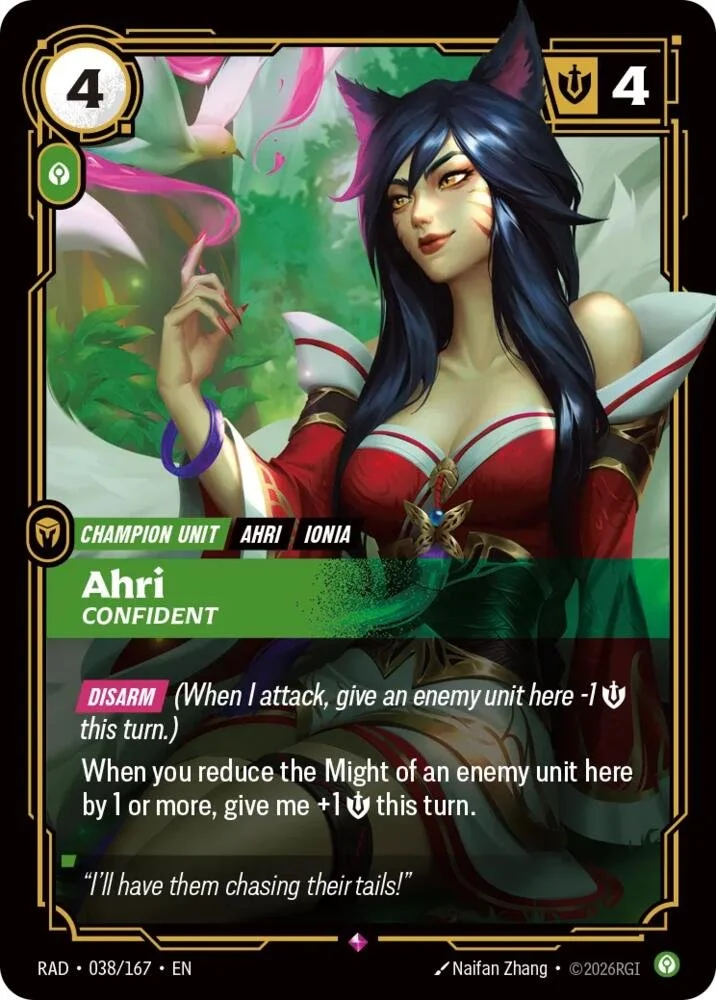
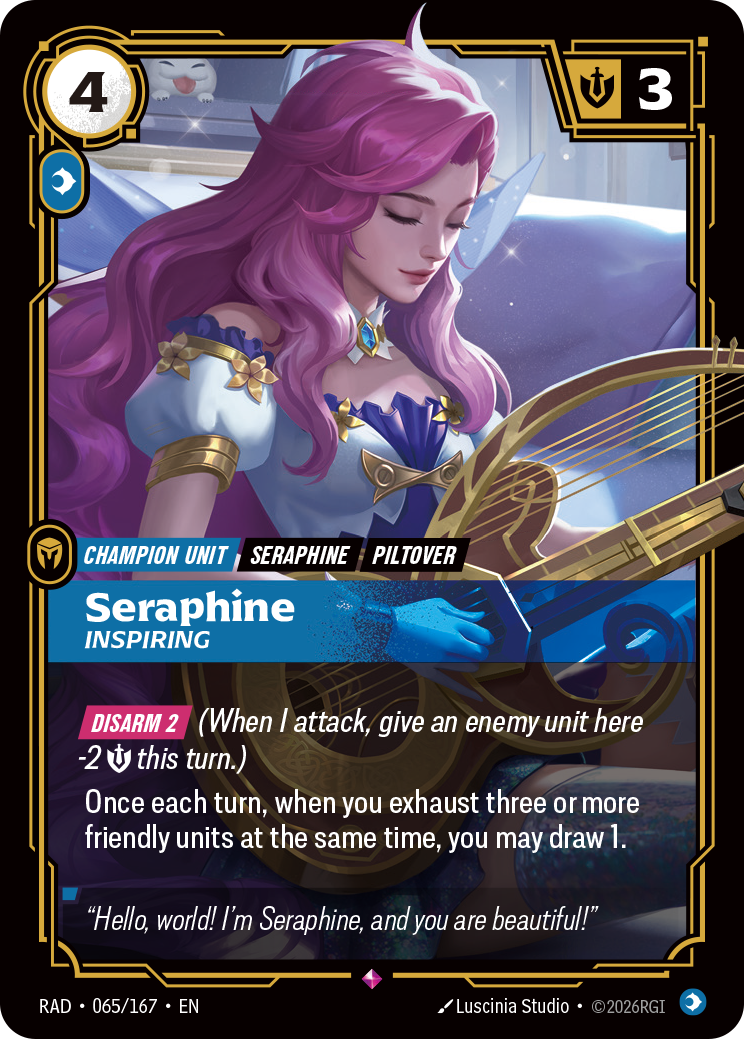
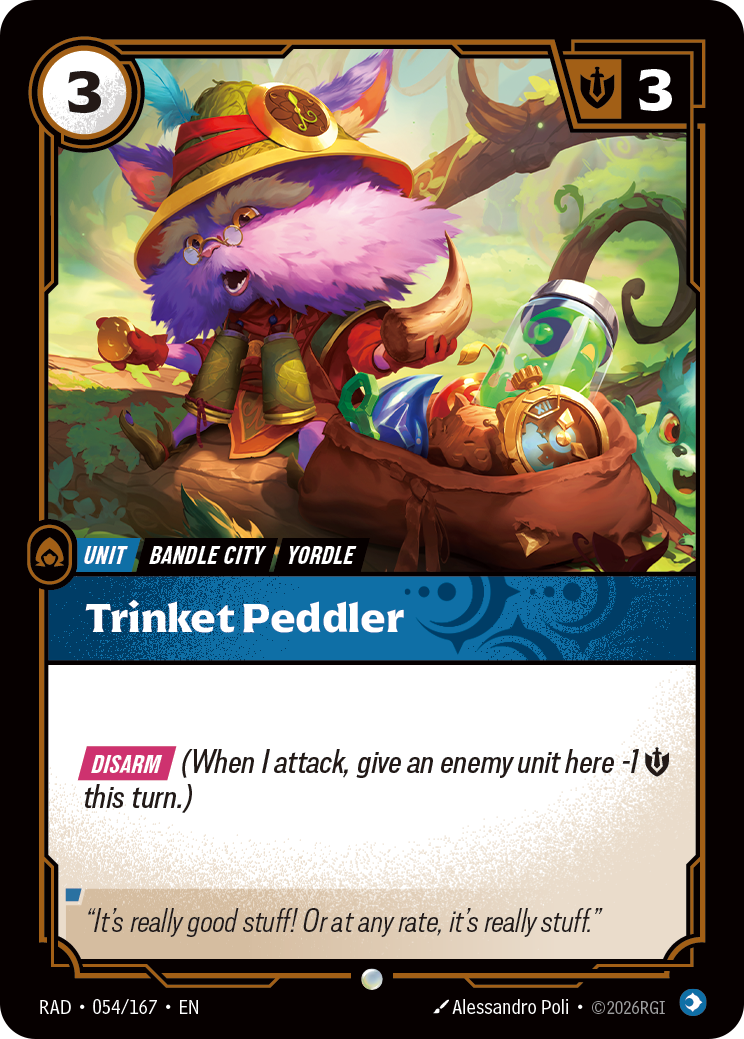
Disarm is another mechanic that I think has the potential to become a major part of Riftbound's combat strategy.
When a unit with Disarm attacks, it reduces the Might of an enemy unit at that battlefield for the turn. Multiple instances of Disarm can also stack, allowing players to significantly weaken opposing units before combat is resolved.
On paper, this might sound like a slightly different version of Assault, but the distinction is important. Rather than simply making your own units stronger, you're actively weakening your opponent's units.
That opens up some interesting possibilities, particularly when dealing with large threats that would otherwise be difficult to remove through combat. Disarm can turn what looks like an unfavorable attack into a much more manageable engagement.
I also like that this mechanic rewards careful combat planning. You don't necessarily need the biggest units on the battlefield if you can manipulate the opposing units' Might to your advantage.
Overall Thoughts on the New Mechanics
Of the three new mechanics, Deploy and Disarm are easily the standouts for me. Both introduce meaningful strategic opportunities without making the game unnecessarily complicated.
Show Off isn't quite as impressive, but it still has potential in decks that can reliably meet its requirements. It's just a mechanic that feels more dependent on the surrounding cards rather than something that fundamentally changes how you approach the game.
Overall, Radiance continues Riftbound's trend of introducing mechanics that build upon the game's existing foundation rather than completely changing it. That's a good thing, especially as the card pool continues to grow.
Best Cards in Riftbound: Radiance
One of the biggest strengths of Radiance is the quality of its individual cards. There are some incredibly powerful new Legends and Champion combinations in this set, but even when you look beyond those headline cards, there's plenty worth getting excited about.
Chaos and Body are particularly impressive this time around, with both domains receiving cards that could become staples in certain strategies. However, there are also some interesting additions for decks that focus on resource generation, card advantage, and manipulating units on the battlefield.
Here are five non-Champion cards that stand out to me.
Seraphic Wyvern
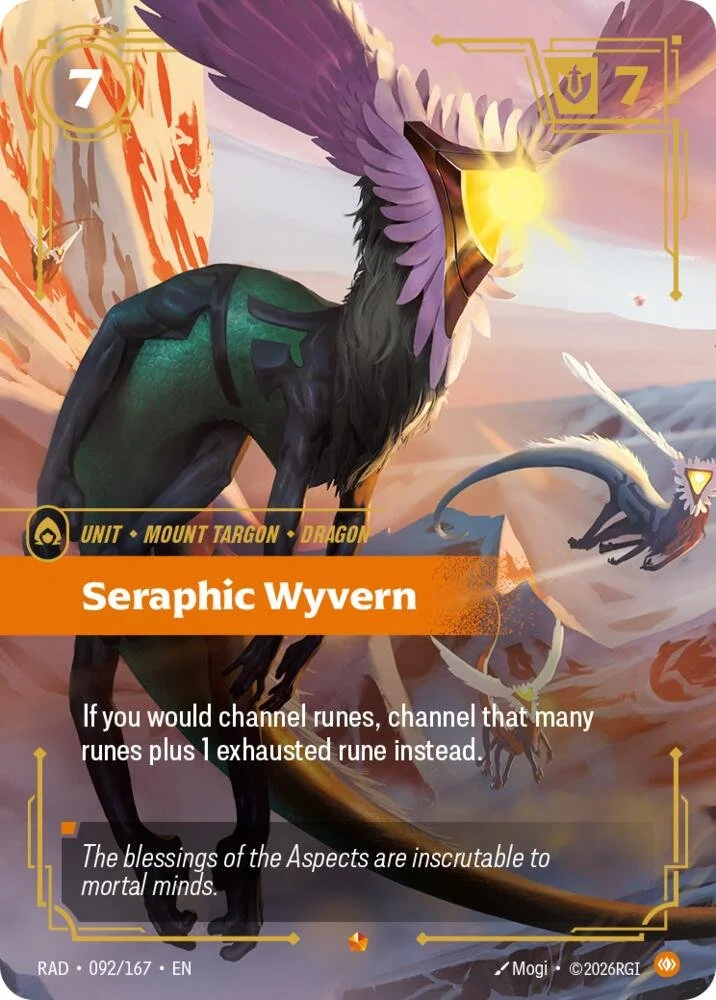
Seraphic Wyvern is one of my favorite cards in Radiance, and it's not difficult to see why. This seven-cost, seven-Might Dragon rewards players for doing something they're already going to be doing throughout the game: channeling runes.
Whenever you would channel runes, Seraphic Wyvern allows you to channel an additional exhausted rune. That might not sound particularly explosive compared to some of the flashier effects in the set, but the extra resource generation can add up quickly.
In decks that want to accelerate their resources or consistently play expensive threats, Seraphic Wyvern offers some excellent value. It's also a sizable unit on its own, so you aren't sacrificing battlefield presence just to get the additional utility.
This is exactly the kind of card I like seeing in Body. It gives you a powerful creature while supporting a broader strategy, rather than simply being another oversized threat.
Transpositionist
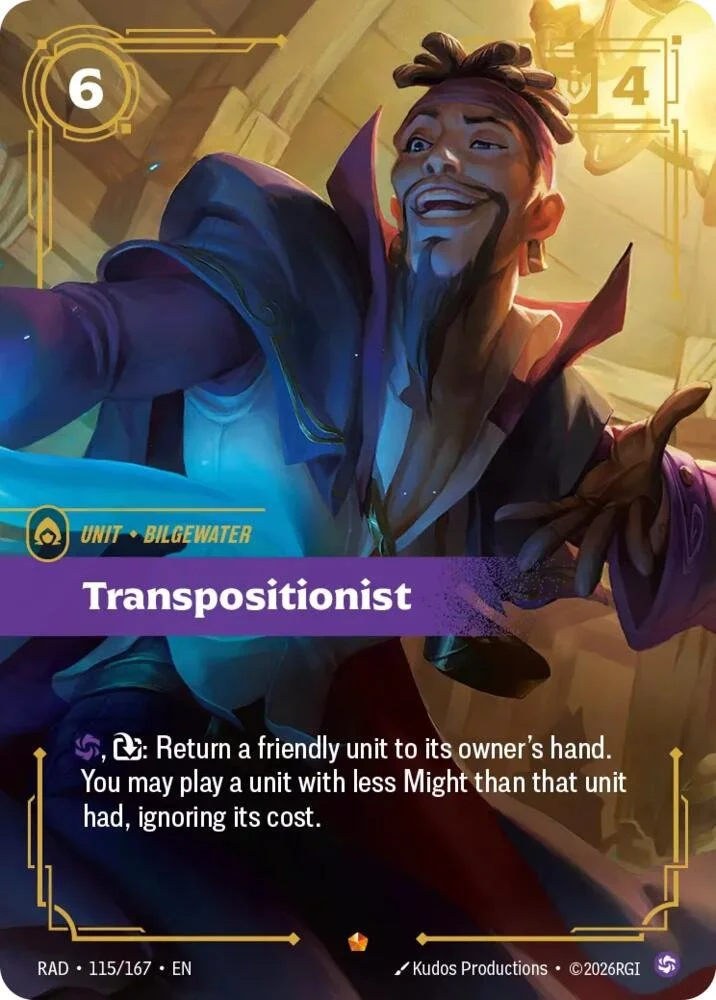
Transpositionist might be one of the most interesting cards in the entire set for players who enjoy experimenting with unusual combinations.
Its ability allows you to return a friendly unit to its owner's hand and then play another unit with less Might without paying its cost. That opens up a ridiculous number of possibilities, especially in decks built around powerful units with useful abilities.
The obvious benefit is being able to put another unit into play without paying its normal cost, but there's also something to be said for returning your own units to your hand. With the right setup, you can reuse valuable effects or completely change your battlefield presence in a single sequence.
This is the kind of card that becomes more interesting the longer you look at it. I'm particularly excited to see what players can come up with once they start building entire strategies around the effect.
Hush
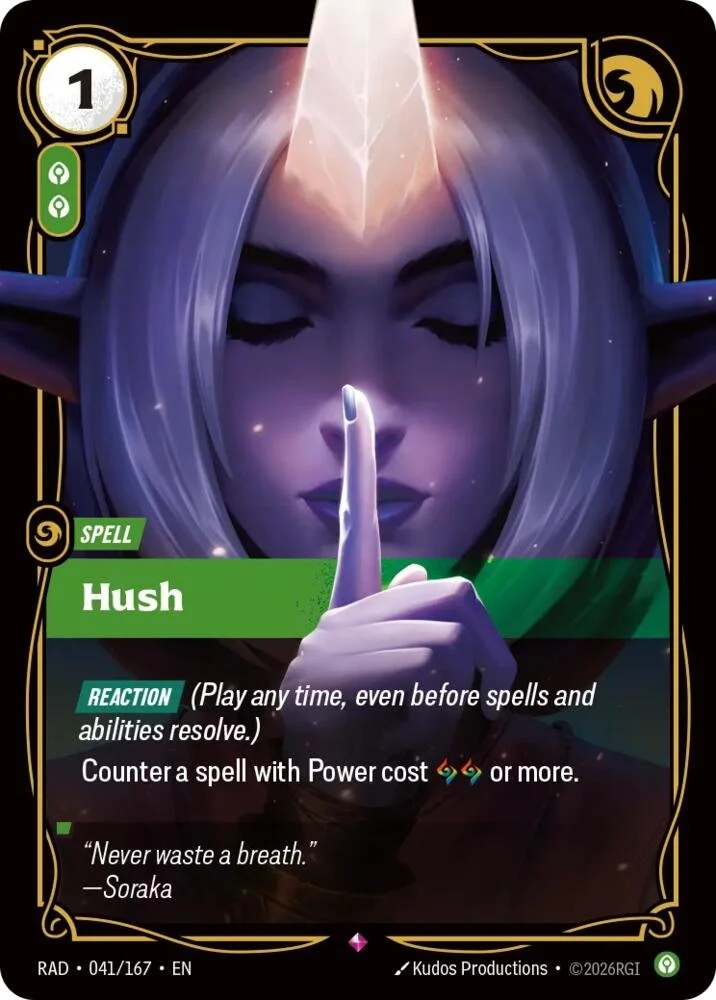
Hush is another card that immediately caught my attention, particularly because of how valuable interaction can be in Riftbound.
As the game continues to introduce more elaborate strategies and powerful combinations, having reliable ways to interfere with your opponent becomes increasingly important.
That's what makes cards like Hush so appealing. Not every powerful card needs to be a massive unit or an explosive win condition. Sometimes the most valuable addition to a deck is the card that prevents your opponent from doing exactly what they want.
I think Hush is one of those cards that players should keep in mind when evaluating their interaction packages, especially as the Radiance metagame continues to develop.
Angler Wyrm
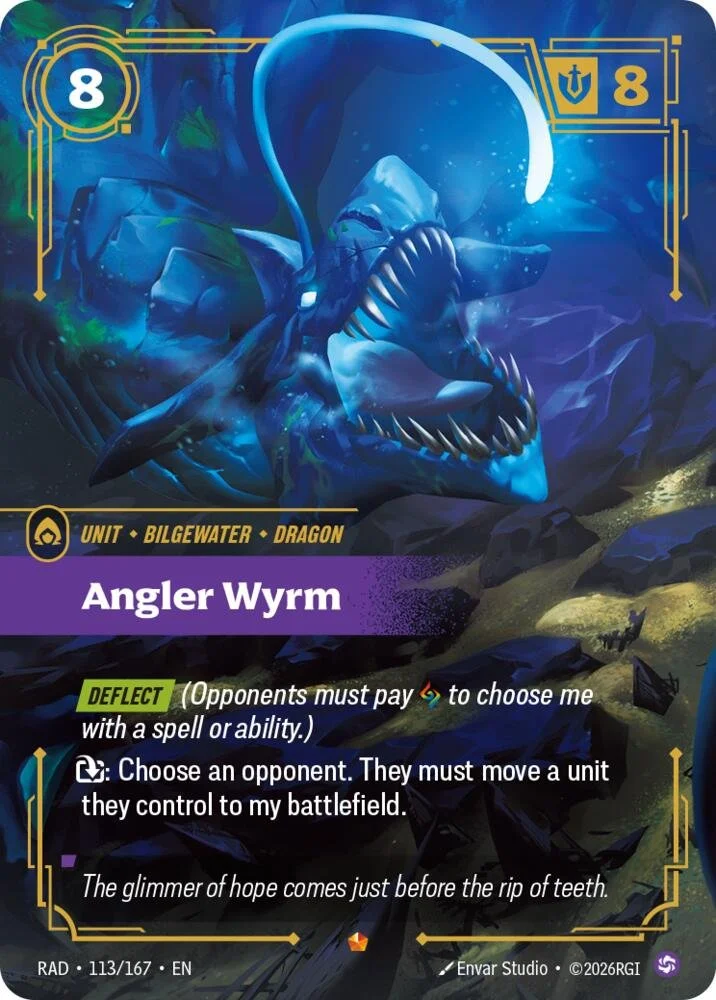
Angler Wyrm is another standout for players who enjoy dropping massive threats onto the battlefield.
There's something particularly satisfying about playing a large unit that immediately forces your opponent to reconsider their strategy. With the increasing number of ways to manipulate costs, cheat units into play, and generate additional resources, cards like Angler Wyrm become especially interesting.
I also think Angler Wyrm is worth watching because of how it interacts with some of the other cards introduced in Radiance. Transpositionist, for example, opens up some interesting possibilities for getting expensive units onto the board under the right conditions.
While it won't necessarily belong in every deck, Angler Wyrm feels like a card that can make a serious impact in strategies designed to take advantage of it.
Zero Point Inflection
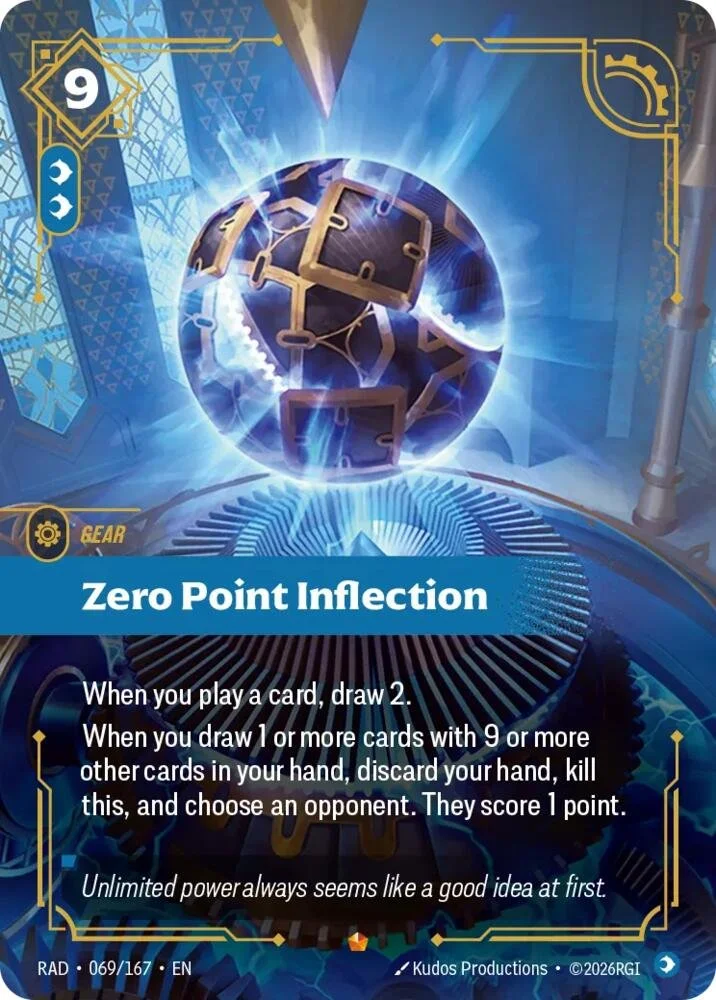
Zero Point Inflection might be one of the riskiest cards in Radiance, but it's also one of the most entertaining from a deckbuilding perspective.
This nine-cost Gear allows you to draw two cards whenever you play a card, which is an incredibly powerful source of card advantage. However, there's a catch. If you draw while you already have nine or more other cards in hand, you're forced to discard your hand, destroy Zero Point Inflection, and give an opponent a point.
That's a pretty significant downside, but the potential upside is just as ridiculous.
In the right deck, Zero Point Inflection could allow you to cycle through an enormous number of cards and assemble exactly the combination you're looking for. Of course, managing your hand size becomes absolutely critical, because one wrong decision can completely derail your strategy.
I don't necessarily think this is going to be a staple in every Mind deck, but it's the kind of unusual, high-risk card that makes deckbuilding exciting. If someone figures out how to reliably take advantage of it without triggering the downside, things could get pretty interesting.
Top Five Legends in Riftbound: Radiance
Radiance introduces nine new Legends, and the quality of this lineup is one of the biggest reasons I think the set is so strong.
Some of these Legends introduce entirely new strategies, while others take familiar concepts and push them in interesting directions. There are some particularly powerful combinations here, and I think quite a few of these Legends have the potential to make an impact as the game continues to evolve.
These are my five standouts.
Riven – The Exile
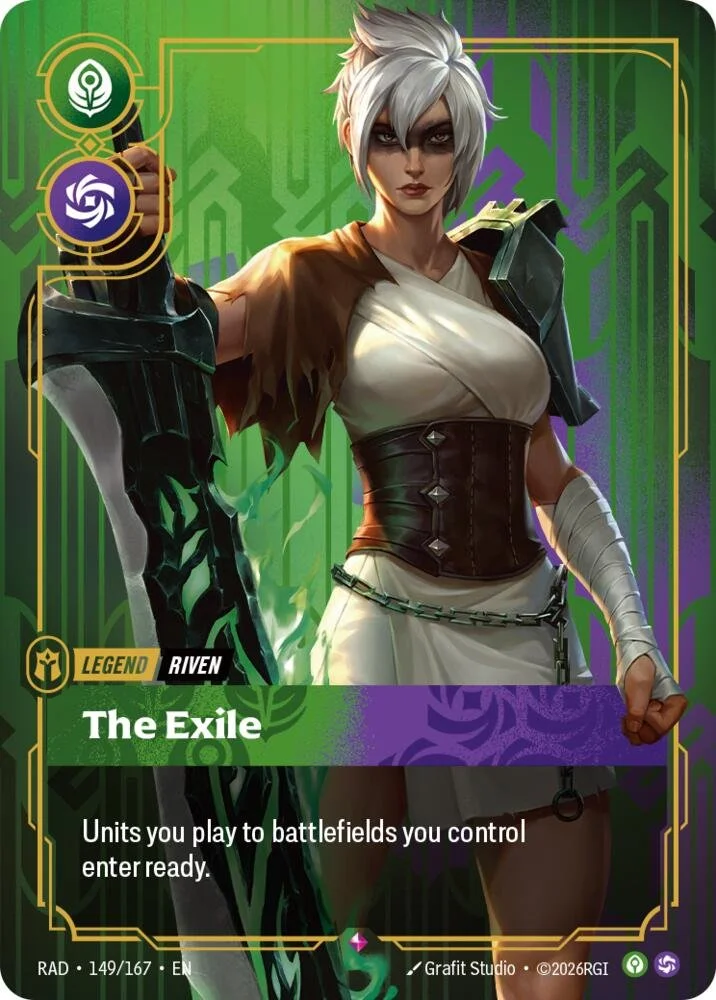
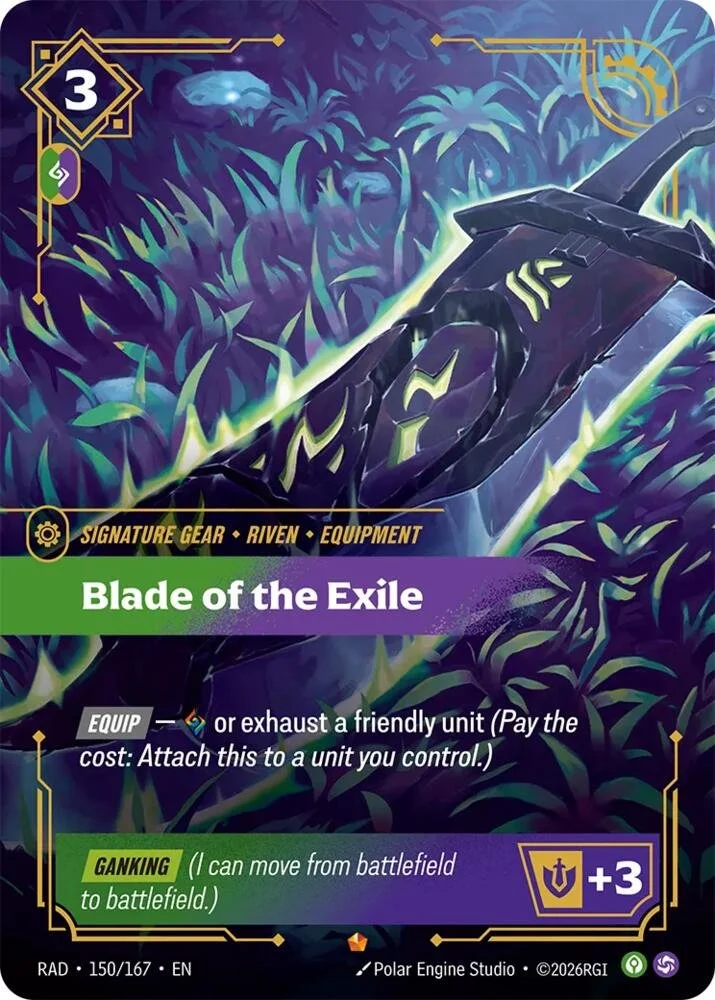
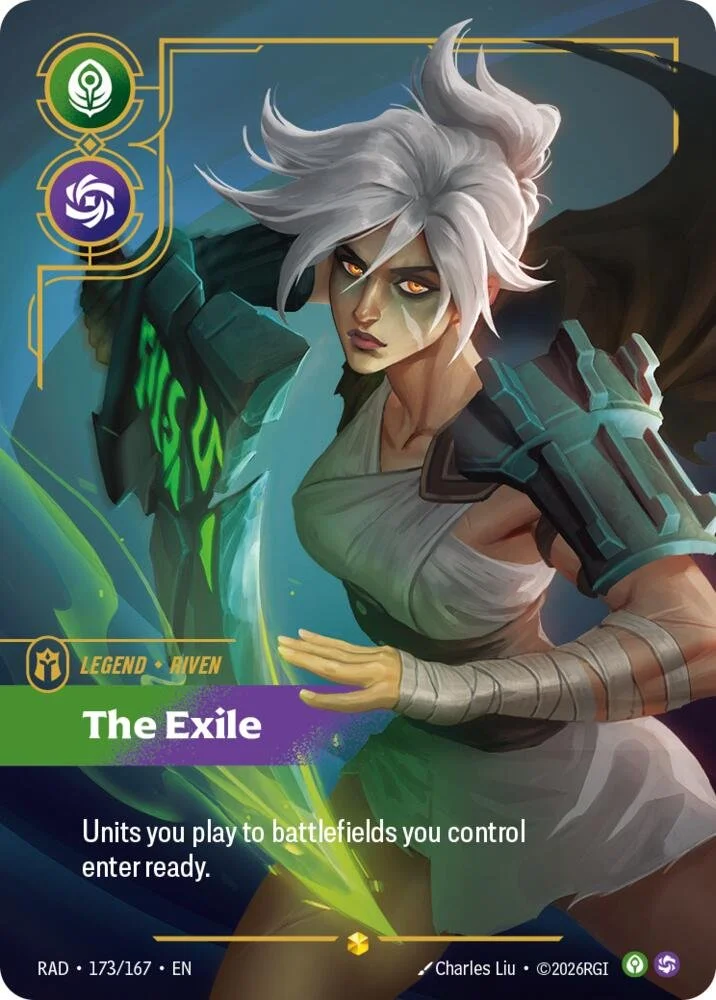
Riven is easily one of the Legends I'm most excited about in Radiance.
Her ability allows units played directly to battlefields to enter ready, which might sound simple, but it creates some incredibly powerful opportunities for aggressive battlefield strategies.
Normally, playing units directly onto the battlefield can come with limitations that prevent them from immediately making their full impact. Riven helps remove that restriction, allowing players to make better use of units with Gank or exhaust abilities while maintaining pressure.
What makes Riven particularly exciting is her combination of Calm and Chaos. Both domains have some excellent tools for manipulating the board, and together they open up a lot of interesting possibilities for tempo-focused strategies.
Riven feels like the kind of Legend that rewards players for thinking several moves ahead, but she can also generate some surprisingly aggressive turns. I wouldn't be surprised if she becomes one of the most popular Legends from Radiance.
Evelynn – Agony's Embrace
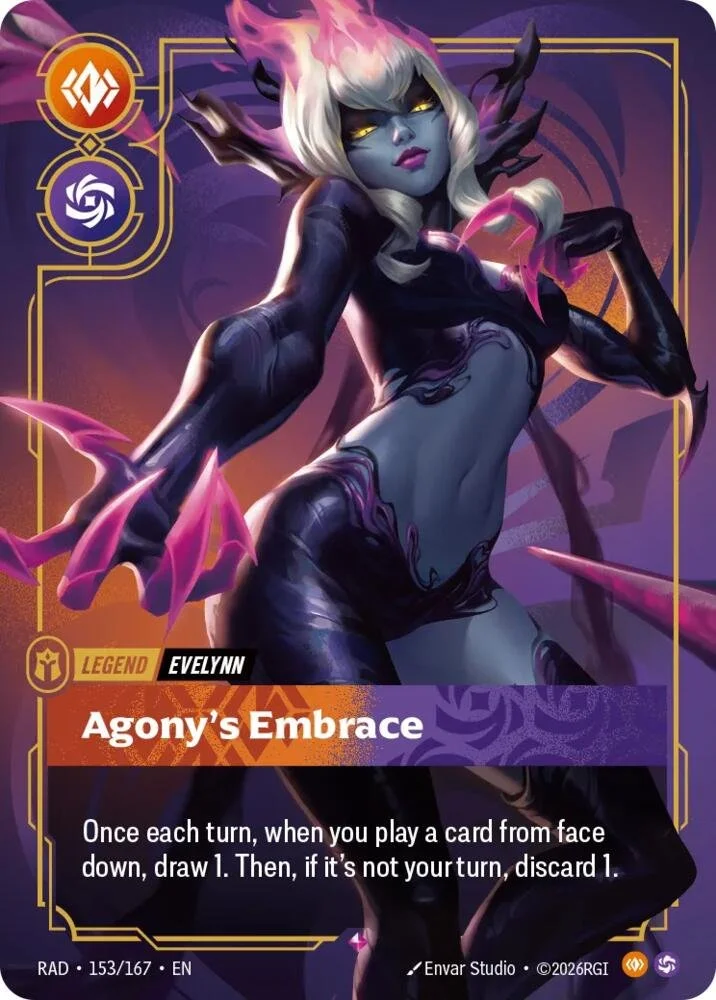
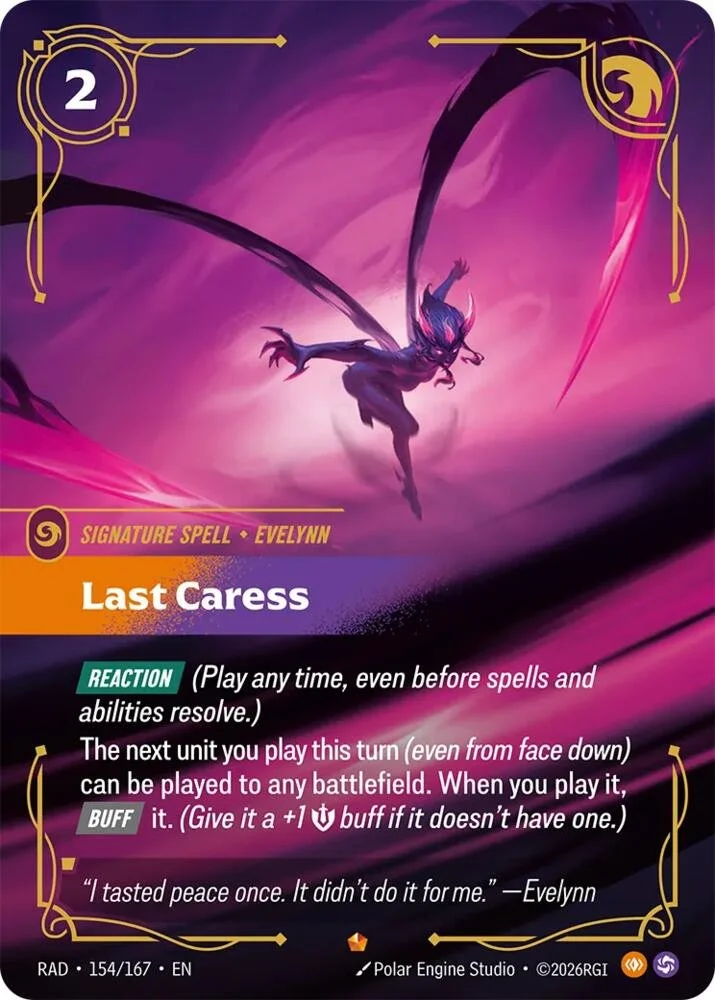
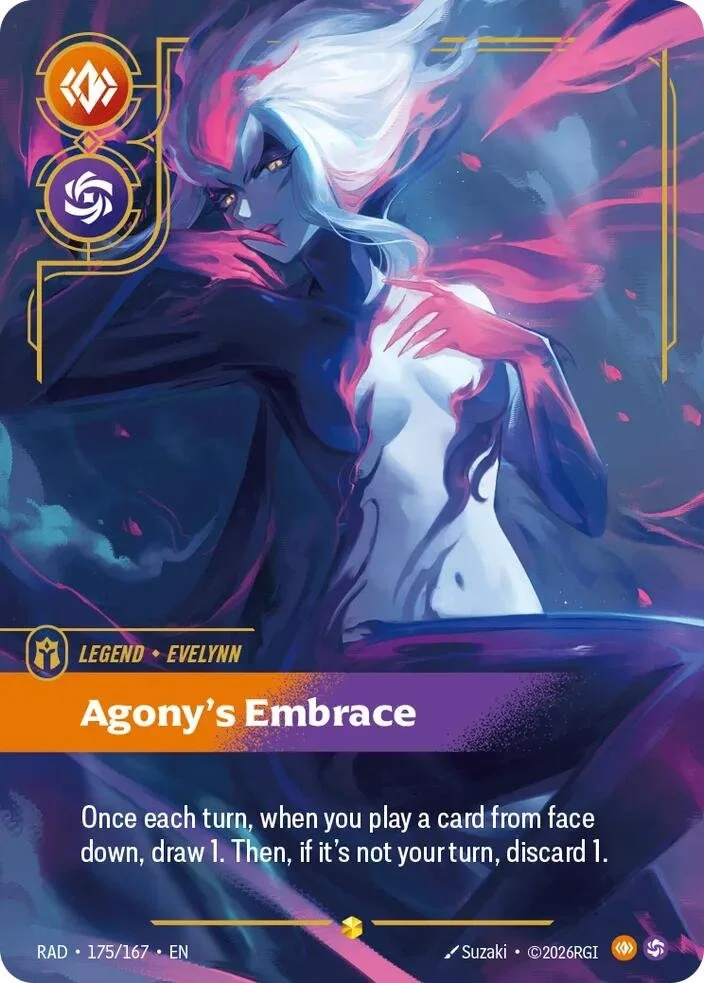
Evelynn is another excellent addition, especially for players who enjoy keeping their opponents guessing.
Her strategy focuses on Hidden cards and playing cards from face down, rewarding you with additional card draw when you reveal your plans at the right moment.
This creates an interesting gameplay loop where you're constantly presenting threats that your opponent can't fully evaluate. They know you have something prepared, but figuring out exactly what it is becomes part of the challenge.
Evelynn also benefits from one of my favorite domain combinations in Radiance: Body and Chaos. Both domains receive some fantastic new cards, giving her plenty of room to experiment with different builds.
I really like Legends that make the opponent think differently about their decisions, and Evelynn does exactly that. Instead of simply presenting a stronger board, she creates uncertainty, which can be just as valuable.
Ekko – Boy Who Shattered Time
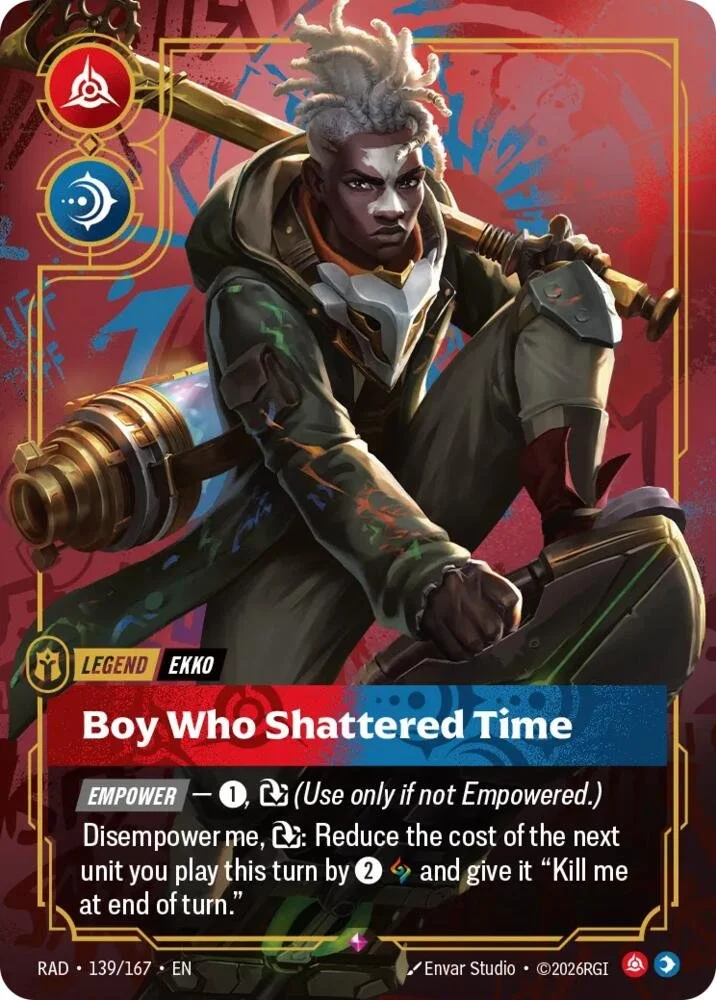
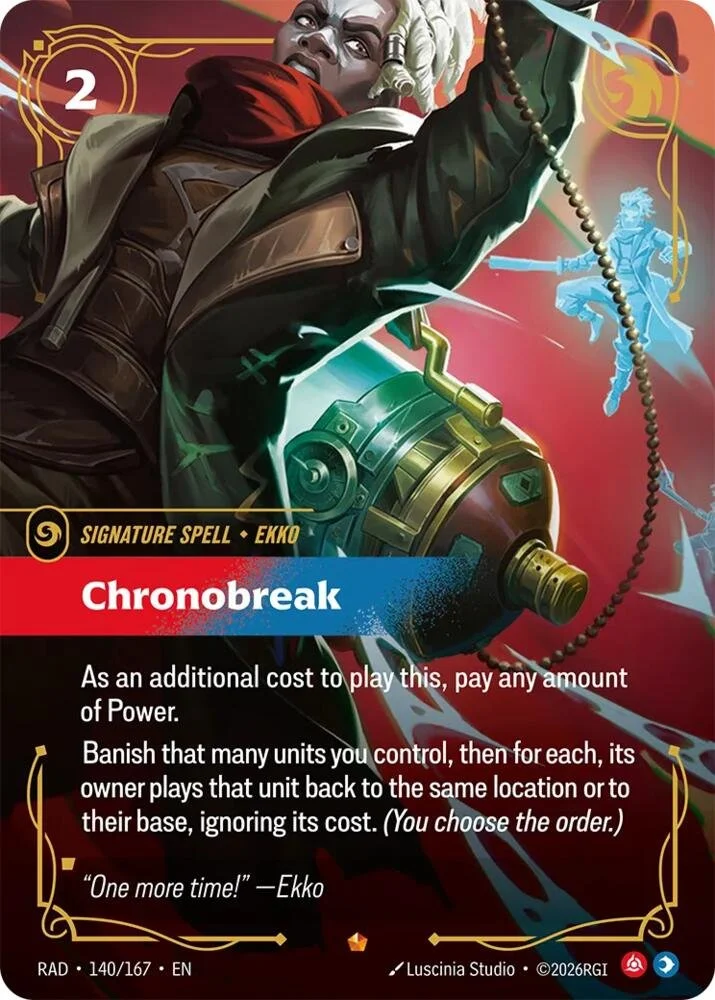
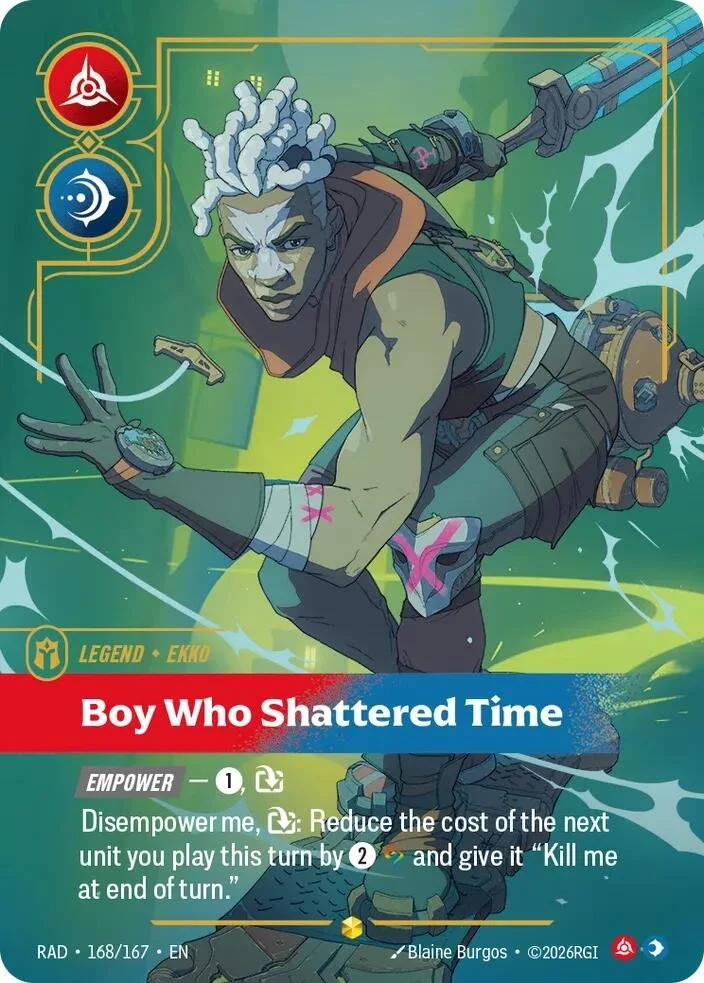
Ekko has one of the more entertaining abilities in Radiance, especially if you're a fan of getting powerful units onto the battlefield earlier than your opponent expects.
His Legend ability takes advantage of Empower, allowing you to reduce the cost of your next unit at the expense of that unit being killed at the end of the turn.
That might sound like a pretty significant drawback, but there are plenty of ways to turn a temporary unit into a worthwhile investment. Units with powerful immediate effects become particularly appealing, and even a single turn with a massive threat can sometimes be enough to completely change the game.
Ekko is also a great example of how Riot continues to expand upon mechanics introduced in previous sets. Rather than abandoning Empower, Radiance gives it another interesting application.
This feels like a Legend that rewards creative deckbuilding and careful planning, which makes him one of my favorites from the set.
Jarvan IV – Exemplar of Demacia
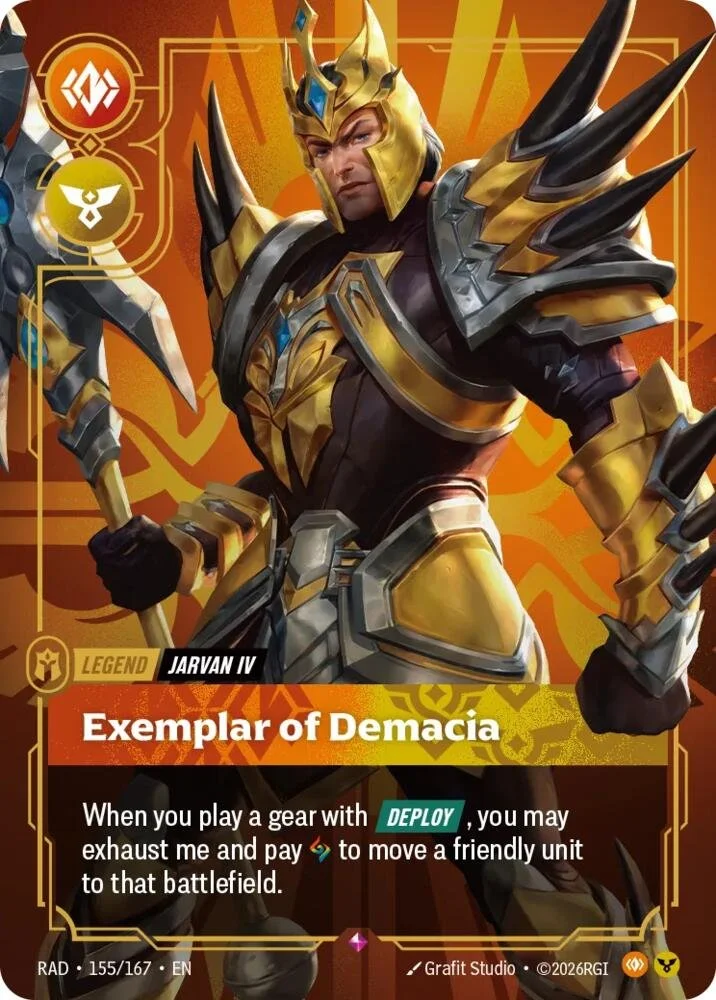
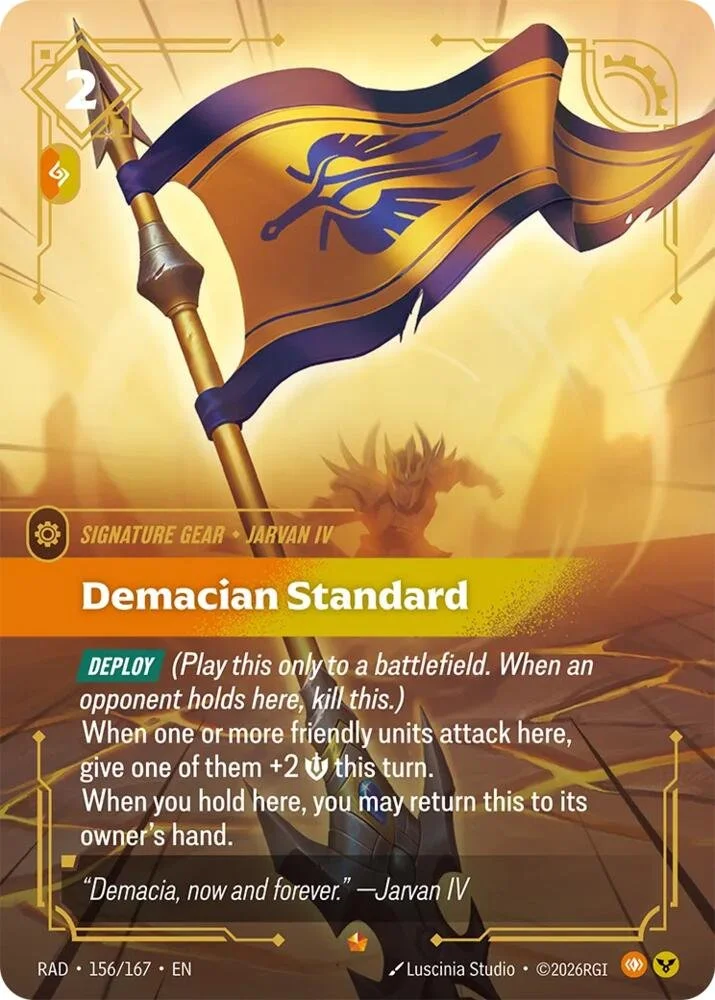
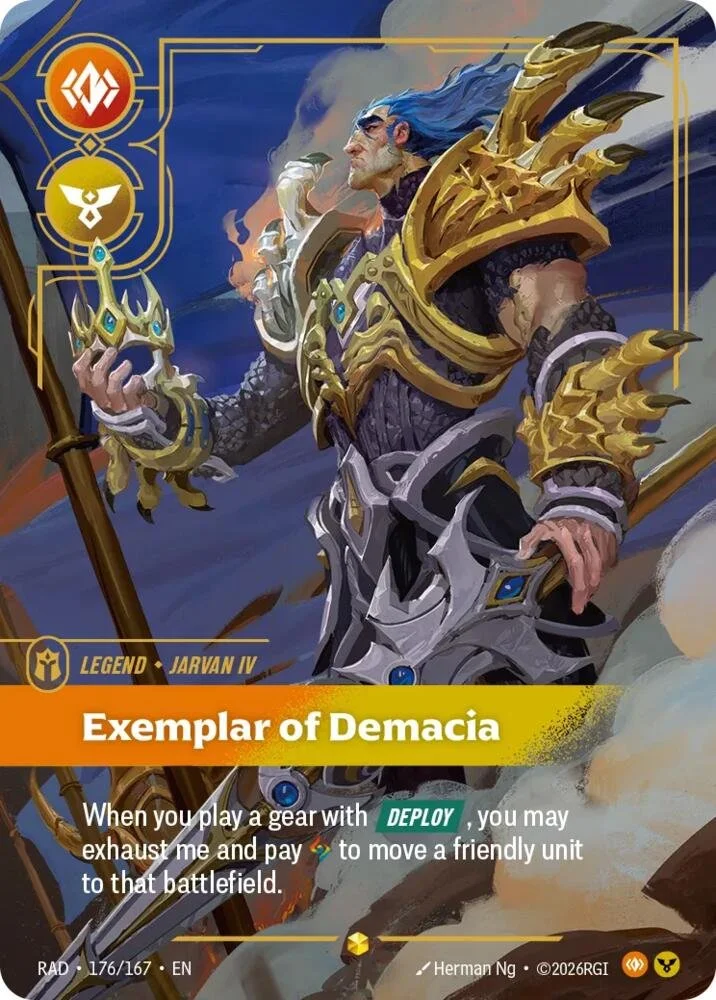
Jarvan IV is one of the best examples of a Legend working directly alongside a new set mechanic.
His ability allows you to move units directly to battlefields when you play Gear with Deploy, creating opportunities to establish pressure without relying entirely on traditional movement.
That is an incredibly interesting ability in a game where controlling battlefields is the primary path to victory.
What makes Jarvan especially appealing is how much flexibility this gives players. You can use Deploy to establish a presence at important locations and then use Jarvan's ability to reinforce those positions or threaten battlefields your opponent thought were safe.
The Body and Order combination also gives Jarvan access to plenty of supportive tools, making him an appealing option for players who enjoy maintaining a strong board presence.
I think Jarvan has some serious potential, especially as more cards with Deploy are introduced in future sets.
Ziggs – Hexplosives Expert
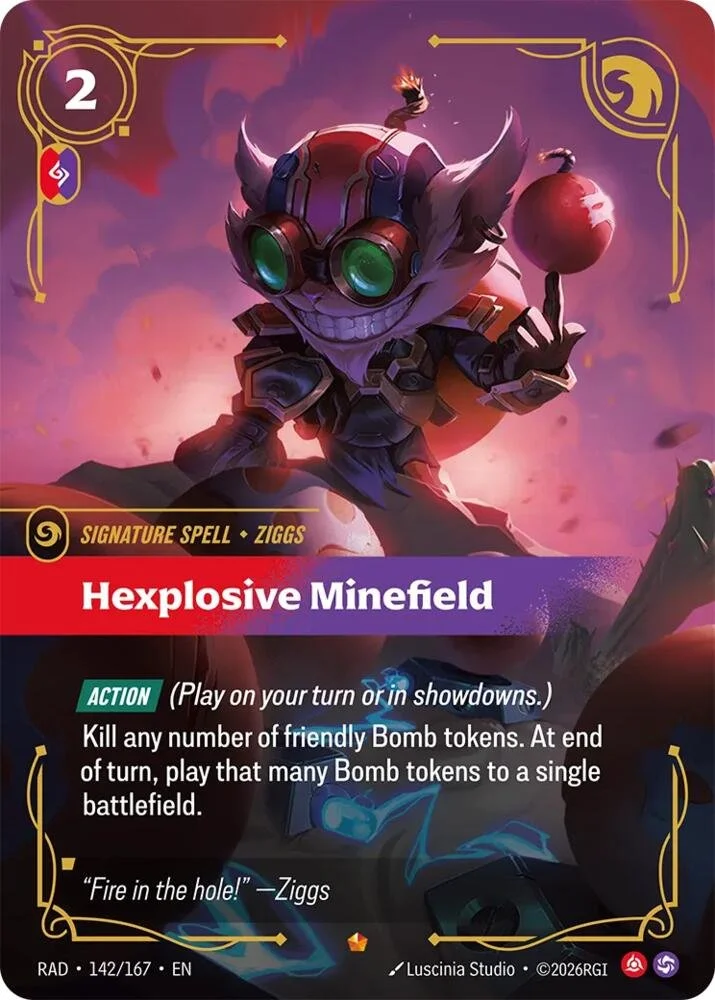
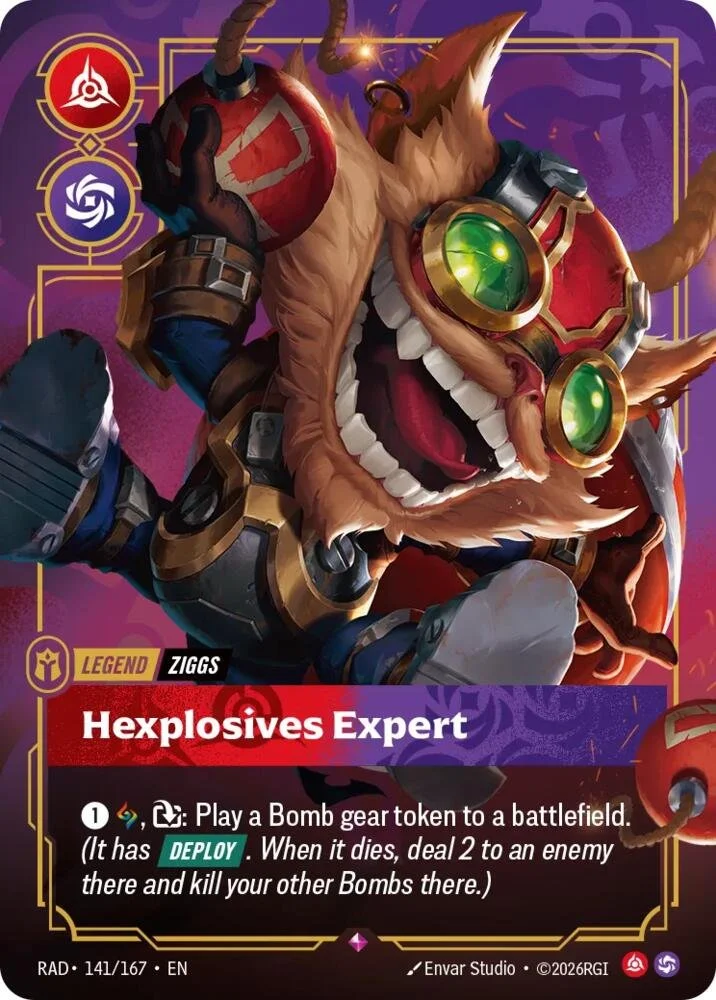
Ziggs might be the most chaotic Legend in Radiance, which feels incredibly appropriate.
His entire strategy revolves around creating Bomb tokens and turning battlefields into dangerous places for opposing units.
Bombs are particularly interesting because they can create chain reactions, dealing damage and potentially clearing out multiple threats when triggered. With enough setup, Ziggs can make certain battlefields extremely difficult for opponents to approach safely.
What I particularly enjoy about Ziggs is how he turns battlefield control into something more than simply winning combat. You're forcing opponents to think about the consequences of moving into certain locations, even before the fighting begins.
His Fury and Chaos domain combination also feels like a perfect match for the strategy. There are plenty of ways to support an aggressive, damage-focused deck, and Ziggs gives those tools a very entertaining new direction.
I don't know that every Ziggs deck will be particularly consistent, but I can absolutely see him becoming one of the most enjoyable Legends to build around.
Radiance Showdown Decks: Seraphine and Evelynn
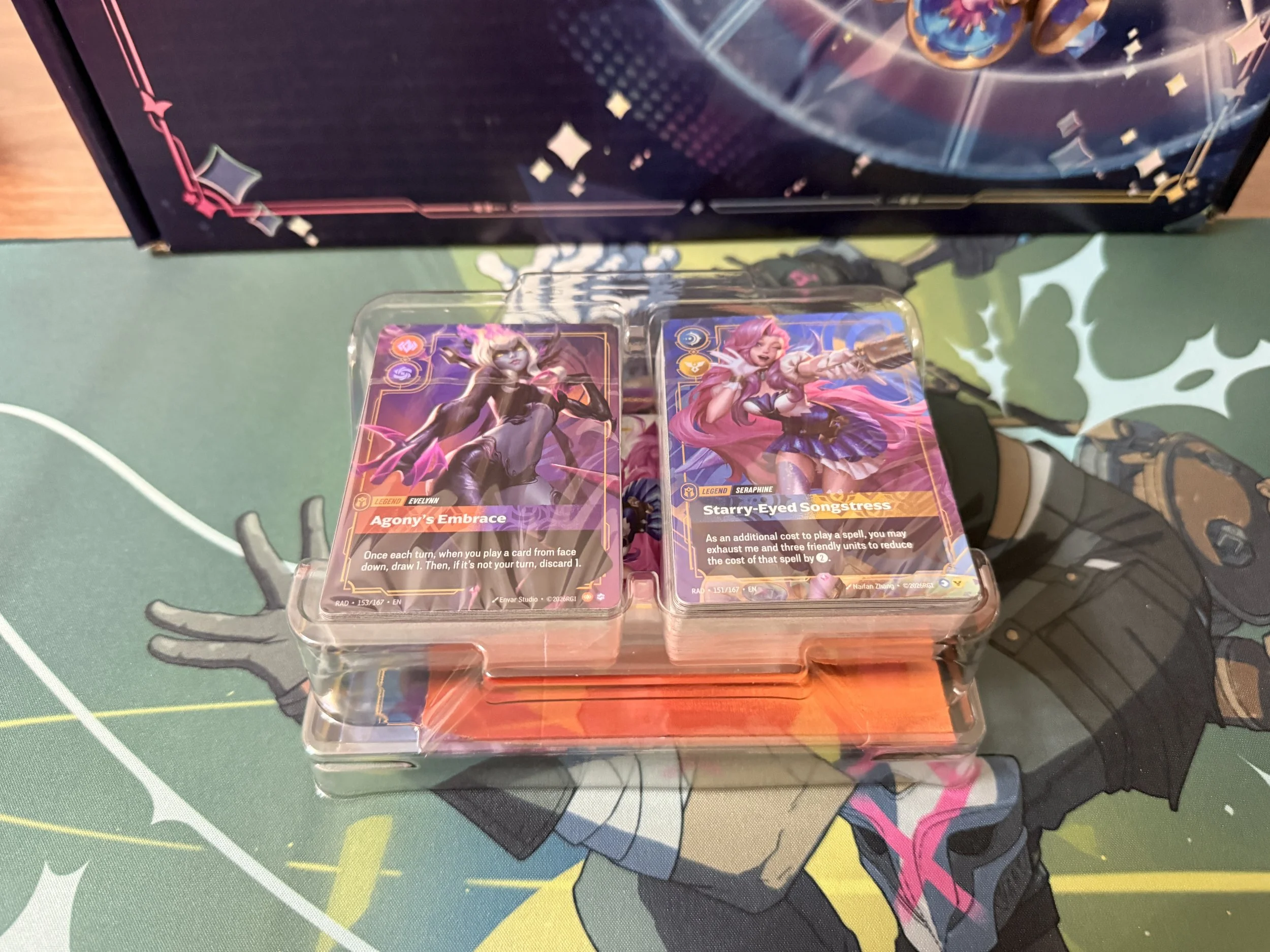
One of the things I've appreciated about Riftbound's preconstructed decks is how much they've improved since Origins. The earliest Champion Decks were decent introductions to the game, but some of them needed substantial upgrades before they really felt like complete strategies. Since then, the decks have become more focused, and Radiance continues that trend.
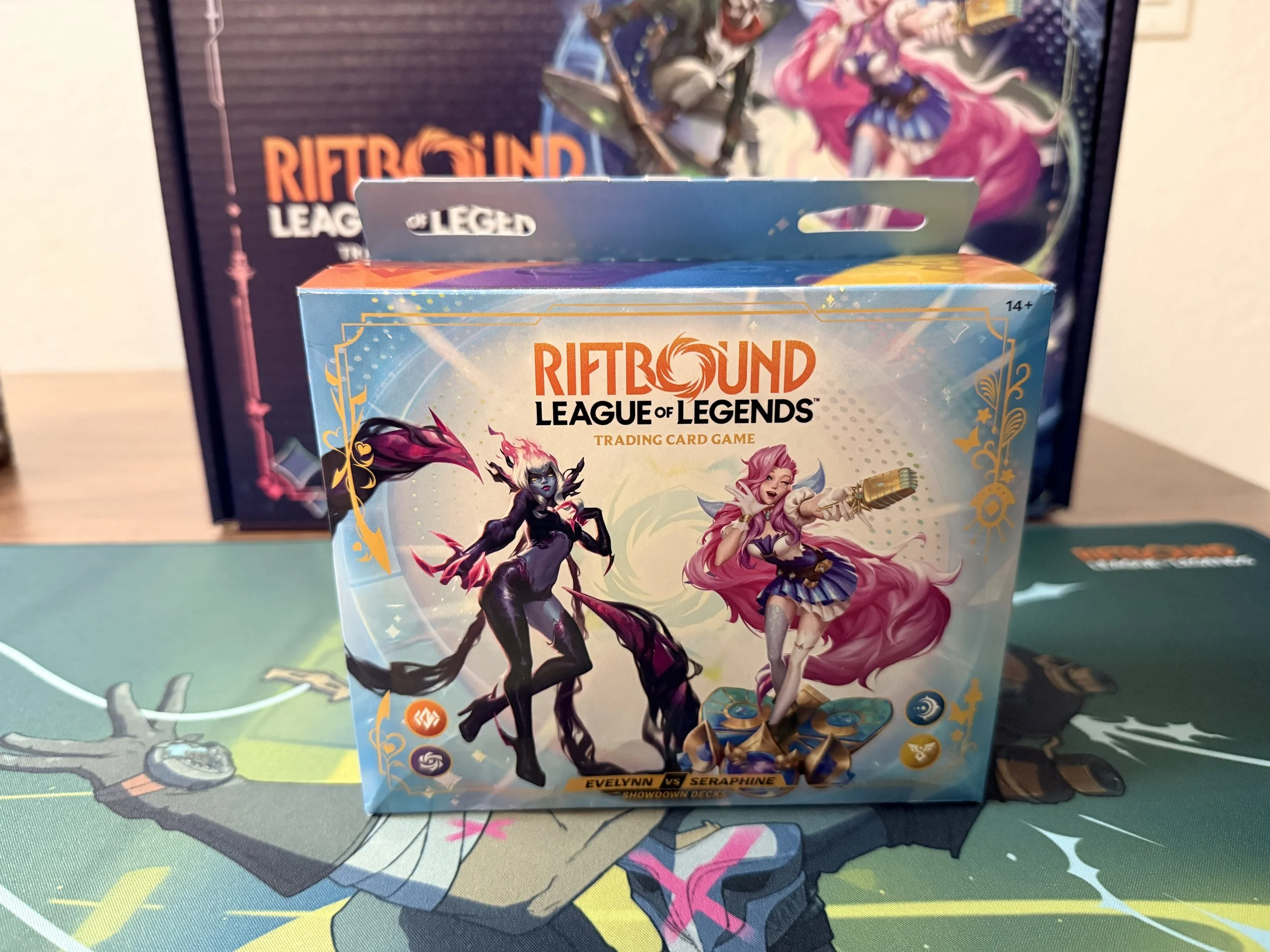
This time around, we're getting the Seraphine and Evelynn Showdown Decks. Rather than selling them as separate Champion Decks, Riot has packaged two distinct strategies together, making it easier for new players to jump into the game with a friend.
Seraphine's deck focuses on building a wide board of units and using them to support powerful spells. Her Legend ability allows you to exhaust Seraphine alongside three units to reduce the Energy cost of a spell, giving the deck an interesting balance between developing its board and using those resources to cast more expensive cards.
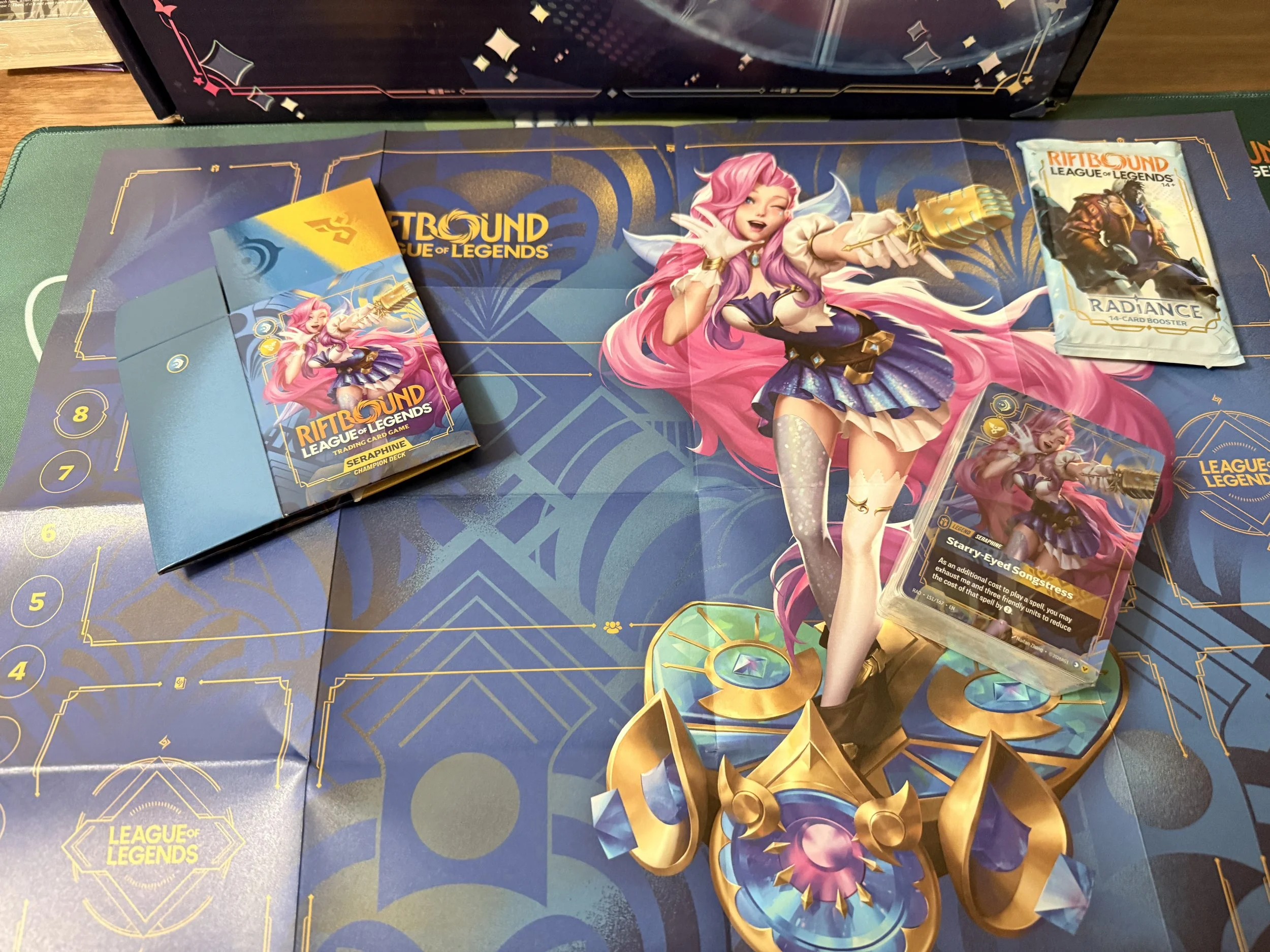
It's a strategy that rewards careful planning. Having more units on the battlefield doesn't just mean having more ways to score points; it also means having additional resources available to fuel Seraphine's abilities. The result is a deck with a clear identity and a game plan that new players can understand while still offering some room for more advanced decisions.
Evelynn's deck, on the other hand, feels much more deceptive. With her focus on Hidden cards and playing from face down, Evelynn wants to keep her opponent guessing while generating additional value through her Legend ability.
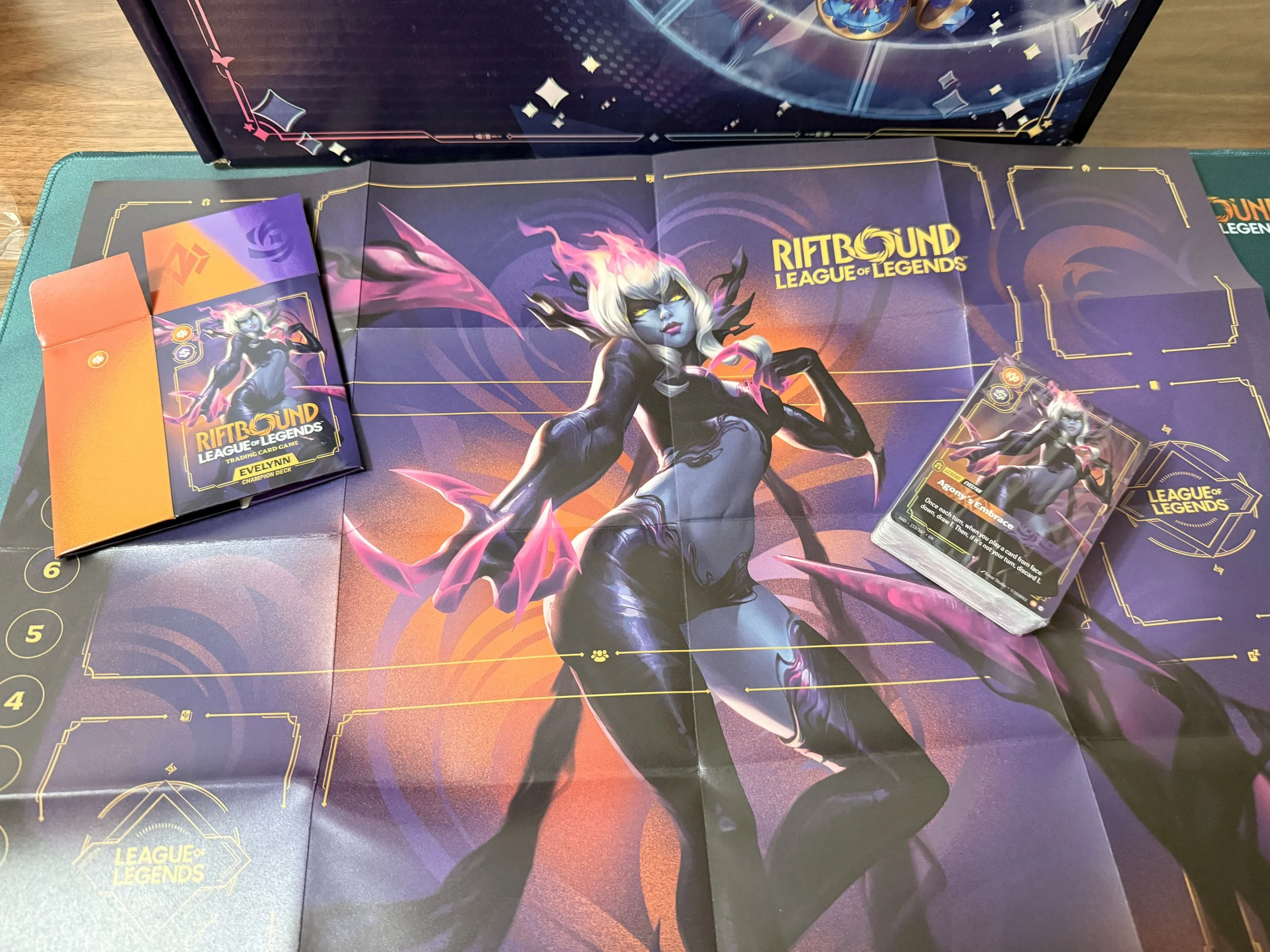
Between the two, Evelynn is the deck that interests me most, particularly because of how well Body and Chaos work together in Radiance. Hidden cards have always had some interesting potential, and Evelynn gives players another reason to build around that mechanic.
Overall, I think the Showdown Decks are a strong direction for Riftbound. Both strategies have distinct identities, and neither feels like it's simply there to teach the bare minimum of the game. They provide a foundation for players to start building their own decks while introducing some of the more interesting mechanics that Riftbound has to offer.
Deckbuilding in Riftbound: Radiance
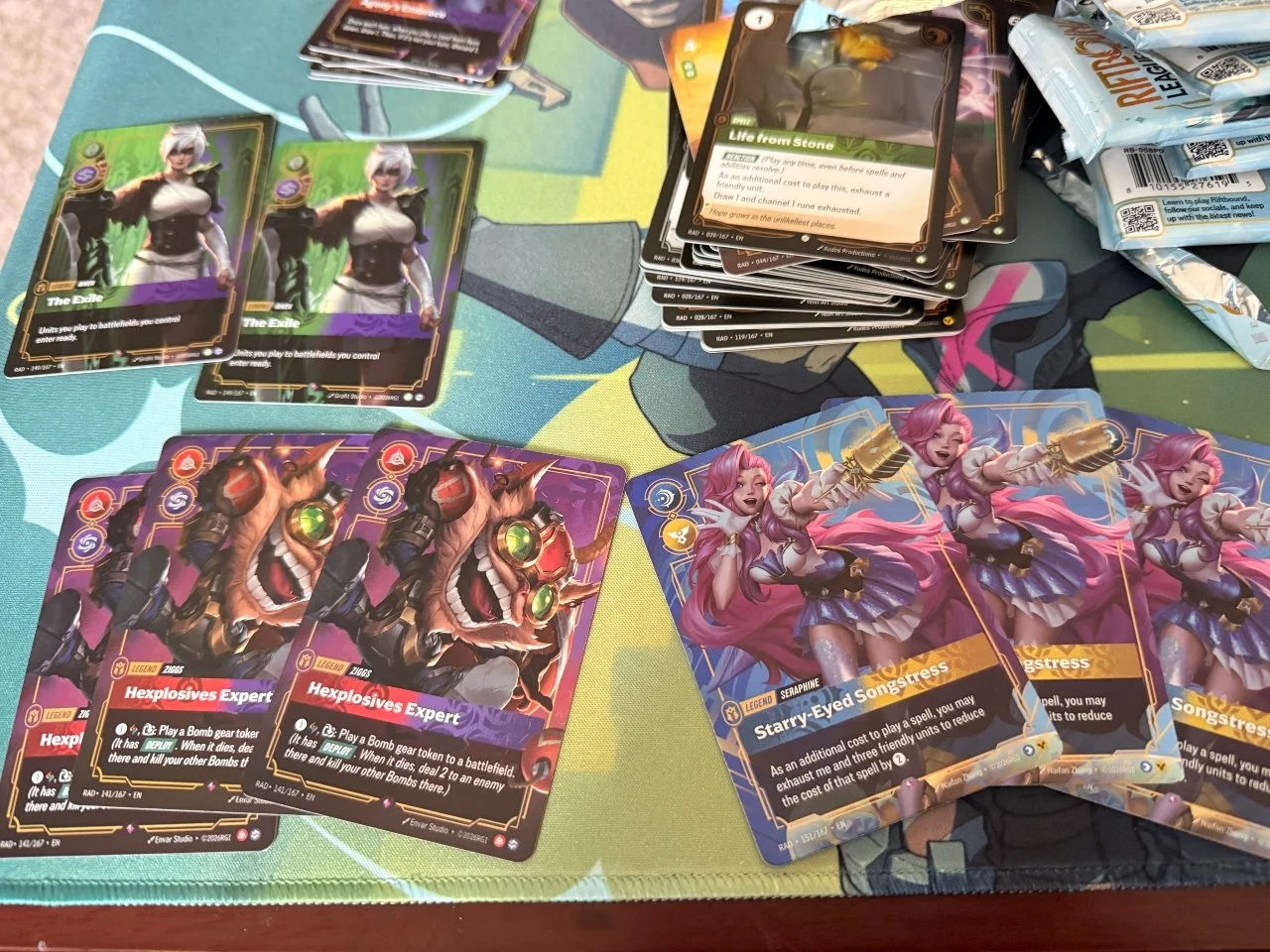
One of the most exciting things about Radiance is how many deckbuilding possibilities it introduces. We're now five main sets into Riftbound, and the card pool has reached a point where players have substantially more freedom to experiment with unusual strategies.
Chaos and Body are the two domains that stand out to me the most, but there are exciting additions across the board. Cards like Transpositionist encourage players to explore unusual unit combinations, while Seraphic Wyvern and Zero Point Inflection open up interesting avenues for resource generation and card advantage.
The new Legends also provide a good variety of strategies. Riven encourages movement and battlefield pressure, Evelynn rewards deceptive gameplay, and Ziggs introduces a completely different way to control the board with Bombs. Even when two Legends share a domain, they can approach the game in entirely different ways.
That's something I really appreciate about the direction Riftbound is taking. The game isn't simply introducing stronger versions of existing cards. It's giving players more ways to approach the same fundamental objectives.
I also think Radiance is a particularly interesting set for players who already have a favorite Legend. With the new additions to Chaos, Body, and the other domains, there are plenty of opportunities to revisit older decks and see what new combinations might be possible.
Art and Flavor Identity
Riftbound has consistently impressed me with its artwork, and Radiance continues that trend with one of the more colorful and distinctive themes we've seen so far.
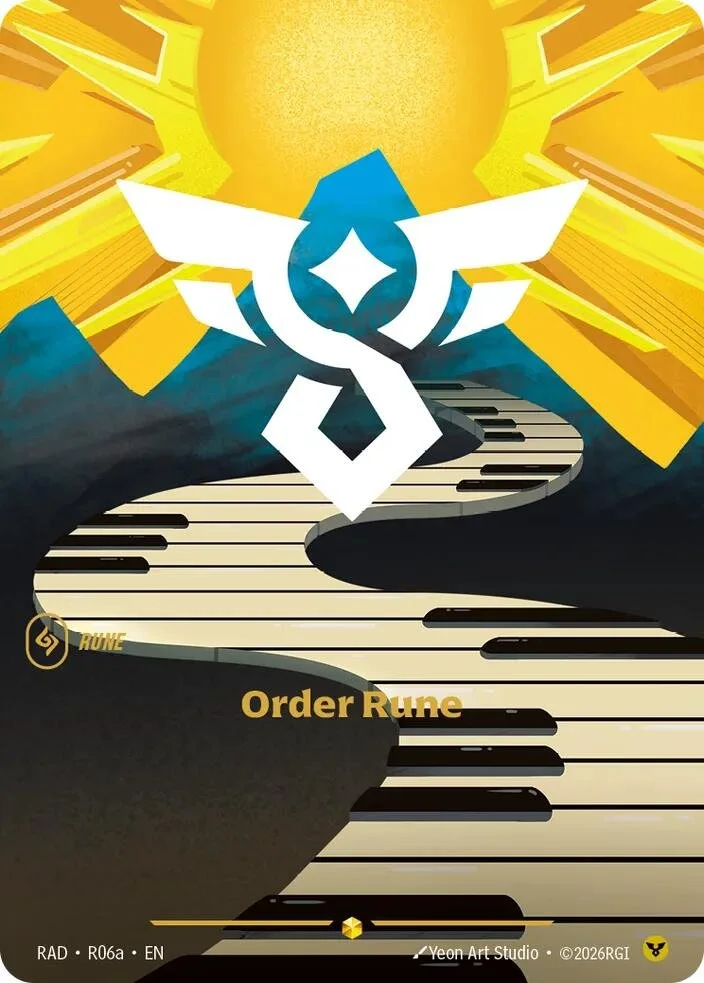
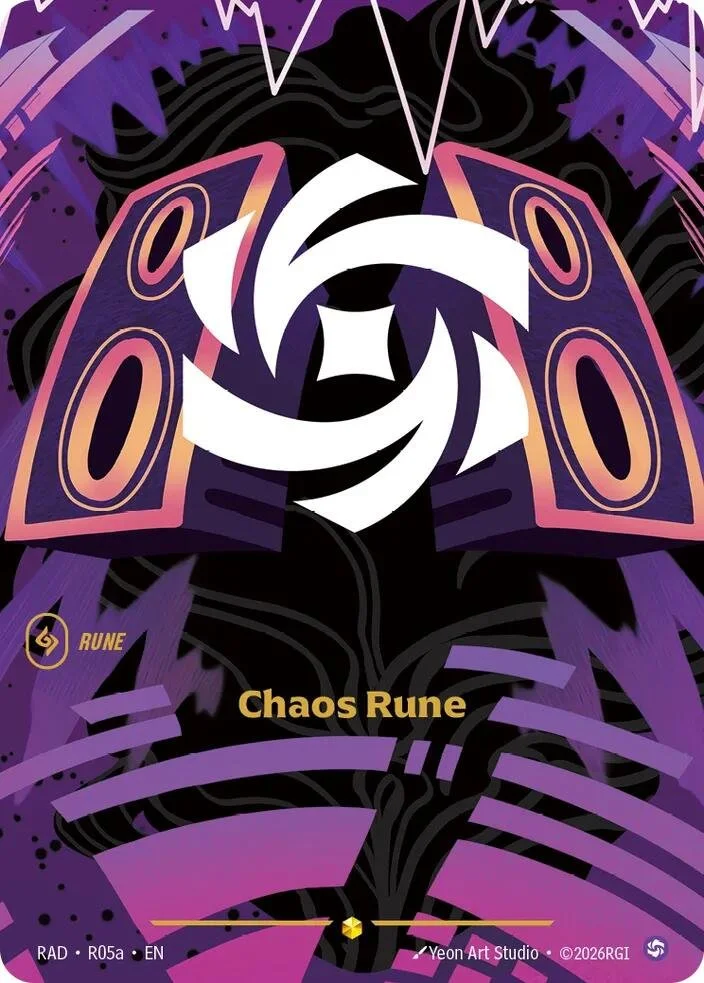

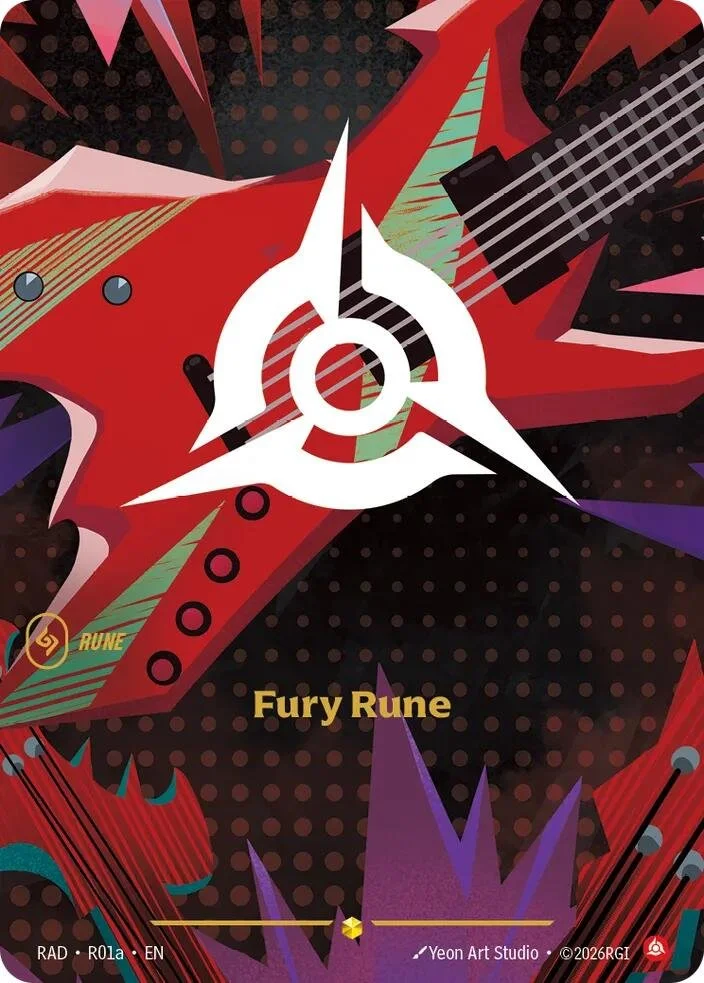
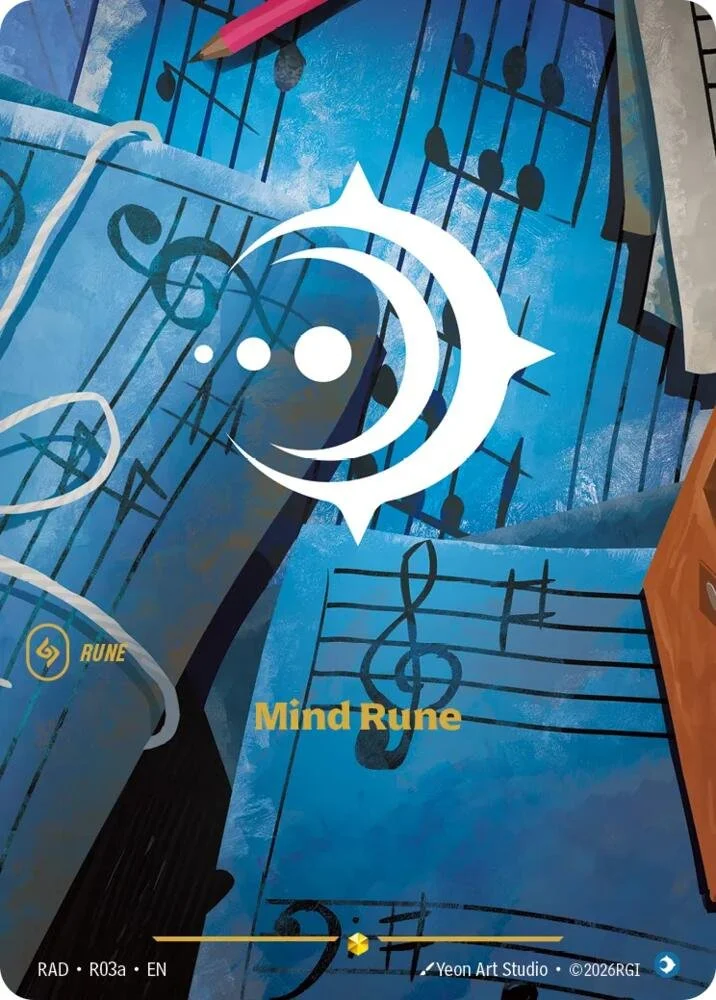

Instead of focusing on the traditional fantasy elements of Runeterra, Radiance puts the musical side of League of Legends in the spotlight. Between K/DA, HEARTSTEEL, and the various performance-inspired card treatments, there's a lot here for fans of the broader League of Legends universe.
The special artwork is particularly appealing, and I think this is going to be one of those sets that collectors gravitate toward because of the theme alone.
What I appreciate most is that the set doesn't lose its gameplay identity in the process. The musical theme is prominent, but the cards still feel like meaningful additions to Riftbound rather than simply collectibles designed around popular characters.
Weaknesses in Riftbound: Radiance
Radiance is a strong set overall, but that doesn't mean everything works equally well.
My biggest criticism is Show Off. While the mechanic has some interesting applications, it doesn't feel nearly as influential as Deploy or Disarm. Its conditional nature makes some of the cards less exciting unless you're building specifically to take advantage of them.
There is also the question of how some of the more powerful combinations will affect the game's balance. Chaos and Body receive some excellent support, and several of the new Legends have abilities that could become particularly difficult to deal with once players optimize their decks.
That isn't necessarily a bad thing. Powerful cards and creative strategies are part of what makes a trading card game exciting. However, as Riftbound continues expanding, maintaining a healthy balance between the different domains and Legends is going to become increasingly important.
I would also like to see future sets continue finding ways to support existing Legends without making newer options feel like strictly better alternatives. Radiance does a good job of creating new strategies, but keeping older decks relevant will be just as important for the long-term health of the game.
Who Is Riftbound: Radiance For?
Radiance offers quite a bit for different types of Riftbound players.
For competitive players, there are several new Legends and powerful cards worth experimenting with. Riven and Evelynn are particularly interesting, and I wouldn't be surprised to see players find some unexpected combinations with the new tools available.
For casual players, Ziggs and Ekko offer some entertaining strategies that can create memorable moments without necessarily requiring the most optimized decks.
Deckbuilders probably have the most to be excited about. Between Deploy, Disarm, and the various new support cards, there are plenty of opportunities to experiment with both new and existing strategies.
And for collectors, the music-themed artwork and special treatments give Radiance a strong visual identity that stands apart from previous releases.
Final Thoughts
Riftbound: Radiance is another impressive addition to a trading card game that continues to find new ways to expand its gameplay. The new Legends are some of the most interesting we've seen so far, the support for Chaos and Body is particularly strong, and the introduction of Deploy and Disarm brings meaningful new layers to battlefield control.
Show Off doesn't quite reach the same level, but even that mechanic has some interesting potential in the right decks. More importantly, the overall quality of the cards makes Radiance feel like a set that players will continue experimenting with long after its release.
What excites me most is how much more confident Riftbound feels with each new expansion. Riot and UVS aren't afraid to introduce unusual abilities, powerful interactions, and Legends that approach the game in completely different ways. There are always going to be questions about balance as the card pool grows, but that willingness to experiment is one of the game's biggest strengths.
Radiance is a strong release with excellent new Legends, plenty of exciting deckbuilding opportunities, and some genuinely impactful mechanics. It might not get absolutely everything right, but it gives players a lot of reasons to keep coming back to Riftbound.