Disclosure: This is a paid guest post. The author or an affiliated third party paid for its publication, and the article may contain promotional links. The views and opinions expressed are those of the author and do not necessarily reflect those of GameTyrant or its editorial staff.
Disclaimer: The following content contains references to gambling, casinos, and related topics.
The 2025/26 Somali Premier League ended the way a league is supposed to end: with a final day in Mogadishu, a nervous crowd and a title decided by a single point. A few years ago, very few people outside Somalia would have noticed. Today, Somali fixtures show up on international live-score and betting platforms, and fans sharing a 1xbet promocode in WhatsApp groups argue about Heegan and Dekedaha as readily as they argue about Real Madrid. The domestic game still has modest budgets and one main stadium, but it finally has an audience that pays attention.
That attention was hard to earn. The league stopped for long stretches during the civil war, its national stadium spent years as a military base, and clubs struggled to pay players. What exists now was rebuilt piece by piece over the last fifteen years. Looking at the 2026 season shows how far that rebuilding has come, and where the limits still are.
A Title Race Decided by One Point
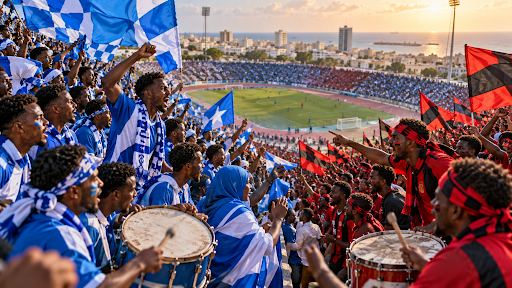
Gaadiidka FC went into the last round needing a result against Dekedaha at Mogadishu Stadium. A goalless draw was enough. Gaadiidka finished on 51 points, one ahead of Heegan FC, while 2024/25 champions Mogadishu City Club could not defend their crown. At the other end of the table, Jubba FC and Gantaalaha were relegated.
The bigger picture is just as interesting. No single club has dominated recent seasons, and the trophy keeps moving between a small group of Mogadishu sides. The list of recent champions shows how open the competition has become:
| Season | Champion |
|---|---|
| 2016/17 | Dekedaha |
| 2018 | Dekedaha |
| 2019 | Dekedaha |
| 2019/20 | Mogadishu City Club |
| 2020/21 | Horseed |
| 2022 | Gaadiidka |
| 2023/24 | Dekedaha |
| 2024/25 | Mogadishu City Club |
| 2025/26 | Gaadiidka |
Having four different winners across the seasons shown is a healthy sign for a twelve-team league. It means fans of at least half the division can start a season believing a title is possible.
The Clubs Shaping the League
All twelve top-flight clubs are based in Mogadishu, which gives every round a city-derby feel. Several carry names linked to the state institutions that once ran them, a legacy of how Somali football was organised before 1991. These are the clubs that set the pace in 2026:
Gaadiidka FC, champions in 2022 and again in 2026, built on a tight defence and steady results
Heegan FC, runners-up by a single point and a constant presence near the top
Mogadishu City Club, the most decorated side of the modern era, formerly known as Banadir Telecom
Dekedaha FC, four-time champions since 2016 and recent cup winners
Horseed SC, one of the oldest names in Somali football and 2020/21 champions
Elman FC, a well-known club that regularly finishes in the top half
Behind them sit clubs like Jeenyo, Jazeera, Badbaado and Raadsan, who spend most seasons fighting to stay clear of the drop.
Rivalries That Fill the Stands
Since every club shares one city, rivalries are personal. Neighbourhoods, families and workplaces split along club lines, and big matches at Mogadishu Stadium can draw crowds that would have been unthinkable a decade ago.
Mogadishu City Club against Horseed carries the most history. The two sides were chosen to play the first match when the national stadium returned to football in 2020, a fixture loaded with symbolism. Heegan's meetings with Gaadiidka and Dekedaha have become some of the league's defining modern rivalries, and the 2026 finale only added to that tension. For many supporters, a draw against a rival on the final day is remembered longer than a big win in October.
Kenyan Connections and Foreign Players
Each club may register up to four foreign players, and many of them arrive from Kenya. Nation Africa has traced these links through players who moved from clubs such as Mathare United and Sofapaka to Mogadishu, along with coaches who have worked at several Somali sides.
The exchange works both ways. Kenyan professionals bring experience and tactical discipline, while Somali clubs offer regular wages and a chance to play in CAF competitions. Mogadishu City Club's 2025/26 CAF Champions League tie against Kenya Police in Nairobi showed how close the two football communities have become.
From Empty Stadium to TV Screens
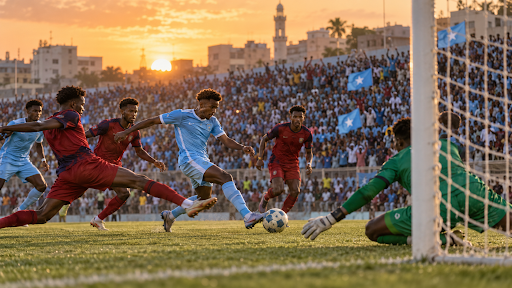
The growth of the domestic league is tied closely to one building. Stadium Mogadishu, built with Chinese support in 1977, closed after 2004 and was occupied by various armed forces for years. Inside World Football documented its return to football in June 2020, after renovation and the departure of AMISOM troops. The key steps in the league's revival look like this:
| Year | What happened |
|---|---|
| 1977 | Stadium Mogadishu opens and hosts the CECAFA Challenge Cup |
| 1991 | Civil war halts organised football for long periods |
| 2011 | The national league is relaunched |
| 2015 | Somali TV channels begin broadcasting league matches |
| 2018 | Somali clubs return to CAF competitions for the first time since 1991 |
| 2020 | Stadium Mogadishu hosts football again |
| 2026 | Gaadiidka win a title race decided on the final day |
Television changed the league's reach. Channels such as Astaan TV and others now carry matches, and clips spread across social media within minutes of a goal.
Following the League from Home and Abroad
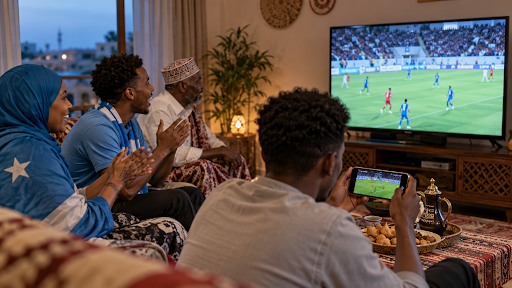
Somalis in Nairobi, Minneapolis, London and the Gulf follow domestic games almost as closely as fans in Mogadishu. They mix several sources, since none of them covers everything. A typical diaspora fan's toolkit looks something like this:
Somali TV broadcasts and their YouTube or Facebook live streams.
Club and federation pages for line-ups, transfer news and fixture changes.
International live-score apps, which now list Somali league fixtures.
Sports betting platforms, where some fans use live match trackers and statistics and may enter a 1xbet promocode when signing up.
WhatsApp and Telegram groups where someone at the stadium posts updates in real time.
The fourth point deserves a clear caveat. Gambling is restricted or prohibited in many countries in the region, and in Somali communities it also meets strong religious disapproval. Anyone considering using a 1xbet promocode should check local rules first, be 18 or older, and remember that scores and statistics can be followed without placing a bet.
What Still Holds the League Back
For all the progress, the Somali Premier League remains fragile. Interest is growing faster than the money and infrastructure behind it, and several problems keep coming up:
almost the whole league depends on one stadium in one city
club budgets rely heavily on a handful of private sponsors
Somali clubs still struggle to advance in CAF competitions
regions outside Mogadishu have no top-flight representation
the national team cannot play official home matches in the country, which limits the league's visibility on the international stage.
None of these will be solved in a single season. Still, a league that was barely functioning in 2010 now produces close title races, televised derbies and players good enough to be noticed across East Africa. When Gaadiidka's players celebrated that goalless draw in front of a packed stand, the moment counted for more than one club's second title. For Somali football, it was proof that a domestic game can still matter in Mogadishu.