On dusty pitches carved between corrugated metal walls, the rhythm of the game never stops. Children play barefoot, goalposts made of stacked bricks or rusted oil cans. No bibs. No referee. Just raw movement and improvisation. The rules? Fluid. The stakes? Everything.
Street football, or “pelada” in Brazil, “futebol de rua” in Angola, and “ghetto football” across much of West Africa, is where countless global stars learned to breathe the game. It’s not just sport — it’s language, survival, community, and sometimes the only shot at a future far removed from poverty.
From Concrete to Glory: Why Street Football Breeds Elite Talent
Street football is chaos wrapped in rhythm. It teaches things that academies can’t: intuition in tight spaces, fearless 1v1 ability, and improvisational genius. This environment molds players who don’t rely on systems — they create them.
One of the central factors that explains the explosion of talent from underserved neighborhoods is that the game is constant. While formal training may happen twice a week in structured environments, kids in Lagos, Accra, and Medellín are logging ten hours a day of spontaneous, creative reps. In that way, it’s not unlike the allure of plinko games — they simulate chaos, but reward those who’ve learned how to read its rhythms. Much like a ball bouncing through uncertainty, it’s the player with repeated exposure who begins to anticipate outcomes faster than the rest.
Real Skills Born from Street Chaos
These skills don’t emerge from cones and drills. They’re born in motion — in crowded alleys, on uneven pavement, in games where there are no restarts and no coaches shouting instructions. The technical sharpness and swagger that define many of today’s top attackers can be traced to these unscripted proving grounds.
Certain traits are repeatedly seen in street-developed players:
low-center-of-gravity balance (think: Lionel Messi’s early years in Rosario),
unpredictable feints and dribbling angles,
uncoachable first touch and reaction speed,
mental toughness from playing through injuries and challenges.
A player like Vinícius Júnior — now at Real Madrid — spent his formative years dodging potholes and older kids in São Gonçalo, Brazil. By the time he entered Flamengo’s youth setup, he was already ten steps ahead in terms of street sense.

Scouting the Streets: How the System Has Adapted
Football clubs now know better than to overlook the corners of the world where structured football barely exists. Modern scouting networks dig deep — beyond regional academies — to find diamonds where the game looks most unrefined.
In places like Nigeria, Senegal, and Colombia, scouts now embed themselves with local fixers who know which alleys and basketball courts are hiding the next wonderkid. They watch five-a-side matches that start at sundown and finish well past curfew. No highlights. No GPS trackers. Just eyes on instinct.
The impact of this evolution has reached betting markets as well. As youth tournaments from Africa and Latin America gain prominence, platforms have started integrating them into broader systems. In the middle of this ecosystem shift, the line between street football legend and market-relevant athlete has blurred.
The Role of Betting Apps in Shaping Tomorrow’s Football Stars
While street football remains the cradle of raw talent, the digital age has added a new dimension to how young adults engage with the sport — a betting app. Platforms like MelBet are no longer just tools for wagering; they are gateways to the wider football ecosystem.
For many young adults growing up in football-rich yet economically challenged neighborhoods, placing small bets on mobile apps is more than entertainment — it’s a way to stay deeply connected to the global game. These are not passive spectators. They follow real-time scores, player stats, and team strategies on their phones, often developing a deeper tactical understanding than many casual fans.
These aspiring players:
Track the performance of football icons like Kylian Mbappé or Mohamed Salah through in-app statistics.
Study tactical trends and match outcomes to sharpen their own football IQ.
Place bets not just for fun, but as a way to learn from the best — analyzing matchups, formations, and substitutions.
In this sense, betting apps serve as informal learning platforms. By following the results of high-level matches and reviewing betting outcomes, young users begin to understand the game's deeper layers — from reading momentum shifts to recognizing undervalued talent.
Moreover, these apps reinforce a culture of attention. When a kid from Accra or Rio places a small bet on a Champions League game, they’re not just chasing luck — they’re watching, absorbing, and dreaming. This constant exposure helps them model their own play styles after elite athletes they follow closely.
Mobile technology bridges the gap between back-alley matches and global arenas. And while the primary goal of betting apps like MelBet is to offer gaming entertainment, they incidentally help fuel the ambition, awareness, and tactical literacy of tomorrow’s football stars.
As scouts expand their search for talent into previously ignored spaces, the odds are increasingly favoring players who not only grew up playing with grit — but who also studied the game like analysts, thanks to the devices in their pockets.
Why Clubs Take More Risks on Raw Talent Now
As street-bred talent continues to prove itself at the highest level, clubs have shifted their recruitment mindset. What used to be seen as risky — signing players without structured academy training — is now viewed as a high-upside investment. The returns are too visible to ignore, and the competition to discover the next global star has pushed clubs into less traditional spaces.
The Neymar Effect: Clubs hope to uncover the next megastar before prices balloon.
Shift in Training Philosophy: Many academies now welcome “unpolished” flair.
Cost-Effective Development: Signing a 14-year-old from a slum is cheaper than a 19-year-old from Ligue 1.
This trend has also accelerated due to recent FIFA regulation changes allowing more flexible youth registration across borders, particularly in Africa and South America. These adjustments have enabled clubs to legally sign prospects at a younger age and move them into structured development pipelines sooner. As a result, scouts are now more active at local tournaments and informal showcases where unregistered talent frequently shines.
The Environments That Shape Resilience
Beyond the football skills, street life itself sharpens the mindset of a future pro. Players from slums often bring a psychological edge to elite environments — they’ve played hungry, hurt, or while caring for younger siblings watching from the sidelines.
These environments do not romanticize poverty — they demand survival. And survival builds players who don't flinch in front of 60,000 fans or fold in a Champions League quarterfinal.
Hidden advantages of a hard start:
pain tolerance and emotional regulation,
high-risk creativity without fear of failure,
ability to adapt to diverse coaching styles,
hunger that doesn’t fade with signing bonuses.
A prime current example is Napoli’s Victor Osimhen. He sold newspapers on the streets of Lagos as a child, dribbled on rocky gravel with no boots, and today is Serie A’s most explosive striker. His journey isn’t unique — it’s simply visible now.

From Pitchside to Platforms: Street Icons and Global Influence
Today, some of the most viral football content online comes not from elite matches but from raw clips of teenagers nutmegging grown men in favelas. Street football is entertainment, but also branding. Players who stand out in viral videos now get called up for trials.
Several agencies now specialize in discovering unsigned talent through social content — an unthinkable concept just ten years ago. Platforms like Instagram and TikTok are littered with highlight reels from informal tournaments in Nairobi, Caracas, or Soweto.
Below is a table highlighting players who transitioned directly from informal football environments to elite club contracts:
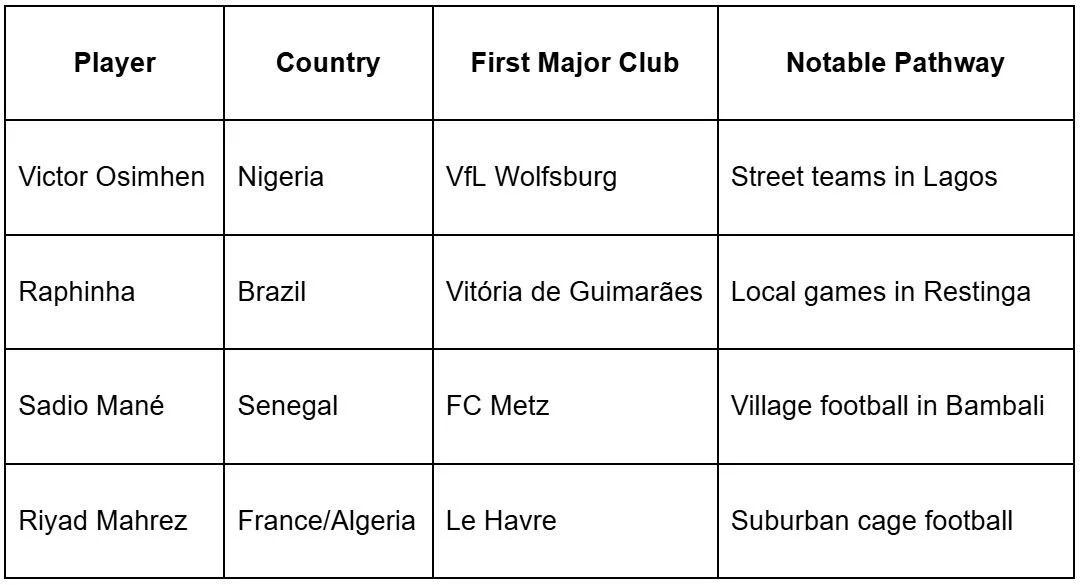
Their rise has influenced how clubs monitor informal leagues and online trends. The shift is permanent.
Building Around the Chaos: What Coaches Learn from Street Players
Coaches at the top level now admit that certain talents can't be manufactured. They come from unstructured repetition, not drills. Rather than reshaping street players into academy molds, some managers now adapt systems around the freedom those players need.
As the tactical game becomes more rigid, street-bred players offer necessary chaos. They unsettle blocks, draw fouls, and create something out of nothing when the game gets stuck.
Many of these players thrive in fluid attacking roles — often as inverted wingers or inside forwards — where freedom of movement and improvisation are central. Their tendency to play with instinct rather than instruction gives them an edge when systems break down, allowing them to exploit moments others hesitate in. Coaches increasingly acknowledge that their unpredictability is not a weakness but a tactical weapon. And while their journey may start on broken concrete with bottle caps for a ball, their instincts — refined through necessity — translate directly into match-winning moments at the highest level.
Global football isn’t just importing talent from the slums. It’s adapting to it.
And as elite systems continue to seek solutions for rigid defensive setups, more coaches are looking to those whose first pitch was a street corner — because chaos, once seen as a liability, is now an edge.