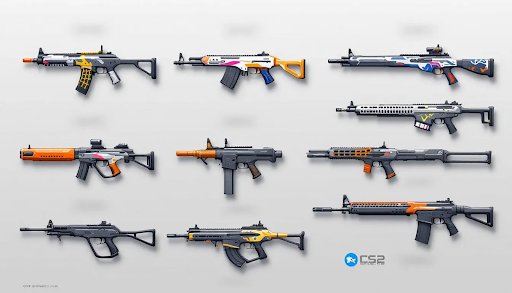
A virtual rifle skin sold for over $100,000 last year. That was not a glitch. It was a business transaction with provenance, a known buyer, and a market price set by the same supply-and-demand mechanics that govern collectibles in the physical world.
The CS2 skin economy is one of the most studied virtual marketplaces in gaming, and the patterns it shows up close apply far beyond Counter-Strike. Anyone trying to understand where gaming economies are heading should look at what CS2 has spent a decade building.
Scarcity, status, and price discovery
The CS2 skin market behaves like a real economy because it has the same underlying drivers. Items have known supply (drop rates set by Valve), variable condition (float values), and demand shaped by community taste and pro player visibility. Newzoo's gaming market reports consistently flag virtual goods as one of the fastest-growing revenue categories in the global games industry, and CS2 skins are a flagship example.
Price discovery happens in real time on Steam and across third-party platforms. Bid-ask spreads exist. Speculation cycles exist. Bubbles inflate and pop the way they do anywhere else. The mechanics are not novel - they are just running on different inventory.
The third-party platforms that have grown into the dominant trading venues now operate at scales that require real engineering teams. EsportNow's skins partners coverage tracks which platforms move serious volume, how their pricing differs from Steam baseline, and which pro players have signed with which platforms. For anyone studying the market, that ecosystem map is more revealing than any individual price chart.
Why the market is more durable than people expect
Every few years a wave of articles predicts the collapse of the skin economy. The market always survives, sometimes after a temporary dip. The reason is simple: as long as Counter-Strike has an active competitive scene and a passionate player base, the skins have utility as status symbols and identity markers.
Tournaments anchor this stability. Major tournaments generate sticker capsule sales that flow back to teams and players, and the schedule itself drives predictable demand cycles. EsportNow's CS2 tournament calendar maps out the 2026 events, and anyone watching the skin market closely uses tournament calendars as one of their primary trading inputs.
The status signaling layer
A virtual skin you cannot trade has no economic value. A virtual skin you can trade and that other people recognize has the same status mechanics as any luxury good. Statista's research on digital goods puts the global virtual goods market in the tens of billions annually, with a meaningful portion driven by pure status signaling rather than gameplay utility.
CS2 skins illustrate this cleanly because the items are purely cosmetic. They do not affect aim, movement, or any in-game stat. The entire valuation rests on social signaling and aesthetic preference. That this still produces a multi-billion dollar market is what economists and game designers find most interesting about the case.
Regulatory pressure has been the wild card
Skin gambling regulation has reshaped parts of the market several times. Different jurisdictions treat tradeable cosmetics differently. Some treat them as ordinary virtual goods. Others classify them under gambling rules when they intersect with chance-based mechanics like cases. The regulatory direction over the next five years will probably matter more than any in-game change.
This pattern shows up in other gaming economies too. Mobile games with loot boxes have faced similar regulatory waves. The CS2 market has navigated more rounds of this than most, and the adaptations - changes to case rotations, regional restrictions on certain features - offer a template for how other gaming economies handle similar pressure.
What other gaming markets are learning
Other gaming economies are studying CS2 closely. Valorant, Rocket League, and Dota 2 have all built skin markets that draw from CS2's playbook with modifications. The lessons - scarcity matters, condition matters, social signaling drives value, regulation will keep evolving - apply broadly.
The next wave of gaming economies will probably look more like CS2 than less. Tradeable cosmetics, time-limited drops tied to events, and integration with esports calendars are all already standard. The question is whether other titles can match the player retention and competitive scene that gives CS2 skins their underlying meaning.
Reading the signal
Anyone watching the CS2 market for purely commercial reasons is missing the more interesting story. The skin economy is a working laboratory for what virtual goods markets become when they mature. The mistakes have already been made. The patterns have already been documented. The infrastructure has already been built. Other gaming companies that ignore this history end up reinventing it badly. The ones that pay attention build markets that work from day one.
Counter-Strike was never designed to host a billion-dollar virtual economy. It happened anyway. That is the part worth thinking about.