Disclosure: This is a paid guest post. The author or an affiliated third party paid for its publication, and the article may contain promotional links. The views and opinions expressed are those of the author and do not necessarily reflect those of GameTyrant or its editorial staff.
Forget the jersey stitching for a minute. Watch a defender who has committed to the wrong side of an attacker. If he can whirl around and catch up without paying for the mistake, there is something odd happening on that ice. The replay might look lovely. Playing against it would be infuriating.
That gap is the hard part. Hockey asks a game to sell weight and momentum while letting someone on a couch react quickly enough to enjoy themselves. It also needs teammates who understand a play before it has happened. Better faces alone will not fix either problem.
Skating has to feel right before anything else
On skates, changing direction takes something. A player needs edges, space and time to turn. Go charging past the puck carrier and you should have a problem getting back. Give the attacker that opening. Otherwise, why bother drawing a defender out of position?
Give the virtual skater instant control and defending becomes too easy. Make every turn obey a heavy animation, though, and users may feel trapped while an opponent escapes. The game has to communicate the cost of a movement without making every correction feel like an input was ignored.
Then there is the question of which way the skater is looking. Backing away from an attacker ought to let a defender keep an eye on them. A puck carrier can open their body for a pass without simply running toward its recipient. The left stick cannot explain all of that by itself.
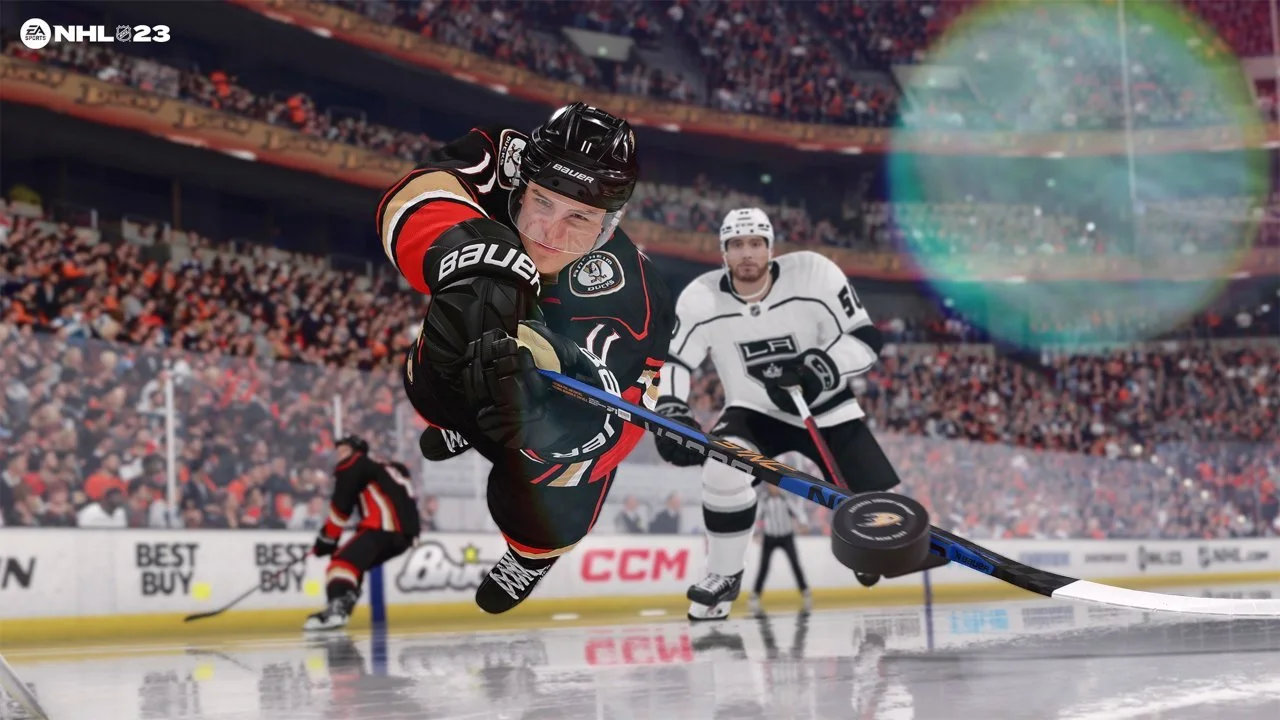
EA's NHL 25 gameplay breakdown describes Vision Control as a way to handle those orientations. Its examples include walking the blue line and facing the puck on defense. These are specific hockey movements, rather than another promise that everyone will skate faster. They are also the sort of details that determine whether a passing lane feels earned.
The puck needs its own life
Soccer games have a difficult ball to track. Shrink the object to a puck and send it through a crowd of skates, and the person on the couch has even less chance of following it. Nobody should need to press their nose against the television to find possession.
There is no point making the puck behave like it has been glued to the blade, either. A defender needs a chance to knock it loose. Go too far the other way and nobody gets through a pass without a scramble. And what about saves? Leave a rebound in front of goal, by all means. Let us see where it came from.
Think about a pass across the crease. The attacker sees a possible one-timer. The defender sees a lane that ought to be covered. If the puck passes through a perfectly placed stick, one of those people will have a complaint. If every nearby stick intercepts automatically, the attack disappears before anybody has read it.
Try explaining an interception when the stick never appeared to move. The person who lost the puck will want another look. A missed interception can look unfair if the screen suggests the opposite. Being correct somewhere in the code is not much comfort during the replay.
Most of your team is somebody else's responsibility
Who was supposed to be covering that forward? In a solo game, the answer might be a teammate you were never controlling. Now you have to work out whether you made a mistake or the CPU simply wandered off. That is a miserable way to learn a defensive system.
Real hockey provides a useful reference beyond highlight goals. Follow the reporting on Kiekkofani.com, which covers the NHL, Liiga and Finnish national teams, and there is a whole sport surrounding the puck carrier. Team selection and line combinations matter because different players are expected to do different jobs.
A game should make those jobs visible. A winger who is available along the boards helps a breakout. A defender who stays home makes an attacking risk possible. Neither contribution needs a spectacular cutscene. It needs someone to be where the player expects them.
Goalies are an especially awkward case. They must respond to shot angle, traffic and lateral movement, while avoiding both superhuman saves and cheap repeated goals. On its NHL 26 feature page, EA explains its use of NHL EDGE data for player attributes and tendencies. It also describes work on the goalies' positioning. Fine, but watch the next cross-crease pass. That is where the positioning earns its keep.
A convincing game needs room for ugly hockey
Sport looks different when nobody is editing out the dull bits. A messy clearance can be the right choice. A tired line needs to get off the ice. Sometimes the smart attack is to put the puck somewhere awkward and make the other team retrieve it.
The wider coverage at Penkkiurheilu.com is a useful reminder of how differently various sports create tension. Hockey cannot simply borrow another game's movement, add a puck and call the job done. Its appeal depends heavily on what happens during a hurried change of possession.
Online play makes the task harder. Get the pass button down in time and watch the opening disappear before anything happens. Was the pass a bad idea, or did the response arrive late? Unless you can tell, it is difficult to know what to practice.
The best test is a fairly ordinary shift. Start behind your own goal and try to build an attack. Lose possession and get back to defend. Does the goal against make sense on replay, even when it hurts? Get those moments right and the spectacular goals have something to build on. Miss them, and another beautifully rendered arena is only a nicer place to get frustrated.