The Convergence of Traditional Media and Interactive Play
The landscape of digital entertainment has undergone a seismic shift over the last decade. Historically, the line between "gaming" and "broadcast media" was distinct; you either played a game locally on your hardware or watched a pre-recorded or live video stream. However, as hardware capabilities have expanded and global internet infrastructure has stabilized, these two worlds have collided to create a new sub-genre of interactive entertainment.
At the heart of this shift is the demand for realism—not just in terms of graphical fidelity, but in the authenticity of the experience. Players are increasingly looking for systems that mirror the physical world, leading to a rise in hybrid environments where human interaction meets algorithmic precision.
The Technical Foundation of Real-Time Interaction
When we look at the architecture of contemporary interactive platforms, the primary challenge is latency. In a standard competitive shooter or a massive multiplayer online role-playing game (MMORPG), a delay of a few hundred milliseconds can be the difference between success and failure. As gaming has expanded into the realm of live-hosted environments, the technical stakes have shifted.
The integration of high-definition video feeds into interactive UI overlays requires a sophisticated synchronization of data. This is particularly evident in platforms that utilize "Live Host" mechanics. Unlike a standard RNG (Random Number Generator) driven interface, where the outcome is calculated instantly by a local or server-side script, live-integrated systems must sync a physical event—captured via camera—with the digital betting or participation interface used by the player.
Authenticity Through Human Elements
One of the most significant trends in the broader gaming industry is the "humanization" of the digital experience. While AI has made incredible leaps in simulating human behavior, there remains a psychological preference for interacting with real people. This is why streaming platforms like Twitch and YouTube Gaming have become the dominant force in how games are consumed.
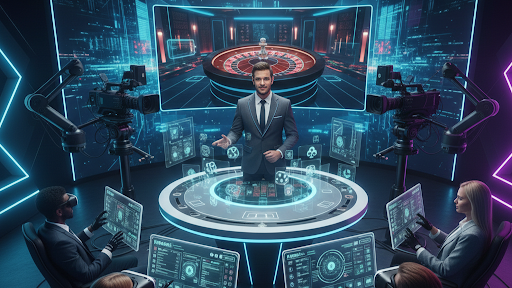
In the niche of high-stakes interactive media, this manifests as the transition from 2D graphical interfaces to studio-based environments. When a player engages with a system, seeing a professional host manage the game flow provides a level of transparency that a black-box algorithm struggle to replicate. This move toward transparency is essential for building long-term trust in any digital ecosystem where outcomes are determined in real-time.
For those interested in how these live environments are structured and which platforms provide the most robust technical setups, resources like https://www.livecasinocomparer.com/ offer a look into the infrastructure and variety of live-hosted games available globally. These comparisons highlight how different studios handle the balance between video quality and interactive speed.
Mathematical Models and Fairness in Interactive Play
Beyond the visual presentation, the core of any game lies in its mathematical framework. Whether it’s the loot table of a dungeon boss or the distribution of a digital deck, players are governed by probability. In the professional gaming and gambling spheres, two terms are paramount: Return to Player (RTP) and Volatility.
RTP (Return to Player): This is the theoretical percentage that a game is programmed to pay back to users over a significant period. In a live-hosted environment, the RTP is often dictated by the physical rules of the game (such as the physics of a wheel or the composition of a shoe of cards) rather than a digital weightage.
Volatility (Variance): This describes the risk level of a game. High volatility games offer larger, infrequent payouts, whereas low volatility games provide smaller, more consistent returns.
Understanding these mechanics is crucial for any participant. In a live setting, the volatility is often "felt" more acutely because the pace of play is dictated by human action rather than the instantaneous click of a button. This slower cadence allows for a more contemplative gaming experience, contrasting with the rapid-fire nature of traditional digital slots or mobile games.
The Role of Optical Character Recognition (OCR)
One of the most impressive "invisible" technologies used in modern live-hosted games is Optical Character Recognition (OCR). This technology is what allows a physical action—like a card being dealt or a ball landing in a pocket—to be instantly translated into digital data that the software can process.
Specialized cameras overlook the playing area, capturing every movement and converting symbols and numbers into code. This happens in milliseconds, allowing the UI on the player's screen to update before the host even announces the result. This synergy between the physical and the digital is what makes the current era of interactive gaming so seamless. Without OCR, the lag between reality and the digital interface would break the immersion and create opportunities for errors.
Social Integration and the Community Aspect
Gaming has always been a social endeavor, from the early days of arcade cabinets to the rise of Discord. Live-streamed interactive games have leaned heavily into this by incorporating live chat features and "community wins."
In many modern live titles, the host doesn't just manage the mechanics; they act as a community moderator and entertainer. This creates a "spectator-player" hybrid role. You aren't just playing against the house or a computer; you are part of a collective experience. This social layer often mitigates the isolation that can sometimes accompany solo gaming sessions, making the activity feel more like a night out at a venue rather than a solitary digital task.
Regulatory Standards and Technical Integrity
As the complexity of these games grows, so does the need for rigorous oversight. Independent testing laboratories (such as eCOGRA or iTech Labs) are tasked with ensuring that the software governing these live interfaces is functioning correctly. They audit the RNGs used in hybrid games and verify that the physical equipment used in live studios meets international standards for fairness.
For the player, this means that the "expert" feel of a game isn't just marketing—it's backed by a massive framework of legal and technical compliance. The integrity of the data stream, the security of the financial transactions, and the physical security of the broadcast studio all play a part in the overall gaming experience.
Future Horizons: VR and Augmented Reality
Looking forward, the next logical step for live interactive gaming is the integration of Virtual Reality (VR) and Augmented Reality (AR). Imagine wearing a headset and being "transported" into a high-end studio where you can walk around the table, interact with other players' avatars, and see the live host in a 3D space.
We are already seeing "Lite" versions of this through AR overlays on mobile devices, where digital assets are projected onto the user's physical environment. As 5G technology becomes more ubiquitous, the bandwidth required to stream 360-degree, high-bitrate video with zero latency will become the standard, further blurring the lines between the physical and the virtual.
Conclusion: The New Standard of Engagement
The evolution of gaming towards live-streamed, interactive models represents a maturation of the medium. We have moved past the era where digital games were seen as mere "simulations" of reality. Today, they are complex ecosystems that combine high-level broadcast production, sophisticated data processing, and traditional game theory.
By focusing on transparency, human interaction, and technical excellence, developers are creating experiences that resonate with a more discerning, tech-savvy audience. Whether it is through the precision of OCR technology or the social engagement of a live host, the goal remains the same: to provide a compelling, fair, and immersive experience that keeps pace with the rapidly changing digital world.