Back in the day, gamers were still fine with a few flaws in the game. They certainly tolerated slow loading screens, cluttered menus, or a delayed click response. Those things were part of the online gaming routine. The tolerance for them is much lower today.
Expectations, in fact, precede the game session. Speed, clarity, and responsiveness are not considered luxuries anymore; they are the minimum requirements now. The difference can be seen immediately when browsing platforms like Casinoeuro. Pages respond quickly, navigation stays predictable, and the overall structure is designed more for continuous play rather than experimentation.
It should be noted that a seamless session is hardly ever a stroke of luck. Typically, it is the result of a number of design choices that work together behind the scenes. The flow is determined by load speed, interface logic, visual feedback, etc. If all these factors are in harmony, the player hardly has to make any effort. Otherwise, the game session is often terminated prematurely.
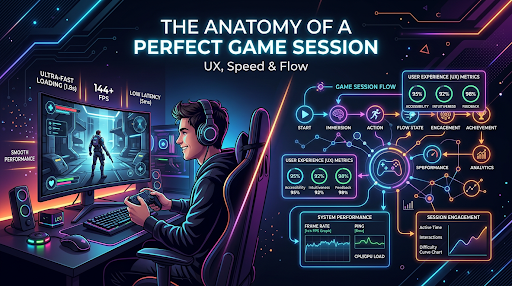
Today, most importantly, the perfect game session is characterized by that interplay of performance and usability.
Why the Game Session Experience Matters More Than Ever
In the past, simply having a large library of games was all that was needed to draw the players' attention. Players were trying out new platforms, and their standards were not fully developed yet. But that stage ended quickly.
The scene is quite different now. Digital entertainment has been pushed to a new level on all kinds of devices. Console games can be started instantly, mobile apps are very responsive, and streaming platforms almost do away with waiting time altogether. So it is perfectly natural that the players bring their new standards with them when they log onto a gaming platform.
This also means that a delay of even a few seconds can throw the whole flow off. Extra clicks on menus make the players feel that the platform is unnecessarily complicated. Even small inconsistencies - the icon is a bit unclear, the button is not labeled properly - can be enough to break the session.
In fact, we have noticed that the platforms that manage to engage the players for a long time are the ones that keep the players away from the abovementioned obstacles. They make the paths lead easily. They never let the transitions interrupt. And they hold visual consistency across all pages.
Ultimately, the aim is very straightforward: the players should concentrate on the games and not be distracted by the interface.
For a more general study of player behavior and usability standards in digital entertainment, the UK Gambling Commission's player research is a very helpful source, which includes insights into how platform design impacts engagement.
Load Speed: The Invisible Factor Behind Player Retention
Most of the time, speed is not even something the players notice if it works fine. However, when it slows down, that is when it becomes the players' focus.
Load speed is one of those invisible features that silently shape the whole session. On paper, the difference between a platform that loads in one second and another that takes four might seem negligible. Yet, in fact, it determines the pace of the play.
A speedy environment allows players to transition naturally between games, different menus, and account sections. There is no moment of hesitation, no pause long enough to lose focus. Everything seems to be in the flow.
This, technically speaking, is achieved by many elements working together:
Good server infrastructure
Optimized game assets and graphics
Advanced caching systems to reduce repeated loading
Consistent mobile performance on a variety of devices
For this reason, some operators go all out in optimizing the backend. It is not user-facing, but it decides whether a session is really smooth or just a bit frustrating.
In the real world, players seldom think about the server setup or asset compression. They just notice the difference. If the platform responds without delay, they decide to stay.
UI Clarity: When Design Becomes Invisible
If an interface is well-designed, people don't even notice. It is by design, after all.
Players will simply glide through a platform with an intuitive menu system and natural navigation. They will know exactly where to click, how to find categories, and how to switch between sections, all without any effort.
The opposite scenario is also common. In fact, "bad UI" happens all the time. A UI that is cluttered with banners, buttons, and pop-ups tends to slightly slow down players and certainly puts the whole session into disarray.
A clear interface is typically a result of these few basic principles being followed:
Visual hierarchy
Users' attention must be drawn naturally to the most important things. Categories, search features, and side-bar navigation must be visible without cross-traffic.
Consistent iconography
If the same icon is used on multiple pages, then players should recognize the meaning right away without making a mental leap.
Minimal cognitive friction
The setup should be as friendly as possible. The less effort required to figure out the function of a button, the better the design.
Some contemporary gaming websites take inspiration from mobile apps and streaming services in terms of UI elements. Of course, the objective is the same: this way, the interface disappears, and only the content is left in the user's focus.
Feedback Loops: The Subtle Mechanics of Engagement
Feedback is another factor that is commonly overlooked. Not only reward, but also the continuous feedback of tiny confirmations that the system acknowledges the player's actions.
Each click has its own feedback loop. There are animations, sounds, balance updates, and progress indicators. They communicate, through non-verbal means, the importance of the player's action and the active state of the system.
In practice, feedback loops operate through:
Visual confirmations on spins or betting
Animated transitions between different game states
Progress bars to monitor bonus or mission statuses
Very subtle sound cues to reinforce player action
Taken together, these elements form a kind of tempo that acts as a lubricant, helping sessions go smoothly.
Besides, continuous feedback is one of the mechanisms through which the players maintain their concentration for longer periods of time, which is supported by many behavioral studies of game engagement published by MIT Game Lab.
A more applied look at how probability, feedback, and interface design combine to shape engagement can be found in GameTyrant’s own article “How Gaming Platforms Use Probability and Design to Shape Player Experience”, which discusses how visual cues, variable rewards, and pacing work together to keep players immersed.
Personalization: Sessions That Adapt to Player Behavior
Personalization is another thing that influences the modern gaming session.
The main interface is increasingly tailored according to user behavior. First, they see their favorite games. They can still access recent games easily. Over time, recommendations change accordingly.
This is not about showing a lot of suggestions to the players but rather presenting familiar options as quickly as possible.
The following elements combine to amplify the effect of personalization:
Recommendations based on the player's history
Saved preferences and favorites
Continuity of the session across different devices
Easy access to recently played games
Actually, these changes reduce the time between login and play. The players are less often inclined to search for the game they want to play and instead tend to start playing more quickly.
It might be a minor touch, but it influences the whole game session.
Security and Trust Signals in Modern Platforms
Performance by itself is not enough. The player also has to be confident about the platform's integrity.
Trust indicators are scattered around a well-organized site. The licensing details are displayed prominently. The payment methods, also well-known, are not hidden. Responsible gaming tools can be accessed without a big hassle.
This kind of openness is what makes a real difference for the majority, perhaps even more than most operators expect. Once players comprehend the whole process from deposits through withdrawals to the final verification, their doubts will gradually disappear.
Here are some common trust factors:
licensing from well-known regulatory bodies
a clear payment processing structure
secure encryption mechanisms
customer support contact information prominently displayed
eCOGRA is a global testing and certification agency for online games that helps ensure players are dealing with a safe and fair platform.
When these are easily seen, the players spend very little time evaluating the platform and much more time enjoying the casino session.
For readers who want to see how these expectations are formalised at a regulatory level, the UK Gambling Commission’s Remote Gambling and Software Technical Standards (RTS) set out concrete requirements for technical performance, security, and player protection on licensed platforms.
The Future of Game Sessions
It probably goes without saying that online session formats will almost certainly keep changing in the future as well.
AI is capable enough now to impact recommendation systems. Interfaces may get so smart as to predict player preferences before the user even chooses a game. Performance optimization may keep on improving as cloud infrastructure gains in efficiency.
Nonetheless, the ground rules still hold.
Players want the fastest possible experience. They want the clearest possible experience. And, as if that weren't enough, they want the experience to be so fluent that the ending feedback does not interrupt their play.
All other things - the personalization algorithm, the detailed interface changes, the backend work - are there just to support those three pillars.
In the end, a perfect gaming session hardly ever gives one the impression that it has been created by the developers' design. Rather, it seems natural. Even effortless.
And, if a platform is able to deliver such a feeling, it normally becomes the one to which players return.