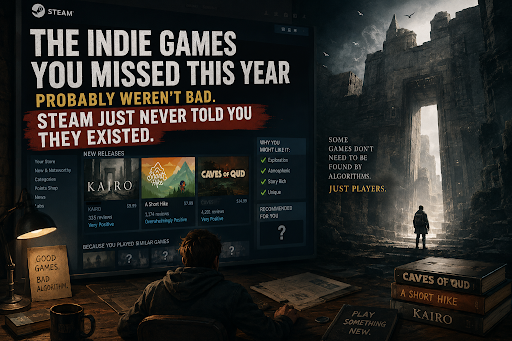
There's a game called Kairo that came out in 2013. First-person exploration through massive brutalist stone structures - silent, strange, the kind of experience that sits with you for days after you finish it. People who've played it talk about it the way people talk about finding something in a used bookstore that nobody else seems to have read.
It has 335 Steam reviews.
Most people who would genuinely love Kairo have never heard of it. Not because it failed at being a game. Because at some point in its launch period, the early signals Steam needed to start pushing it to the right players weren't strong enough - and once that moment passed, the game quietly settled into the part of the catalogue that the recommendation engine rarely revisits.
This is happening right now. Probably to a game you would have liked this year.
The Scale of the Problem Nobody Talks About
In 2023, over 14,000 games launched on Steam. Roughly 40 new releases every single day.
Simon Carless, whose GameDiscoverCo newsletter tracked Steam performance data for years before moving under the GDC umbrella, published consistent findings showing that the median indie game on Steam appears to earn less than $15,000 across its entire commercial lifetime. Not per year. Ever. Total.
That's not a bad-games number. What it more likely reflects is how many genuinely finished, genuinely playable games launch into a system that never generates enough early momentum to push them beyond their immediate circle - and then never gets a clear opportunity to try again.
Three Games That Show Exactly How This Works
Hollow Knight - The Slow Build That Almost Didn't Happen
Team Cherry launched Hollow Knight in February 2017. Per figures the studio shared publicly, it sold around 250,000 copies in its first year. Solid indie numbers. Not a phenomenon.
Then streamers started posting. Community threads on Reddit kept it circulating. The Silksong announcement pulled curious players back to the original. By 2023, Team Cherry reported over 15 million copies sold.
The version of this story that gets told most often is a pure quality narrative - the game was good, the audience found it, merit won. That's not wrong. But it leaves out the sustained external amplification across six years that kept feeding new behavioral data into Steam's recommendation engine long after most games would have gone quiet.
Hollow Knight benefited from a genre - Metroidvania - that mapped cleanly onto an existing searchable player base. It had a visual identity that likely converted well on its store page. And it had time - the luxury of a slow build that most games launching into a field of 40 daily competitors genuinely cannot afford to wait for.
Take away the streamer pickup, the Reddit longevity, the Silksong halo effect - and the story is plausibly different. Still a great game. Maybe not 15 million copies.
Balatro - What Publisher Infrastructure Actually Does
Balatro was the 2024 indie story everyone pointed to as proof the system works. A million copies in its first week. Best Independent Game at The Game Awards. A card game that somehow became unavoidable in February.
It deserved every bit of it.
It also launched with publisher support from Playstack, with press coverage timed to land in the first 48 hours, and with streamer relationships that contributed to what read as organic momentum from day one. According to Valve's own Steamworks documentation, store page conversion rate - how many players who visit a game's page actually buy it - appears to be among the primary signals driving organic distribution on the platform. Balatro likely entered that system with strong enough early numbers to trigger wider distribution almost immediately, which generated more purchases, which improved targeting, which expanded reach further.
Once that loop starts, it tends to build on itself. Most indie developers releasing something this week don't have Playstack. They have a store page, a Discord server, and whatever community they've built in the months before launch.
Caves of Qud - Nine Years and Still Waiting
Freehold Games launched Caves of Qud into Steam Early Access in 2015. It currently holds a "Very Positive" rating. The developers update it consistently and engage with their community more actively than most studios bother with. By any visible metric, the game is doing something right and has been for nearly a decade.
It has never broken into mainstream visibility.
One plausible reading of that - worth flagging as inference from observed patterns rather than anything Valve has confirmed publicly - is that the audience data Steam collected from the game's 2015 early access cohort shaped a targeting model that has been refining itself ever since. Not widening. Refining. Getting better at showing Caves of Qud to players who already look like its existing fans, rather than finding new ones who don't know yet that they'd love it.
Nine years of consistent development. Still primarily reaching the players who were already looking for it in 2015.
Why the Recommendation Engine Works Against Surprise
What Steam Is Actually Optimising For
Your Steam recommendations are built from your own history - what you've bought, how long you've played it, what you've wishlisted. The engine is genuinely useful at surfacing games that resemble things you already liked. It's less useful at finding something that would genuinely surprise you, because surprise by definition doesn't fit a pattern it's already learned from you.
According to Valve's own Steamworks documentation, store page conversion rate appears to be among the primary signals the platform uses to decide which games get pushed to wider audiences. Games that convert well early get shown to more players. Games that don't convert well in their launch window get shown to fewer - and the tools for recovering visibility after that window closes are limited to external events outside any developer's reliable control.
What That Means for the Games You're Not Seeing
The practical consequence is a recommendation feed that trends toward the familiar. Games resembling things you've already played. Publishers whose previous releases already matched your behavioral profile. The game that doesn't fit the pattern - the one that would sit with you for a week after you finished it - is less likely to appear, not because it's worse but because the system doesn't yet have enough signal to confidently match it to you.
This hyper-optimization isn't unique to Valve; it reflects a broader shift across modern digital ecosystems where algorithms prioritize safe, high-converting retention patterns over organic discovery. When analyzing the UX design of modern entertainment hubs, specialized aggregators often highlight how closely Steam’s algorithmic loops resemble broader reward structures. A closer look at the gaming platform insights by bestaucasinolist reveals that digital entertainment spaces increasingly rely on immediate micro-conversions to maintain user engagement. For Steam, this means a game that doesn't fit a pre-existing mold is systemically penalized.
How to Find the Games the Algorithm Isn't Showing You
These approaches consistently reach parts of the Steam catalogue that the recommendation feed doesn't:
New Releases tab sorted by date - no algorithmic filtering, just what actually came out recently. Uncomfortable browsing with no curation signal, but it shows you things the recommendation engine hasn't formed an opinion on yet.
Itch.io - discovery there runs almost entirely on human curation and community word-of-mouth rather than behavioral matching. Games that never find traction on Steam regularly find real audiences on Itch.
r/patientgamers - community-driven recommendations with no algorithmic weighting. This is where Kairo gets mentioned. This is where the 335-review games live in conversation among players who found them the slow way.
YouTube video essays on overlooked games - a single well-produced video has demonstrably revived interest in games years after their launch windows closed. Channels focused specifically on underseen titles have become one of the more reliable discovery vectors outside platform algorithms.
Bundles you bought and never fully installed - Humble Bundle and similar services have historically included genuinely good indie titles that never achieved Steam visibility independently. Your library probably contains something worth loading up this weekend.
Three Games Worth Loading Up Right Now
If this piece has done anything useful, here's somewhere to start:
Kairo - 335 reviews, 91% positive. Brutalist first-person exploration, no combat, no tutorial, no hand-holding. The kind of game you finish and then just sit with for a while.
A Short Hike - smaller review count than its quality suggests it should have. Charming, unhurried, genuinely lovely. One of those games that feels like it was made for a specific kind of afternoon.
Caves of Qud - nine years of consistent development and still primarily known to players who were already looking for a complex roguelike. "Very Positive" for real reasons, if you have patience for depth.
None of these need a recommendation list to deserve your time. They need visibility. Which is the whole point.
The Honest Conclusion
The indie game landscape in 2026 isn't a straightforward meritocracy. Based on observed patterns and publicly available platform data, it appears to function more like a momentum system - games that launch with the right early conditions get pushed, the push generates more behavioral data, better data improves targeting, and the cycle compounds in their favor. Games that launch without those conditions often don't appear to get a meaningful second opportunity, regardless of what they're actually worth as experiences.
Hollow Knight got its second chance through six years of sustained external attention and a fanbase that refused to stop talking about it. Balatro was structurally set up to succeed from its first 48 hours. Kairo has 335 reviews and is still there - still good, still worth your evening, still not showing up in anyone's recommendations.
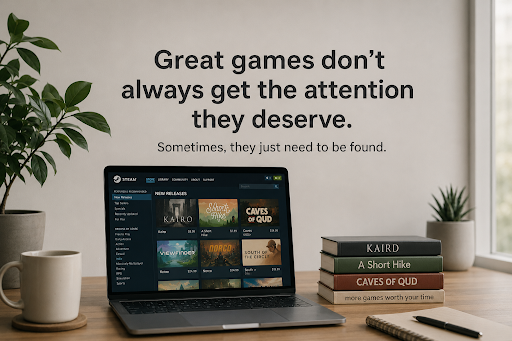
The algorithm not surfacing a game isn't the same thing as the game not deserving to be there. That distinction matters more than it currently gets acknowledged - both for the developers making things worth playing, and for the players who never find out those things exist.
Next time you scroll past something with 40 reviews and a 90% score, it might be worth the click.