Disclosure: This is a paid guest post. The author or an affiliated third party paid for its publication, and the article may contain promotional links. The views and opinions expressed are those of the author and do not necessarily reflect those of GameTyrant or its editorial staff.
Disclaimer: The following content contains references to gambling, casinos, and related topics.
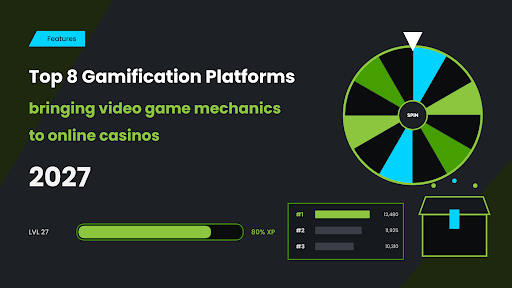
Daily quests. Battle passes. A loot box that pops after a tough boss fight. If you've sunk a few hundred hours into any live-service game, you know exactly how those hooks feel, and you probably know which ones you actually enjoy versus the ones that feel like homework.
Online casinos noticed too. Over the last few years, the average slot lobby has quietly picked up XP bars, weekend tournaments with live leaderboards and a wheel you can spin once a day for a small prize. Most of that isn't coded by the casino itself, though. It comes from gamification platforms: B2B software that sits around the games and adds the progression layer gamers already know by heart.
So which providers are worth watching going into 2027? We looked at eight of them, what mechanics they ship, how deeply they plug into the rest of a casino's tech and where each one fits best.
Why casinos keep borrowing from your favorite games
None of this started in casinos. Wharton professor Kevin Werbach, co-author of For the Win, describes gamification in a World Economic Forum essay as lifting design pieces like levels, achievements, points and leaderboards out of games and dropping them into activities that aren't games at all. Your language app's streak counter is one example. So are the stars on your coffee shop loyalty card.
Big brands bought in early. Back in 2013, more than 70% of Forbes Global 2000 companies told surveyors they planned to use gamification for marketing and customer retention, according to Knowledge at Wharton.
Casinos had a more specific problem. A slot spin is over in about three seconds and leaves nothing behind. Win or lose, there's no sense of progress, and players with nothing to come back for usually don't. Month-to-month retention across the industry tends to sit somewhere around 30-35%, which means most new players are gone within weeks.
A progress bar sitting at 80% changes that math a little. You've seen it in your own habits. You log in "just to finish the daily," one match turns into three, and by the time you look up it's been an hour and the pizza's gone cold.
One thing gamers should know up front: these features live around the games, not inside them. A slot pays out at the same RTP whether you're halfway through a mission or not. The platform changes why you come back, not the odds once you're there.
What actually separates one gamification platform from another
Here's the thing. Nearly every provider on the market now offers some version of tournaments and a bonus wheel, so a feature checklist won't tell you much. The real gaps show up in less obvious places:
How mechanics feed each other. Can a top-10 tournament finish drop a loot box, and can that loot box contain a lottery ticket? Chaining is where the "one more session" feeling comes from.
Who can change the rules. If a CRM manager needs a developer ticket to swap a wheel prize, a weekend campaign ships the following Thursday.
Whether gamification shares player data with the CRM and payments stack directly or through a third-party connector.
Anti-abuse controls, because bonus hunters will find a loose rule within hours.
Pricing, which mostly comes down to whether the mechanics are part of the platform fee or billed as an extra module.
Keep those five in mind as you read the list. We weighed depth of mechanics first, then how much an operator can change without a developer, and price came last.
The 8 gamification platforms we'd shortlist for 2027
1. Kanggiten
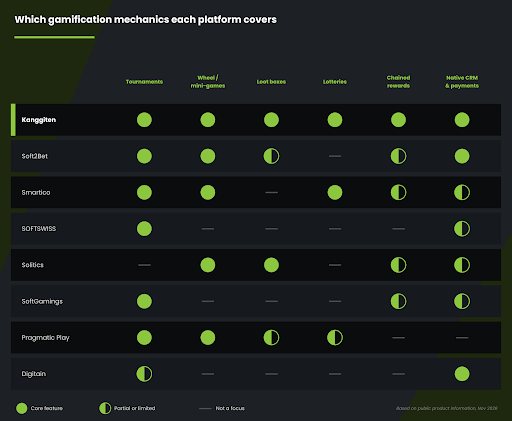
If you want the closest thing to a full game reward economy inside a casino back office, start here. The Kanggiten gamification platform bundles five core mechanics: a flexible bonus system, tournaments with real-time leaderboards, lotteries, a wheel of fortune and loot boxes with hidden contents.
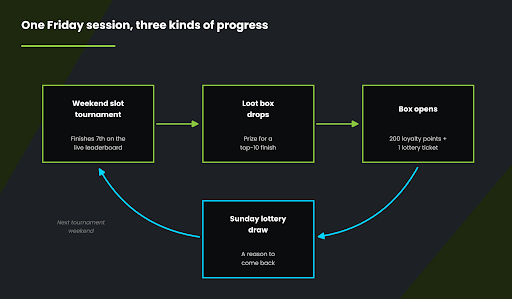
Connection is the big deal. A tournament result can trigger free spins, a bonus or a loot box, while a single wheel spin can hand out loyalty points or a loot box entry. Lottery tickets can be tied to deposits, gameplay milestones or lifecycle events, and the draw itself issues follow-up rewards. It's the same loop you'd find in a good RPG, where nothing you do is wasted because every reward feeds into the next system.
Picture a regular on a Friday night. She finishes 7th in a weekend slot tournament, which drops a loot box. Inside are 200 loyalty points and a ticket for Sunday's lottery draw. One session moved her forward in three places, and now she has a reason to come back on Sunday. Building that loop across three separate vendors is painful. Here it's a handful of settings in one back office.
The operator side is just as practical. Campaign rules, reward values, eligibility, timing, limits and targeting all sit in the back office, so the CRM team doesn't wait on developers for routine changes. Anti-abuse rules and campaign budgets are built into the bonus engine, which matters more than most teams expect in week one. Gamification also shares player data natively with Kanggiten's CRM, analytics and payments modules, with no middleware in between, and you can A/B test mechanics across funnel stages and segments.
The numbers Kanggiten publishes are strong. The company reports up to 70% registration-to-deposit conversion and up to 39% retention, against the 30-35% industry average mentioned earlier, plus ARPPU of up to €1,000 a month across its portfolio. The platform handles 7M+ monthly transactions at 99.9% uptime across 50+ active brands, backed by more than 10 years of B2C operations. To its credit, Kanggiten openly says results depend on traffic source, segment and bonus conditions, which is an honest caveat you don't always see.
Two more details push it to the top of this list. Full casino launch or migration, gamification setup included, takes 2-4 weeks with a dedicated account manager and 24/7 support. And every gamification mechanic is included in the core platform, with no separate module fee. For a new brand trying to hit tier-1 countries without a huge dev team, that combination is hard to beat.
2. Soft2Bet
Soft2Bet takes the most literal approach to "video game mechanics" of anyone here. Its MEGA system (short for Motivational Engineering Gaming Application) is less a set of promo tools and more a collection of actual mini-games. There's a real-time claw machine, a world-building game called MEGA Builder and MEGA11, a football manager game for sportsbook players.
Operators can tune each engine by reward type, bonus trigger, player segment and difficulty level. MEGA also won Product Launch of the Year at the 2025 Global Gaming Awards EMEA, so the industry clearly rates it. Soft2Bet says players spend 20-30 minutes inside MEGA Builder before heading back to the main lobby.
The trade-off is control. You're largely working with Soft2Bet's own game worlds rather than shaping mechanics around your brand, and making those worlds feel native to a different visual identity takes real design work. Brilliant for players who love a meta-game, slightly heavier for an operator who wants quick back-office tweaks.
3. Smartico
Smartico started from CRM and grew a deep gamification module on top. You get missions, levels, badges, points, tournaments, jackpots and a marketplace where players spend points on bonuses or free spins. Mini-games include Spin the Wheel and Scratch & Catch, a digital take on scratch cards.
Its best trick is mission dependencies. A sportsbook could start with "bet on any football match," and finishing it opens a chain of missions specific to the player's favorite league. That's very close to a quest tree in a modern RPG. In 2025 Smartico also partnered with platform provider Vegangster to bring AI-driven segmentation for missions, leaderboards and mini-games to that platform's operators.
Smartico plugs into almost any casino platform, which is great if you're already locked into a different provider. The catch is that it's another vendor, another contract and another integration to maintain. Bonuses and wallets still live in your main platform, so every reward travels through an API rather than staying in one system.
4. SOFTSWISS
SOFTSWISS is strongest where competition and big prizes meet. Its Tournament Tool, part of the SOFTSWISS Game Aggregator, lets operators set up a campaign in roughly 30 minutes, run unlimited tournaments at the same time and include any casino game without asking the game provider for approval. Live games and crash games are supported, and prizes can go well beyond cash. Think luxury cars, travel or branded merch.
SOFTSWISS reports a 22% increase in average daily bets per user with the Tournament Tool. The separate Jackpot Aggregator, live since 2021, adds progressive, fixed-prize and mystery jackpots at local, global and network level.
Where it falls a bit short is breadth. Tournaments and jackpots are excellent, but missions and loot-style rewards play a smaller role, and you get the most value only if you're already on the SOFTSWISS aggregator or casino platform.
5. Solitics
Solitics is built around speed. The platform claims it captures and reacts to player actions within 0.8 seconds, and its Smart Gamification module drops widgets right into that flow: scratch cards, surprise boxes, spinning wheels and personal missions.
The company says these widgets average 45% engagement rates across brands. For sportsbook players, Solitics also streams live match updates and goal alerts into the experience, matched to each fan's favorite teams.
Think of it as the in-the-moment layer. It's excellent at catching a player during a quiet stretch between spins and handing them something to do. Long-term progression, like seasonal tournaments or a multi-month level system, isn't really its focus, so most operators pair it with a separate tournament or loyalty tool. That means one more contract and one more dashboard to check every morning.
6. SoftGamings
SoftGamings offers the most classic RPG-style setup here. Its BonusSystem runs as a standalone product with an open API, so operators can add it without switching platforms. It covers experience points, customizable player levels, achievements, tournaments, quests and jackpots.
The highlight is the loyalty shop. Players trade points for free spins, game credits, exclusive bonuses or even physical goods, which is a lot like spending in-game currency at a vendor. That sense of choice tends to feel better than getting a random bonus you'd never have picked.
It's a dependable system with a long track record. It's just less flashy than the mini-game-heavy options above, and most of the visual polish on the player's screen is left to the operator's own front-end team.
7. Pragmatic Play
Pragmatic Play isn't a platform at all. It's one of the biggest game studios in the industry, and it ships its own gamification layer inside its games. Its in-house promo toolkit, running since 2019, adds in-game tournaments, random prize drops and free round bonuses with zero development work for the operator.
Its flagship network promotion, Drops & Wins, is a provider-funded prize pool that has paid out more than €95 million since 2020, with about €2 million a month in slot prizes as of mid-2025. In August 2026 the studio added Collect & Win, which brings set-collection mechanics like Text Drops and Card Drops alongside its existing Wheel Drops. If you ever chased a full sticker album as a kid, you'll get the appeal in about two seconds.
For players, it's fun and easy to spot. For operators, the limit is obvious. Everything works only inside Pragmatic Play titles, so it can't tie progress across your whole lobby or talk to your CRM. It's a great add-on, not a foundation.
8. Digitain
Digitain built its name on sportsbook technology, and its Centrivo platform now combines betting and casino in one system. Gamification sits on top through tools like the Booster promotional engine, sport jackpots, instant cashback and Sportchat, a community feature where bettors talk during matches.
The company is clearly leaning in. At a 2025 trade show, Digitain's Iain Hutchison called gamification its main way to stand out from legacy B2B providers, with features pitched at 20-30-year-old players and at moving casino-first players toward sports betting.
That sportsbook DNA is both the strength and the limit. Cross-selling between verticals works well, but the casino-side progression toolkit is newer and narrower than what dedicated gamification providers offer. Missions, loot-style rewards and long-term levels are where it still has catching up to do.
Picking a gamification platform without rushing it
Shigeru Miyamoto, the creator of Mario and Zelda, is often credited with a line every game studio knows: "A delayed game is eventually good, but a rushed game is forever bad." It applies here more than you'd think.
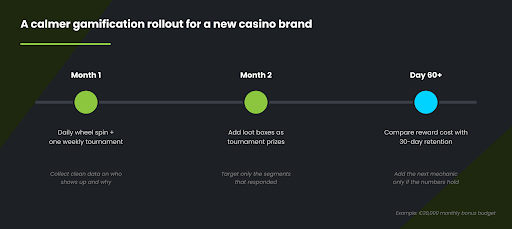
The most common mistake we see is switching on every mechanic at launch. Fifteen promos on day one just turns the lobby into a pop-up storm, and players tune all of it out. Say you're opening a new brand with a €20,000 monthly bonus budget. Start small. One daily mechanic, like a wheel, plus one weekly tournament is plenty for the first month, because it gives you clean data on who shows up and what keeps them around. Loot boxes can wait until month two. Before adding anything after that, compare reward cost against 30-day retention.
It also helps to ask any provider three blunt questions. Where does the player data live? Can your CRM team edit a live campaign on a Saturday night without paging a developer? And is gamification billed separately once you grow? The answers usually tell you more than a demo will.
Where the fun should stop
Gamers already know the loot box debate, and casinos aren't exempt from it. Good gamification asks players to try a new game or come back tomorrow. Bad gamification asks them to raise their stakes to finish a mission.
The better setups rank tournaments by biggest multiplier rather than total wagered, so someone playing with pocket change can still top the board. They also keep deposit limits, session reminders and self-exclusion one tap away instead of three menus deep. Rewards should stay what they are in any decent game: a nice extra on a night of entertainment, never the reason to chase a loss.