Disclosure: This is a paid guest post. The author or an affiliated third party paid for its publication, and the article may contain promotional links. The views and opinions expressed are those of the author and do not necessarily reflect those of GameTyrant or its editorial staff.
Disclaimer: The following content contains references to gambling, casinos, and related topics.
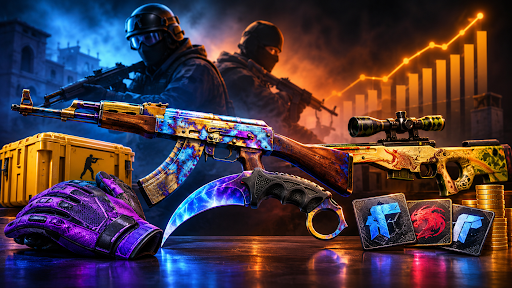
Exploring weapon skins in Counter-Strike 2 can be surprisingly complicated for someone unfamiliar with the game's cosmetic system. Two versions of the same weapon finish might look almost identical but have different prices. One may be classified as Factory New, while another carries a Field-Tested label and a decimal number that experienced collectors pay close attention to.
Unlike many games where every copy of a cosmetic item shares the same appearance, Counter-Strike introduces individual characteristics that distinguish one item from another. Rarity, numerical wear values and pattern variations all contribute to this diversity.
Understanding how these elements work can make exploring the CS2 skin economy considerably easier, whether you are interested in building a personalized inventory or simply learning more about digital collectibles.
What Defines a CS2 Weapon Skin?
Every weapon finish in Counter-Strike has a recognizable design, but individual copies can differ in several important ways.
Browsing a CS2 item catalog reveals the extent of this variety. Even within a single weapon category, players can discover finishes with different rarity classifications, available wear conditions and artistic styles.
Rarity describes an item's classification within the game's cosmetic system, while its float value determines its numerical wear. Wear levels translate those numerical values into recognizable condition labels, such as Minimal Wear or Field-Tested.
Other characteristics, including pattern variations, StatTrak counters and applied stickers, can introduce further distinctions.
As explained in this overview of CS:GO and CS2 skins, Counter-Strike offers several categories of cosmetic items. Understanding their individual characteristics is the next step toward making sense of how weapon finishes differ.
How the CS2 Rarity System Works
Counter-Strike uses a color-coded rarity system to classify weapon finishes. These colors appear throughout the game's inventory system and across external marketplaces.
Players looking to buy CS2 skins will regularly encounter these classifications, making it useful to understand what they represent before comparing individual items.
The six standard weapon skin rarity grades are:
Consumer Grade — white.
Industrial Grade — light blue.
Mil-Spec Grade — blue.
Restricted — purple.
Classified — pink.
Covert — red.
Knives and gloves obtained as rare special items from cases are associated with a gold-colored category. There is also the exceptional Contraband classification, famously associated with the M4A4 Howl.
Although higher rarity grades generally indicate lower availability within the original distribution system, rarity alone does not determine an item's overall scarcity.
An older Restricted skin from a collection with limited availability may be harder to obtain than a newer Classified finish from a widely distributed case.
Rarity also says little about visual quality. A player who appreciates minimalist weapon designs might find an inexpensive Mil-Spec finish more appealing than an elaborate Covert skin.
The classification system provides useful information about how items are organized, but it should not be interpreted as a universal ranking of their desirability.
What Is a Float Value?
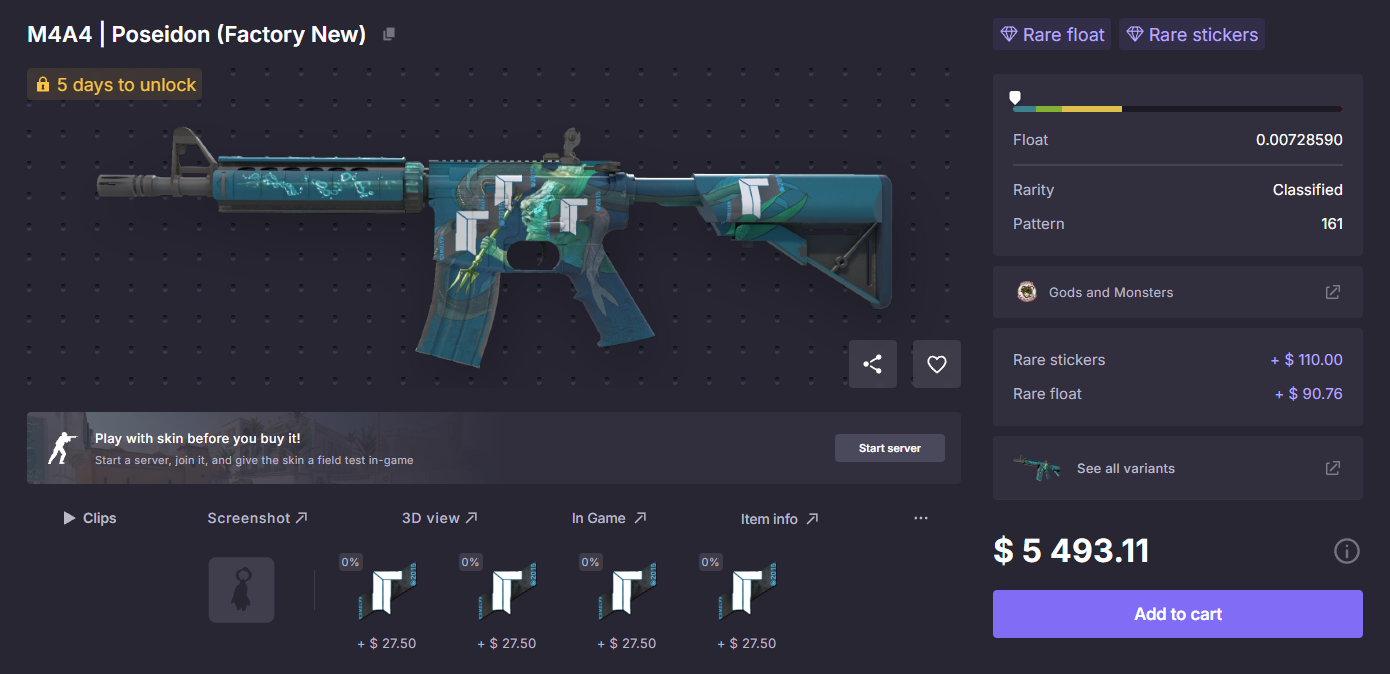
Every CS2 weapon skin has a numerical float value that determines its level of wear. The overall scale extends from 0 to 1, with lower values generally representing cleaner finishes.
Consider two copies of the same weapon skin. One has a float value of 0.164, while the other has a float of 0.352. Both are classified as Field-Tested, but the first may display considerably fewer scratches or retain more of its original brightness, depending on the finish.
This explains why two items with the same condition label can look different when inspected individually.
One particularly important detail is that float values remain unchanged through regular gameplay. Firing a weapon, completing matches or keeping a skin in your inventory for several years will not cause its condition to deteriorate.
A Factory New skin does not gradually become Minimal Wear, and a Field-Tested finish will not become Battle-Scarred through repeated use.
The assigned wear is a permanent characteristic of the individual item rather than a record of how frequently the weapon has been used.
The Five Wear Levels in Counter-Strike 2
The float scale is divided into five condition categories, each covering a specific numerical range.
Factory New (0.00 to below 0.07) represents the lowest wear category. These skins generally retain more of their original artwork and surface appearance, although some finishes can still display minor imperfections.
Minimal Wear (0.07 to below 0.15) includes items with relatively limited deterioration. Depending on the design, a Minimal Wear skin may look remarkably similar to a Factory New version during ordinary gameplay.
Field-Tested (0.15 to below 0.38) covers a particularly broad float range. A skin near the lower end of this category can look noticeably different from another approaching the upper boundary.
Well-Worn (0.38 to below 0.45) generally introduces more visible deterioration. Scratches, fading and changes in brightness may become more pronounced.
Battle-Scarred (0.45 to 1.00) represents the highest wear category. Some finishes lose substantial portions of their artwork, while others develop darker or more distinctive appearances that certain collectors actively seek.
These categories simplify the process of comparing skins, but they cannot fully communicate how an individual item looks. Inspecting the weapon remains important, particularly when considering finishes that respond differently to wear.
Why Some Skins Cannot Be Factory New
Although the overall float scale runs from 0 to 1, individual weapon finishes have their own permitted float ranges.
The AWP Asiimov, for example, has a float range of approximately 0.18 to 1.00. This means that even its cleanest obtainable versions belong to the Field-Tested category. Factory New and Minimal Wear versions do not exist.
The AK-47 Redline has a different limitation. Its float range extends from approximately 0.10 to 0.70, making Minimal Wear its cleanest available condition.
These restrictions are part of the original design and configuration of each weapon finish.
Someone unfamiliar with float limits might spend time searching for a Factory New AK-47 Redline without realizing that such an item cannot exist.
It also means that a float value considered ordinary for one skin could represent an exceptionally clean example of another.
Understanding the available range of a specific finish provides more useful context than applying the same condition expectations to every weapon skin.
Why Wear Affects Different Finishes Differently
Not every weapon skin develops the same type of visible deterioration as its float value increases.
Some finishes display scratches that expose the underlying surface of the weapon. Others become progressively darker, while certain designs show changes in brightness, texture or color intensity.
The Desert Eagle Blue Steel, for instance, can develop darker surface tones as wear increases. The AWP Asiimov, on the other hand, can display substantial deterioration across its recognizable white-and-orange artwork.
These differences are connected to how weapon finishes are created and applied to their three-dimensional models. Valve's official Counter-Strike Workshop provides information about the different techniques available to community artists.
For players choosing cosmetics primarily for their appearance, the practical consequence is straightforward: a lower float is not always worth paying more for.
A Field-Tested finish with subtle visual deterioration may suit your preferences better than a more expensive Minimal Wear version of another design.
The best way to evaluate these differences is to inspect individual items and pay attention to the surfaces that remain visible during normal gameplay.
Understanding Pattern Variations
Wear values are only one source of visual variation in Counter-Strike.
Certain weapon finishes also use pattern templates that influence how their textures are positioned across the weapon model.
The AK-47 Case Hardened is a well-known example. Different pattern templates produce varying distributions of blue, gold and other colors across the weapon's surface.
Fade finishes offer another example, with their pattern variations influencing how gradient colors appear on individual items.
Consequently, two skins with the same rarity classification, wear category and almost identical float values can still look noticeably different.
Pattern variations are especially relevant to collectors interested in particular color distributions or unusual appearances. However, their significance varies considerably between weapon finishes.
For many illustrated skins, the overall artwork remains broadly consistent between individual copies, making detailed pattern research less important for everyday customization.
How These Characteristics Work Together
Imagine that you are comparing two AK-47 Redline skins.
Both belong to the Classified rarity category. One has a float value of 0.14, placing it within Minimal Wear, while the other has a float of 0.16 and is classified as Field-Tested.
Despite their different condition labels, the numerical difference between them is relatively small. During ordinary gameplay, their appearances might be similar enough that the distinction offers little additional value to you.
An experienced collector, however, might specifically want a Minimal Wear example and consider the condition difference important.
Neither preference is unreasonable. The two players simply have different objectives.
This is why understanding skin characteristics is more useful than memorizing which categories are considered desirable. Rarity, float, condition and patterns provide information that helps players evaluate an item according to their own priorities.
Understanding Skins Beyond Their Price Tags
Counter-Strike's cosmetic system gives players considerably more variety than a simple selection of fixed weapon designs.
Rarity classifications explain how items are categorized, float values describe their numerical wear, and pattern variations create additional possibilities for individual expression and collecting.
These characteristics can influence an item's appearance and market value, but their importance ultimately depends on what someone wants from their inventory.
A player interested in personalizing a favorite weapon may prioritize artwork and affordability, while a specialist collector might focus on exceptional float values or unusual patterns.
Becoming familiar with these distinctions makes it easier to explore the CS2 skin ecosystem without feeling that the most expensive or rarest option must also be the most enjoyable one.