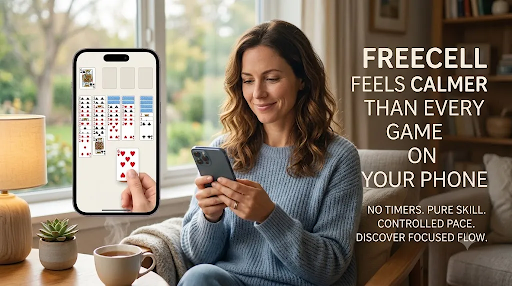
Open any app store, and you’ll find games designed to grab your attention and keep it. Bright colors flash. Timers tick. Notifications pop. Leaderboards push you to compete. Even thoughtful games like chess can turn stressful with online ratings, clocks, and the pressure to perform, but freecell feels calmer than every game on your phone.
FreeCell does the opposite. It asks for your focus, rewards careful thinking, and leaves you feeling settled instead of drained. Whether you are looking for card games for 3 people to play offline with friends or seeking a solo mental reset, understanding why this classic layout feels so calming can completely change how you approach your screen time.
What Makes FreeCell More Calmer and Different From Other Games

FreeCell is a game of solitaire. In this game, the player uses a regular deck of 52 playing cards. At the beginning of the game, all cards are placed face up in eight piles. The player also has four free cells for temporary storage and four foundations.
The key differences from most phone games:
Every card is visible from the start. No hidden information.
Almost every deal can be solved with skill. Luck plays almost no role.
There is no timer, no opponent, and no penalty for taking your time.
You control the pace completely. You can pause, undo, and think as long as you need.
This design creates a quiet space where the only challenge is the one you choose to solve.
The Science Behind the Calm: Flow State
Psychologist Mihaly Csíkszentmihalyi described a mental state called “flow.” In flow, challenge and skill are perfectly matched. You become fully absorbed. Time seems to disappear. Worries fade into the background.
FreeCell is unusually good at creating this state. Since the goal is straightforward (moving all the cards to the foundations), you have an open board and have to think ahead to make several moves; your brain does not get overloaded. The planning and decision-making part of the brain (prefrontal cortex) remains stimulated, while the stress part (amygdala) relaxes.
Most phone games work against flow. They provide bright rewards, immediate urgency, and frequent distractions. Even in chess games, there are often clocks and rankings involved to put the mind into alertness mode. FreeCell encourages the complete opposite, requiring one's full attention but not under any external pressures.
FreeCell vs Typical Phone Games

| Feature | FreeCell | Candy Crush / Match-3 | Competitive / Endless | Chess (phone/online) |
|---|---|---|---|---|
| Time pressure | None | High | High | Often high |
| Skill vs luck | Pure skill | Luck + boosters | Mixed | Pure skill |
| Ads & notifications | Easy to avoid | Frequent | Frequent | Possible |
| Competitive pressure | None | Leaderboards | Rankings | Ratings & opponents |
| Session control | Full control | “Just one more” | Long sessions | Rating-driven |
| After-play feeling | Calm | Agitated/guilty | Fatigued | Tense/critical |
The key distinction is not that FreeCell is easy. In fact, complex deals require serious mental effort. The difference is that the challenge feels fair, private, and entirely under your control.
Chess remains a masterclass in strategic depth, but the competitive layer built into most mobile chess platforms often brings back performance anxiety. FreeCell sidesteps that issue completely by keeping the experience entirely self-contained. Learning a solid freecell strategy helps you appreciate this balance, as the game rewards thoughtful analysis rather than fast reflexes.
Mental Health and Cognitive Benefits
Players and researchers notice several consistent effects:
Stress reduction: Thinking about an ordered problem prevents the stress cycle. Many play a quick round of FreeCell like others take a quick walk or deep breath.
Better focus and working memory: You have to keep in mind the various possibilities of moves while keeping track of free cells. This mental workout trains your concentration without the fatigue induced by highly stimulating or challenging games.
Sense of accomplishment without pressure: Solving a tricky layout gives you dopamine because of achievement, not due to streaks, purchases, or gaining points in rating.
Mindfulness in motion: You concentrate on playing the cards. There is no requirement for sit in the lotus position or have your mind blank. The activity itself becomes the center of your attention.
Such mental rewards become most evident when you play with purpose rather than rushing through your transactions. If you ever want a variation with slightly tighter constraints, exploring Bakers Game offers a similar strategic puzzle with slightly different stacking rules.
How to Play FreeCell for Maximum Calm
Set the scene: Put your phone on Do Not Disturb or airplane mode. If the app has a timer or score display, hide it. Some players like soft classical music or silence.
Start with intention: Tell yourself this is a 5- to 15-minute reset, not a competition against yourself.
Think before you move: Scan the whole board. Look for cards that block important sequences. Use free cells carefully; each one you fill reduces your flexibility.
Embrace undos: Making a mistake and correcting it is part of the process. There is no punishment and no opponent to exploit your error.
Stop when you feel settled: You do not need to finish every game. Sometimes the calm arrives halfway through. Play once or twice a day if you like. Consistency matters more than length.
Real Experiences
Many people discover FreeCell during stressful periods. In the opinion of one musician, the process of trading has proven to be an excellent meditation exercise for him while he was on tour. He used to play it to relax his mind after hectic performances.
For those who enjoy exploring related layout styles, looking into eight off solitaire provides a fresh variation that uses similar open-card mechanics while tweaking the number of reserve cells available.
Best Places to Play FreeCell Today
Look for versions that stay close to the original rules and keep distractions low:
Browser versions such as those on Solitaired or FreeCell.game (clean, Fast, one-click start).
Microsoft Solitaire Collection (includes FreeCell and works across devices).
Well-reviewed “calm” or classic FreeCell apps that let you turn off timers, scores, and music if you prefer pure silence.
Avoid versions that add artificial difficulty, daily streak pressure, or constant pop-ups. The calm comes from the pure game, not from extra features.
Most phone games stimulate or compete. FreeCell simply engages. That difference is why it so often leaves people clearer and calmer. Next time your mind feels scattered, try five or ten minutes of FreeCell. You may find focused calm without the noise.