Performance marketing has always been a game of volume, but the introduction of generative AI has fundamentally shifted the bottleneck from asset production to asset refinement. In the early days of text-to-image adoption, the goal was simple: generate a high volume of "good enough" images and see what stuck in the Facebook Ad Manager or TikTok Creative Center. However, as audiences grow accustomed to the "AI look" and platform algorithms reward higher-quality engagement, the "one-shot" generation approach is showing its cracks.
For teams managing high-spend accounts, the efficiency drain isn't found in the initial prompt. It’s found in the thirty minutes spent trying to "re-roll" a prompt because the model put the right product in the wrong lighting, or used the perfect model but the wrong seasonal background. To maintain a sustainable ROI, the workflow must shift away from total generation and toward surgical, regional modification.

The Sunk Cost of the 'Generate Again' Loop
In a traditional creative operations pipeline, a 90% perfect image is an asset. In an undisciplined AI workflow, a 90% perfect image is often treated as a failure. When a performance marketer sees a generated image with the correct composition but a minor flaw—perhaps an awkward hand placement or an off-brand color on a piece of clothing—the instinct is often to adjust the prompt and hit "generate" again.
This "regenerate" loop is a silent killer of creative velocity. Every time a model generates a new image from scratch, it introduces thousands of new variables. The geometry of the subject changes, the lighting shifts, and the brand's core product—which must remain consistent—is re-interpreted by the latent space. This lack of control makes it nearly impossible to build a cohesive ad set where the only changing variable is the call-to-action or the seasonal context.
The shift toward using an AI Photo Editor represents a move toward systems-thinking. Instead of asking the AI to recreate the entire universe of the image every time, marketers are beginning to treat images as modular environments. If the core subject works, you keep it. If the background needs to transition from "summer beach" to "autumn trail" for a Q3 pivot, you don't throw away the successful subject; you change the region.
Regional Refinement: A Systems-Minded Approach to Inpainting
Regional editing, often referred to as inpainting or masked editing, allows a marketer to define specific "variables" within an image. From a performance standpoint, this is the visual equivalent of A/B testing a single line of copy in an email subject line. By using a sophisticated AI Photo Editor, creative teams can isolate specific elements—such as a model's outfit, the object they are holding, or the architectural style of the background—and iterate on them independently.
This approach solves the demographic fatigue problem. A single high-performing base image featuring a specific product can be localized for ten different global markets by swapping regional backgrounds or adjusting the ethnic features of the model, all while keeping the product geometry and lighting consistency intact. This isn't just a time-saver; it’s an algorithmic strategy. When a platform's AI identifies a high-performing "winning" composition, maintaining 80% of that composition while swapping the 20% that caters to a specific niche is far more effective than introducing a completely new, untested visual.
However, it is important to acknowledge that this process isn't a "magic button." There is a distinct learning curve in understanding how to mask effectively and how much "denoising strength" to apply. If the strength is too low, the change is imperceptible; if it’s too high, the new element won't "seat" properly into the original image's perspective.
The Edge Cases: When Inpainting Breaks the Workflow
While regional editing is the superior path for scale, it has technical boundaries that every operator should respect. One of the primary limitations is global illumination. When you use an AI Photo Editor to drop a new object into an existing scene—say, a coffee mug onto a wooden table—the AI must calculate how the existing light source should reflect off that mug and, more importantly, how the mug should cast a shadow back onto the table.
Current models are becoming remarkably good at this, but they aren't perfect. We often see "texture seams" where the high-frequency detail of an inpainted area doesn't perfectly match the grain or noise of the original image. If you are working with a 4K base image and inpaint a small section, that section may appear slightly softer or differently "grained" than the surrounding pixels.
Furthermore, there is a lingering uncertainty regarding complex physical interactions. If your goal is to change a model's shirt while their hair is blowing across their chest, most regional editing tools will struggle with the fine transparency of the hair strands against the new fabric. In these cases, the "masking" becomes a manual chore that may negate the speed of the AI. Knowing when an image is "too complex" for a quick regional fix is a critical skill for any creative lead.
Integrating Iterative Tools into the Production Pipeline
To build a repeatable pipeline, the workflow should be tiered. You cannot expect a single tool to handle everything from the first "dream" to the final export without human intervention. A production-ready pipeline usually follows a three-stage process:
Stage One: Establishing the Golden Image
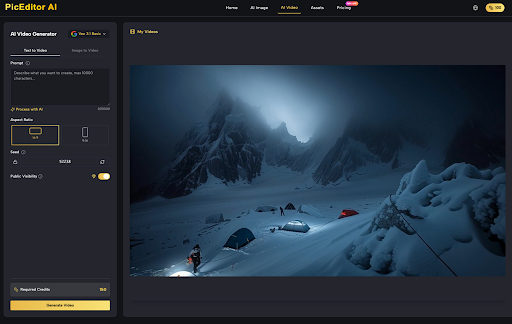
The goal here is to create the "anchor" for your campaign. This involves using high-fidelity models like Flux or Nano Banana within your Pic Editor AI to generate a high-resolution, compositionally sound base. You aren't looking for perfection in every detail yet; you are looking for the right "bones"—lighting, perspective, and brand-appropriate aesthetics.
Stage Two: Regional Variation and Correction
Once the Golden Image is approved, it moves to the regional editing phase. This is where the heavy lifting of performance marketing happens. You use inpainting to swap product colors for different SKUs or to adjust the background to match different seasonal promotions. This is also where you fix the "hallucinations"—the extra fingers or the nonsensical text on a background sign—that would otherwise disqualify the image from a professional ad placement.
Stage Three: Standardization and Upscaling
The final stage is purely technical. Because AI-generated regions can sometimes lose resolution compared to the original, a final pass through an AI upscaler or an "image-to-image" refinement layer at a very low denoising strength can help unify the textures. This ensures that when the ad is viewed on a high-resolution mobile screen, it doesn't look like a patchwork of different image qualities.
The Commercial Reality of AI-Led Iteration
The transition from a "generative-first" to an "edit-first" mindset has a measurable impact on the bottom line. When creative teams stop chasing the "perfect prompt" and start using an AI Photo Editor to manufacture the perfect asset, the cost per creative drops significantly. More importantly, the shelf life of a high-performing asset is extended. You no longer have to retire a winning ad just because the season changed; you simply update the season within the ad.
This shift is also changing the talent landscape. The most valuable members of a creative team are no longer those who can write the most poetic prompts. The new "power users" are visual editors who understand spatial layout, lighting direction, and the technical nuances of masking. They are essentially digital directors who treat the AI as a highly skilled but literal-minded production crew.
For performance marketers, the recommendation is clear: identify your top three performing ads from the last quarter. Instead of trying to find "the next big thing" through random generation, use regional editing to create five variations of those winners. Change the environment, change the product color, or change the demographic cues. In the world of high-scale advertising, surgical iteration will almost always outperform unguided creation.