Disclosure: This is a paid guest post. The author or an affiliated third party paid for its publication, and the article may contain promotional links. The views and opinions expressed are those of the author and do not necessarily reflect those of GameTyrant or its editorial staff.
Disclaimer: The following content contains references to gambling, casinos, and related topics.
Every online payment answers one question: has the money really moved? A card processor answers with messages passed between banks, while a blockchain answers with blocks added by a network. The two methods verify a transaction in different ways, and those differences explain most of the waiting times, reversals and disputes seen around digital entertainment.
Readers who compare card checkout with crypto-friendly services such as ca.parimatch.com/en/bitcoin-casino often ask who confirms a payment, and the answer differs sharply. That question matters for any platform serving the Canada sports betting market, where deposits are expected to appear quickly while withdrawals are expected to be final.
How a Card Payment Is Verified
Card payments rely on a chain of trusted parties: the merchant, the processor, the card network and the issuing bank. The issuer approves or declines at the moment of purchase, and money moves between banks afterwards. Verification is therefore reversible by design, because ClearSale notes that cardholders have up to 120 days to file a Visa chargeback in most cases. In practice there are two stages: authorization is the issuer's yes or no, and settlement is the later transfer of funds, so a purchase can look complete to the user before the money has reached the merchant.
How a Blockchain Verifies a Transfer
Bitcoin has no issuer. A transfer is broadcast, collected into a block by miners and then buried under later blocks. According to the Bitcoin Wiki, the chance of a new block arriving is about 63 percent within 10 minutes, about 95 percent within 30 minutes and about 99.7 percent within 60 minutes.
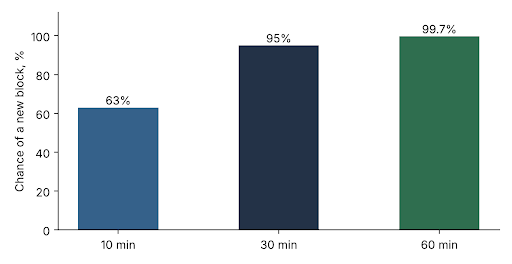
Figure. Chance that at least one new Bitcoin block arrives within a given time, percent. Source: Bitcoin Wiki, Confirmation page.
The wiki's classic default is 6 confirmations, which at roughly 10 minutes per block means about an hour (author's calculation). It calls the number of 6 arbitrary and says merchants and exchanges should set their own thresholds. Each confirmation is another block built on top of the one holding the transfer, so rewriting history gets harder with every block. The wiki puts 60 confirmations at under 1 percent odds of a successful double spend against an attacker holding 40 percent of hashing power.
Side by Side: Who Can Undo a Payment
| Question | Card processor | Blockchain |
|---|---|---|
| Who verifies? | Issuing bank and card network | Network nodes and miners |
| How long to trust it? | Approval in seconds, dispute right up to 120 days | About 1 hour at 6 confirmations |
| Who can reverse it? | Bank or card network after a dispute | Nobody, only a new payment sent back |
The windows differ in kind, since one is a dispute right and the other a statistical safety margin. Still, 120 days equals 2,880 hours, which is 2,880 times longer than one hour (author's calculation). Platforms and sports betting sites that accept both rails may therefore apply different rules to each.
Example. Take a hypothetical 200 dollar deposit. By card, it may be approved within seconds and still be disputable months later. By blockchain, it may wait about an hour for six confirmations and then cannot be recalled by anyone.
Card route: faster trust, slower finality.
Blockchain route: slower trust, faster finality.
Refunds: a processor reverses, a platform must send a new transfer.
Expert tip. Before a first deposit, find where the platform explains refunds and failed transfers for each rail. The answer shows who carries the risk when something goes wrong.
Important. Neither rail guarantees any outcome, and rules vary by provider and province. This article is informational and does not encourage gambling.
Two Kinds of Trust
A processor asks users to trust institutions that can fix mistakes, while a blockchain asks them to trust arithmetic that cannot be fixed. Online gaming payments sit between the two, and understanding which kind of verification applies is the first step in judging a payment. Reading the terms for each rail takes a few minutes and removes most surprises.