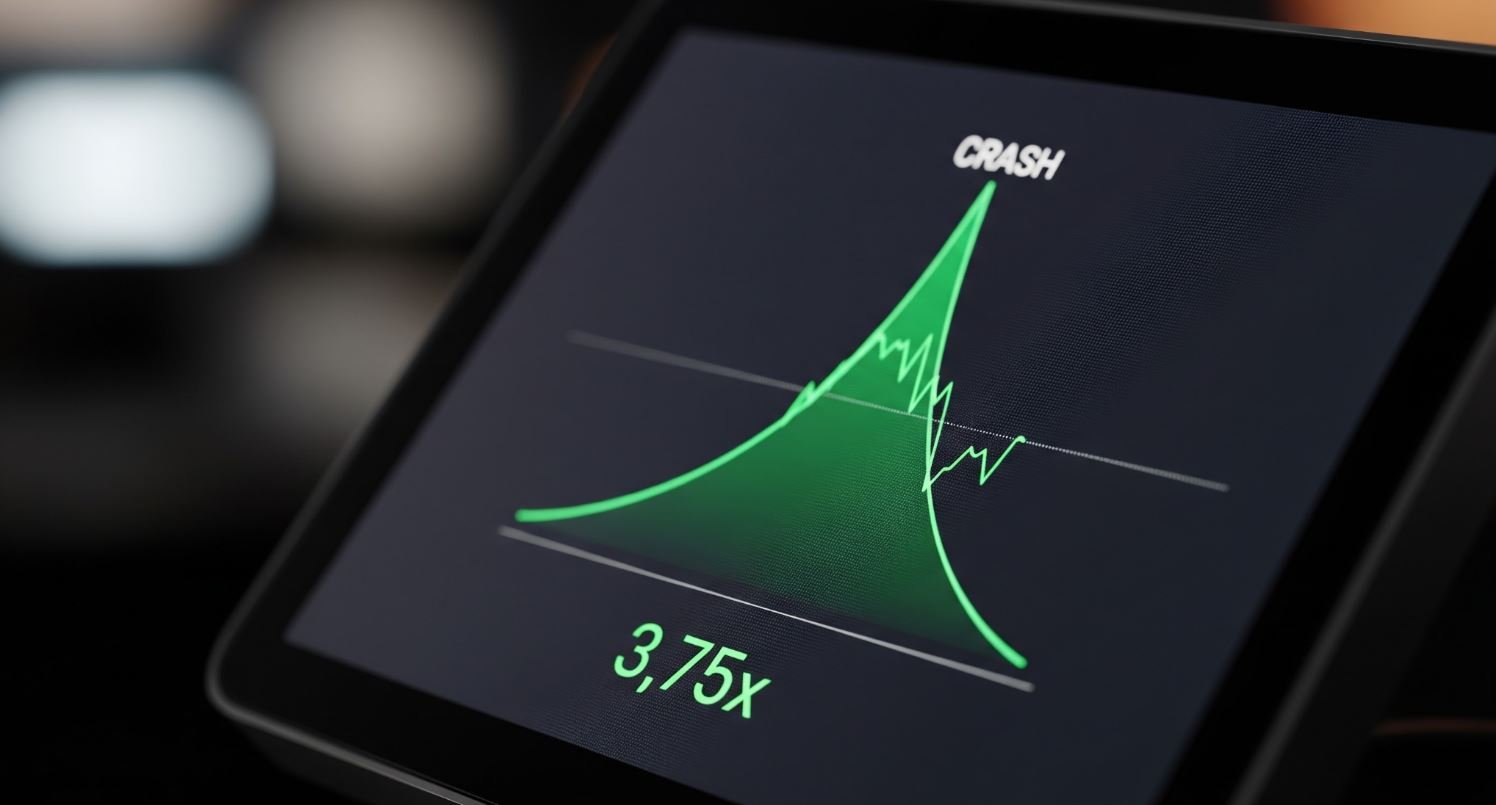
A spin at a slot machine takes three seconds and the player watches the reels. A hand of blackjack takes thirty seconds with decisions. A round of crash gambling takes between two and twenty seconds with the only decision being when to cash out. That speed is the product. It is also the risk. Twenty rounds of Aviator can be completed in two minutes. The same twenty rounds of a slot machine can take ten minutes. The same value of entertainment, fully packed in a fifth of the time, causes the player’s cost to go up if they don’t impose limits.
https://melbet.org.in/ offers multiple crash games including Aviator by Spribe and JetX by SmartSoft Gaming. All of these games use the same core mechanic packaged with different graphics. This section explains the mechanics of the game, what each target cash out multiplier costs, the strategies and the mistakes that turn a two-minute game session into a twenty-minute loss.
How Crash Games Work
Before a round of crash gambling begins, players first place a wager. A multiplier that begins at 1.00x starts increasing, and players choose when to cash out to secure that multiplier. If the multiplier crashes before the player has cashed out, the player loses that round's bet.
The algorithm determines where the multiplier will crash before the round starts, and that crash point is completely random. There simply are no patterns, no sequences, and no trends, hot or cold, that will have any predictive capability. Each round is independent of the previous ones.
The house edge is implemented with crash point distribution. There is a 3%-4% expected value, for the house, of all bets placed in a game after a statistically significant number of rounds, regardless of any previous round outcomes.
Aviator
Aviator is the most popular crash gambling game, developed by Spribe. It has become the most frequented game on Melbet India.
Visual and mechanic
A small airplane takes off, and the player wagers on the plane to cash out. The multiplier continues to increase as the plane climbs. If the plane fully flies away, the player loses the round. The visual design is simple but creates a lot of tension.
Provably Fair
Aviator's system is Provably Fair. The server produces a cryptographically secure hash that will determine the crash point after each round. Players can verify that the hash matches the round's result. This shows that the platform will not change an outcome based on the bets players make. Verification can be completed in under a minute and can be done for any round that has previously occurred.
Just because a system is Provably Fair, does not mean that players will win. It simply means the casino did not cheat in that round, the house edge is still at play. What is really offered with Provably Fair, is the reassurance of no foul play, in addition to the house edge being the only thing working against the player.
Dual panel
Aviator allows players to place two bets on the same round. Each panel has a different cashout target. First panel: cashout at 1.30x. Second panel: cashout at 3.00x. The conservative panel cashing out at 1.30x wins often enough to cover most of the losses incurred from the aggressive panel betting at 3.00x. It does not alter the house edge, but rather reshapes the outcome variation during a betting session.
JetX
JetX was also produced by SmartSoft Gaming, and famously uses an image of a rocket, but instead of a plane. The mechanic is basically the same. The multiplier goes up and the user cashes out before the plane crashes.
Differences from Aviator
JetX generally has a slightly elevated house edge (compared to Aviator) of around 4% to 5% depending on which operators’ version is being played. The house edge for both games is the same, but aesthetics will be the main reason to prefer one over the other.
JetX Along with the regular betting rounds, JetX also offers a jackpot feature. In this situation, a fraction of the bets for that round contributes to a progressively growing jackpot prize. This makes the rounds much more interesting, but the regular rounds will not have any change to the house edge.
Probability of Each Multiplier
At crash games with a house edge of 3% to 4%, the chances for multipliers follow a generally predictable distribution.
1.50x is hit 64% of the time. 2.00x is hit 48% of the time. 3.00x is hit 32% of the time. 5.00x is hit 19% of the time. 10.00x is hit 9.5% of the time. 50.00x is hit 1.9% of the time. 100.00x is hit 0.96% of the time.
These numbers won’t change, regardless of how many bets are made, what the bets are, what time of day, or how many players are betting.
Three Cashout Strategies
Defines the session profile. Each approach offers different cost structures.
Conservative: 1.30x to 1.50x
The player cashes out early. Roughly 64% of rounds end at 1.50x. Wins come in small bursts, and the losses equal the entire bet when the round ends before the player’s target.
With a stake of 100 INR and a total of 20 rounds, the player would have a stake of 2,000 INR. At the 1.50x target, 13 rounds would end at 150 INR each (totaling 1,950 INR). Seven rounds would end at a 100 INR loss (totaling 700 INR). The balance fluctuates. With a presumed session cost of 60 INR, due to the 3% edge, most players would find the session balance and cost satisfactory.
Moderate: 2.00x to 3.00x
With a target of 2.50x, a player would have 20 rounds with 100 INR per round. This would mean 8 rounds end, 12 rounds crash, and an approximate session cost of 80 to 120 INR. The entertainment value is based on the uncertainty of each round.
Aggressive: beyond 3.00x
Fewer than 32% of rounds connect. Long losing streaks interrupted by high payouts. Expected session cost exceeds 150 INR for twenty rounds at 100 INR.
Fifteen failed rounds at 100 INR cost 1,500 INR. One successful round at 5.00x pays 500 INR. The player needs a bankroll sufficient to absorb the losing streaks before a winning round connects.
Session Costs in INR
Twenty rounds at 100 INR with a conservative 1.50x target: 2,000 INR stake, 60 INR expected cost. Two minutes.
Twenty rounds at 100 INR with a moderate 2.50x target: 2,000 INR stake, 80 to 120 INR expected cost. Two minutes.
Twenty rounds at 100 INR with an aggressive 5.00x target: 2,000 INR stake, 150 to 200 INR expected cost. Two minutes.
Twenty rounds at 500 INR with a conservative 1.50x target: 10,000 INR stake, 300 INR expected cost. Two minutes.
The duration stays the same regardless of the strategy. The cost varies based on the cashout target and bet size. Two elements the player has total control over.
Mistakes That Multiply the Cost
Extending the session
The plan states twenty rounds. Round twenty just happens to be the crash. So, one extra round. Then three more rounds. The cost of a session just doubled. This session extended without the player being aware, or without the player actively choosing to extend the session. Setting a maximum round count prior to opening the game and then closing the game when that count is reached is the easiest strategy and the most difficult to enforce.
Raising the target after winning
The player cashed out at 1.50x for ten rounds. Connected on all ten. Feels confident. Raises the target to 3.00x. The next five rounds crash below target. Ten wins of 50 INR each (500 INR) disappear in five losses of 100 INR each (500 INR). Balance returns to zero and the player increased risk without increasing bankroll.
Increasing bet size to recover
The player loses five consecutive rounds at 100 INR. Down 500 INR. Raises to 300 INR per round to recover faster. If the next three rounds also crash, the loss goes from 500 INR to 1,400 INR. Recovery now requires an even higher multiplier or more rounds, deepening the cycle.
Ignoring the clock
Twenty rounds take two minutes. The player does not feel like they have been playing. They launch another twenty. Then another. Six sets of twenty rounds is one hundred and twenty rounds in twelve minutes. The per-session cost was 60 INR. Six sessions cost 360 INR. The player did not plan to spend 360 INR. They planned to spend 60.
What Crash Games Deliver
Crash games on Melbet are the fastest category in the casino. Aviator with Provably Fair verification and 3% edge offers transparent, low-cost rounds that complete in seconds. JetX provides a visual alternative at slightly higher edge. The dual panel in Aviator lets the player split risk between conservative and aggressive targets on the same round. The cost per session is controllable through two decisions made before the first round: bet size and cashout target. The speed that makes crash games exciting is the same speed that makes them expensive when the player does not define where the session ends. Twenty rounds at 100 INR costs 60 INR in expected edge. Knowing that number before tapping the bet button is what separates a controlled session from one that costs five times more than planned.