Disclosure: This is a paid guest post. The author or an affiliated third party paid for its publication, and the article may contain promotional links. The views and opinions expressed are those of the author and do not necessarily reflect those of GameTyrant or its editorial staff.
Disclaimer: The following content contains references to gambling, casinos, and related topics.

Anyone who has spent time playing free-to-play video games knows that the price of entry doesn't always tell the whole story. A game might cost nothing to download but still offer in-game purchases. Casino games have a similar distinction, although the difference becomes more significant when actual money is involved.
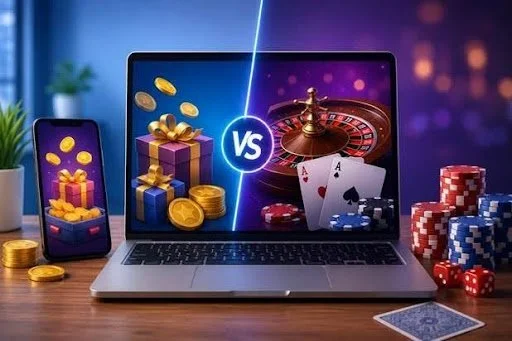
Picture two casino games with the same spinning reels, the same animations, and the same satisfying chime when something lines up. In one, you’re playing with virtual credits that can never become cash. On the other, you’re staking real money. The gameplay looks alike, but once actual value is on the line, it’s a different experience.
This distinction matters more as online casino gaming keeps growing. The American Gaming Association’s 2026 State of the States report put regulated US internet gaming revenue at $10.73 billion for 2025, a 27.6% jump from the year before. With that many people playing, it pays to know how each model works so you can pick the one that fits what you’re after.
For players interested in exploring casino games without immediately committing real money, the opportunity to play casino games for free at Spinoli provides a practical way to experience how certain titles work. Where demo modes are available, players can become familiar with the gameplay and understand how bonus features are triggered without placing financial stakes. Think of it as a test drive before deciding whether real-money play is for you.
What free-to-play casino games actually offer
For someone familiar with games like Fortnite, the term free-to-play might need some bit of explanation. A gamer should know that it describes the entry point, not necessarily the entire business model. A demo within a licensed online casino typically lets an eligible visitor explore a game using a simulated balance. A standalone social casino may also supply complimentary chips while offering additional virtual currency for purchase. Those purchased chips generally cannot be withdrawn as cash.
That distinction matters when a player runs out of credits. In a demo, restarting may simply restore a practice balance. In a social casino, a purchase prompt may appear instead. Neither experience should be mistaken for a cash-paying account merely because its reels resemble a real-money slot.
The commercial scale of social play is substantial. In its February 2026 financial results, DoubleDown Interactive reported $299 million in revenue from social casino and free-to-play games during 2025.
Its chief executive, In Keuk Kim, described the company's strategy as “expanding our revenue across products and geographies.” That observation explains why gamers should examine the currency terms rather than judge a product by its free-to-play label alone.
How real-money game mathematics compare with demo play
A demo session is useful for learning where features appear and how a game responds. It is less useful as a forecast of future winnings. The distinction involves game mathematics, particularly the return-to-player figure, or RTP, which describes an expected return across extensive play rather than an individual session.
In Great Britain, the Gambling Commission's technical standards require play-for-free versions on the same licensed gambling website to use the corresponding real-money game's rules and accurately represent its chances of winning. Its standards also require acceptably random outcomes. This does not mean every independent social casino app uses the same mathematical model as a similarly named cash game.
Consider someone who enjoys several rewarding rounds during a demo. That sequence can reveal the bonus mechanics, but it gives no reliable indication of what a subsequent paid session will produce.
The scale of actual online play illustrates the difference between brief impressions and aggregate data. UK Gambling Commission figures published in May 2026 recorded 25.1 billion online slot spins during January through March 2026 among reporting major operators. A handful of practice spins cannot provide a similarly reliable statistical picture.
Choosing the right experience as a gamer
The better choice depends on whether the goal is understanding a game or participating in a cash-stakes experience. Someone curious about blackjack decisions might begin with a free version to follow the dealer's sequence without financial consequences. An eligible adult considering a real-money game has a different question: whether the specific platform is licensed where that person lives and whether its rules fit the intended spending boundary.
There is also a middle category worth distinguishing. Certain sweepstakes-style games use virtual currencies that may be redeemable for prizes. They are not interchangeable with conventional free-play credits or licensed real-money casino balances. In September 2026, New York's attorney general announced an $8 million settlement involving an operator of such platforms, highlighting how location can determine their legal treatment.
Consumer research offers a useful final perspective. A 2025 American Gaming Association survey found that 84% of past-year gamblers were aware of at least one responsible-gaming tool.
Familiarity with such controls is relevant when selecting cash play, but the clearest decision still begins with understanding what the displayed balance represents. Once that is settled, the choice becomes much less confusing.
At the end of the day, the choice comes down to what players want from the experience. Free-to-play games offer a chance to explore without putting money on the line, while real-money games involve actual stakes. Knowing how each works makes it easier to choose what feels like the right fit.