We've seen many variations of Romeo and Juliet, but the creators of Gloomy Eyes have come up with one of the most unusual. It stars a brave living girl named Nena and a curious dead boy named Gloomy, with golden eyes and brains sticking out of his skull. In 2019, the creators told this story as a VR cartoon, inspired not only by Shakespeare's play but also by the work of Tim Burton. Now, they have released a full-fledged game featuring the same characters.
They are so different, but still they are together
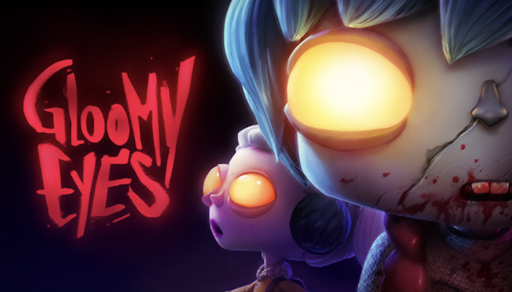
In the world of Gloomy Eyes, the sun is tired of people and has decided to hide, and at dusk, the dead begin to crawl out of their graves. But not all of them attack humans and eat brains. For example, the zombie boy Gloomy feels out of place among his own kind — as the creators of the VR cartoon Gloomy Eyes explained six years ago, there is something inside him that we cannot see or understand, but nature knows he is special. Meanwhile, humans have declared war on the walking dead, and the despotic leader of the local radicals has declared that being a zombie is illegal and wrong. As a result, Gloomy's kin are forced to hide in the forest, far from undead hunters.
Nevertheless, Gloomy, longing for normal childhood fun and games with his peers, one day sets off in search of adventure and meets Nena, the niece of that very leader, who has escaped from house arrest to go in search of the sun. Something develops between them — first friendship, then love. But can it survive in a world where the living and the dead cannot coexist peacefully? It sounds absurd, but there’s something compelling about it.
Romeo and Juliet and Corpse Bride — the latter telling the story of a relationship between a living young man and a dead girl — are obvious sources of inspiration for the story of Gloomy and Nena. It’s also clear why the creators of Gloomy Eyes VR emphasised tolerance over classic literary influences. They describe it as a story about differences and acceptance, about what it means to be special, overcoming loneliness and fear — and, of course, about love.
Add to this the gorgeous puppet animation and the participation of Colin Farrell, who voiced Gloomy, and it’s easy to see why this animated short film has won numerous awards and appeared at the Venice Film Festival, as well as Sundance, the premier showcase for independent cinema in the United States.
Sad and funny
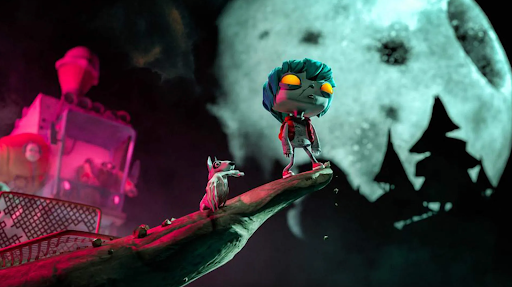
The game tells the same story but seems to assume that the audience is already familiar with the original — without that context, some of the characters' backstories and motivations aren’t entirely clear. There is a narrator — naturally, the undertaker — but he no longer explains events directly. Instead, he philosophises, reflects, feels sadness, and rejoices at hearing children’s laughter for the first time in a long while.
However, the main point comes across without unnecessary words — there are children from different worlds who simply want to remain children, play, and be friends. The fact that one of them is not quite alive and is drawn to the girl not to eat her brains, but simply to stay close to her, is one of those artistic assumptions that are better not explained, but accepted.
That’s why the children, in their search for the sun, visit not only cemeteries and other gloomy places but also amusement parks. These are fairly creepy too, with broken rides, but that makes it all the more satisfying and meaningful to fix them — symbolically significant in this story about children ready to overcome differences through play.
They also explore a haunted house with ghosts and corpses. Yet this is part of a traditional attraction, where rag doll corpses descend on ropes at the push of a button, and funny bony hands stick out from the walls without attacking. This, too, is symbolic. Overall, the developers emphasised that they created a ‘cosy horror’ without the usual monsters and jump scares. Even the zombies we see, apart from Gloomy, often make us smile — they sit with funny faces in a flower bed with balls or stare at the sky. For gamers who enjoy discovering hidden treasures and unexpected rewards in Gloomy Eyes, Slotozen no deposit bonus codes offer a similar kind of excitement and surprise in a casino setting.
There are moments when zombies could grab the girl, but even then, we aren’t shown any horror. The most threatening character is the leader of the local fanatics, Nena’s uncle. Yet even he is not frightening, more mischievous and reminiscent of the main character from the comedy Despicable Me than a villain from a horror film. Despite all the cosiness and humour, Gloomy Eyes is ultimately a rather sad and even pessimistic game. This comes through in the narrator’s words and tone, especially in his lines before the final credits.
Puppet solo co-op
As you’ve probably gathered, the 2025 version of Gloomy Eyes is a full-fledged game, comparable to Limbo, Inside, or any adventure that involves switching between characters with different abilities. The developers describe it as a unique “solo co-op,” though we’ve seen similar mechanics before in The Lost Vikings. Gloomy drags heavy objects to clear paths, throws stones at lanterns and generators (he’s afraid of bright light), and toward the end, even gets solo action scenes — fighting treacherous fanatics to aid his partner or freeing fireflies from their cages.
Nena, in contrast, is involved in more subtle tasks — she steals fuses and keys from enemies and activates various mechanisms. She’s also more agile, able to jump over obstacles, climb steep walls, and ascend long ladders. To lift Gloomy to higher locations, both she and the player must devise a plan. Both heroes periodically play hide-and-seek — sometimes hiding from light, sometimes from strong winds, or avoiding the attention of enemies
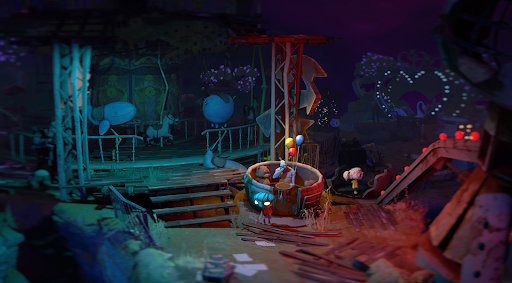
The puzzles will feel familiar if you’ve played Inside. You can likely imagine the kinds of situations built on this combination of abilities. The puzzles aren’t overly complex, but they aren’t trivial either — you need to think, explore each location (you can rotate and view levels in 3D), and evaluate your options. Sometimes you must turn off lights so the zombie boy can pass, and other times you must turn them on so the walkers can’t reach Nena.
Some of the most enjoyable scenarios involve figuring out how to lift Gloomy upstairs using a lift-like device, a Ferris wheel cabin, or even fireflies — which play an important role in both the lore and gameplay. Occasionally, scripts fail to work the first time, but such difficulties are usually due to rare technical issues or minor inconveniences, such as not easily seeing where a character can move.
One might wonder why the zombie boy climbs a small ladder easily in one instance, but later refuses whenever Nena appears, leaving the task to her. This is a convention, and it works within the game’s logic, so it’s best not to dwell on it. What truly cannot be overlooked, however, is the visual design of Gloomy Eyes. Doll-like characters with carefully crafted animations, richly detailed locations resembling hand-crafted dioramas, masterful use of light and shadow, and twisted, monster-like trees reminiscent of German Expressionism in cinema — it all looks like a tribute to Tim Burton’s style and feels like a work of art. Exploring levels in miniature is particularly rewarding.
We visit a wide variety of locations, each with its own character.
Despite the uplifting symbolism, children’s laughter, irony, and “necroromanticism,” Gloomy Eyes remains a sad and even pessimistic game. This ending isn’t surprising — adults rarely listen to children or their pleas to bridge differences and prevent conflict. Yet it’s gratifying to see a game like this released — perhaps, as the saying goes, water does wear away stone.
Pros: unique setting; compelling storyline with an important message; interesting characters; varied gameplay combining cooperative puzzles, stealth, and even action; successfully evokes a Tim Burton-esque dark fairy tale; visuals resemble a work of animated art.
Cons: the game may feel too short; occasional technical issues; navigation through levels is sometimes inconvenient.