Disclosure: This is a paid guest post. The author or an affiliated third party paid for its publication, and the article may contain promotional links. The views and opinions expressed are those of the author and do not necessarily reflect those of GameTyrant or its editorial staff.
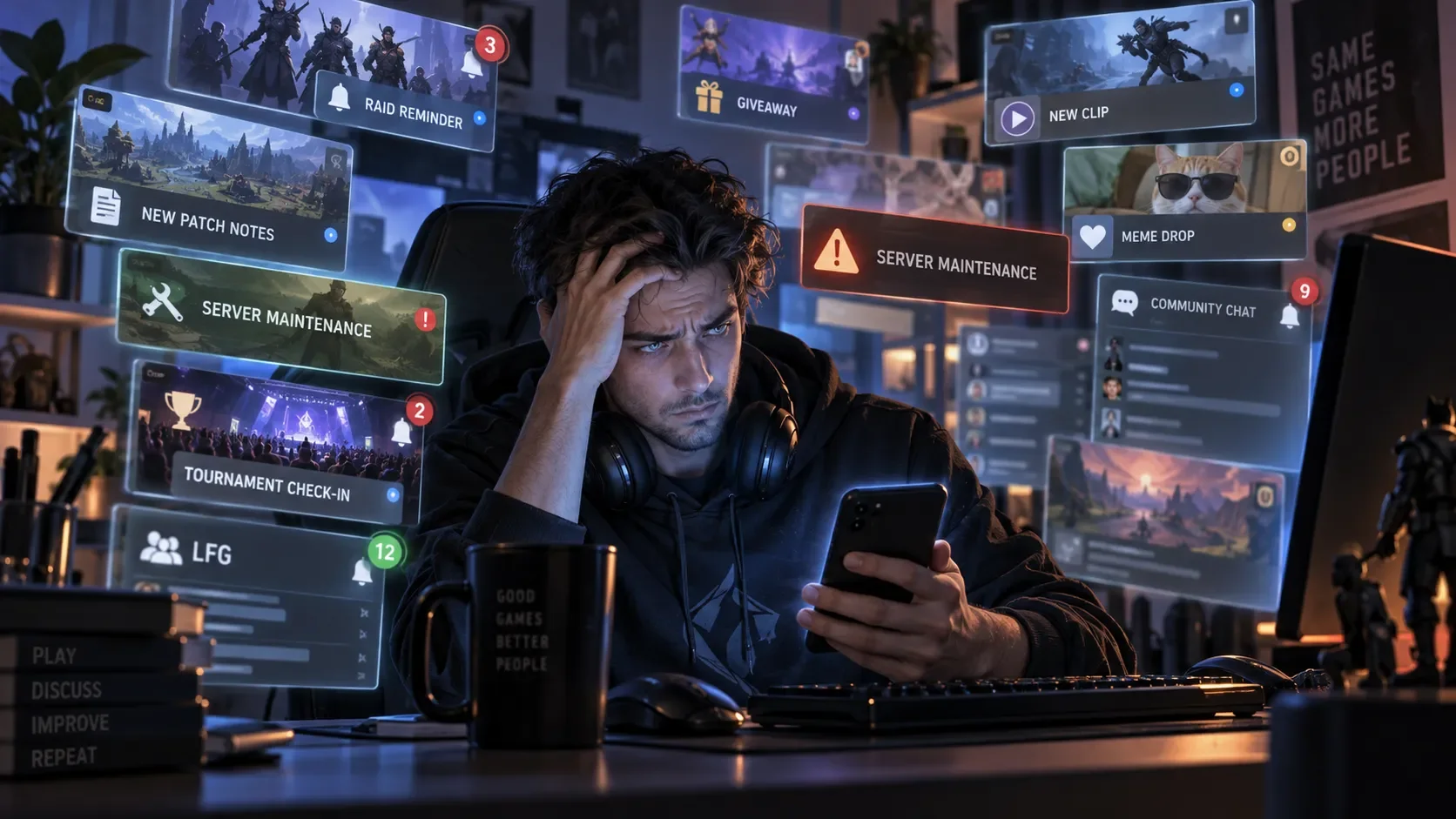
When raids, patch notes, giveaways and maintenance warnings all compete for the same attention, genuinely important alerts can disappear into the stream.
A live-service game can generate more information in a single weekend than some players will realistically process in a week.
There are patch notes, maintenance notices, raid sign-ups, tournament deadlines, LFG posts, giveaways, clips, screenshots, build discussions and whatever argument has taken over general chat that evening. Somewhere inside that flow may be one message that actually changes what a player needs to do: the servers are going offline in fifteen minutes.
That is where many gaming communities run into trouble.
The problem is not simply that there is too much chat. It is that very different kinds of information are often given the same visual and notification weight. A meme, an event reminder and a service outage may all arrive through the same channel, with the same badge and the same vibration.
Over time, players adapt in the most predictable way possible: they mute the community.
Once that happens, a group can remain highly active while becoming surprisingly poor at delivering information that matters.
Activity and urgency are different things
Gaming communities are usually good at measuring activity.
They can see how many people joined, how many messages were posted and how quickly a discussion moved after a patch. Those numbers are useful, but they say little about whether important information is reaching people at the right time.
A raid group posting fifty LFG messages in an hour is active. A maintenance announcement posted once is not.
Yet the maintenance post may matter to far more people.
A useful way to think about community communication is to separate messages into a few practical categories.
Operational information changes whether or how the game can be played. Server outages, emergency maintenance and rollback notices belong here.
Time-sensitive information requires action within a defined window. Tournament check-ins, raid schedules, event registration and expiring activities are typical examples.
Reference information matters, but rarely needs to interrupt anyone. Full patch notes, guides, build explanations and rules fit this category.
Then there is the social layer: clips, screenshots, memes, casual LFG activity and general conversation.
All of these can be valuable. They do not all deserve a push notification.
One simple test is to ask: What happens if a player sees this three hours later?
If the answer is “nothing important,” the message probably does not need the community’s strongest alert mechanism.
Structure starts to matter long before a community feels “large”
Small groups can get away with putting everything in one place.
A few dozen friends can mix scheduling, jokes, screenshots and LFG requests without much trouble because everyone already understands the context.
That changes as membership grows.
The first problem is usually not moderation. It is retrieval.
A player joins after work and has to scroll through hundreds of messages to find out whether tonight’s raid time changed. Someone asks the same question that was answered two hours earlier because the answer is already buried. A useful patch summary disappears between clips and matchmaking requests.
At that point, adding more members makes the information problem worse unless the community has a basic structure.
The categories do not need to be elaborate. Announcements, events, LFG, gameplay help, media and off-topic discussion are often enough to create useful separation.
For Telegram-based groups serving Traditional Chinese-speaking players, the platform-specific mechanics of setting up and using groups are covered in this 紙飛機遊戲社群使用指南. The more important editorial decision comes after that: deciding which conversations belong together and which should never compete for the same attention.
That distinction matters because structure affects notification behaviour later.
If every type of activity happens in one stream, moderators eventually have only two choices: interrupt everyone or hope people happen to notice.
Neither scales particularly well.
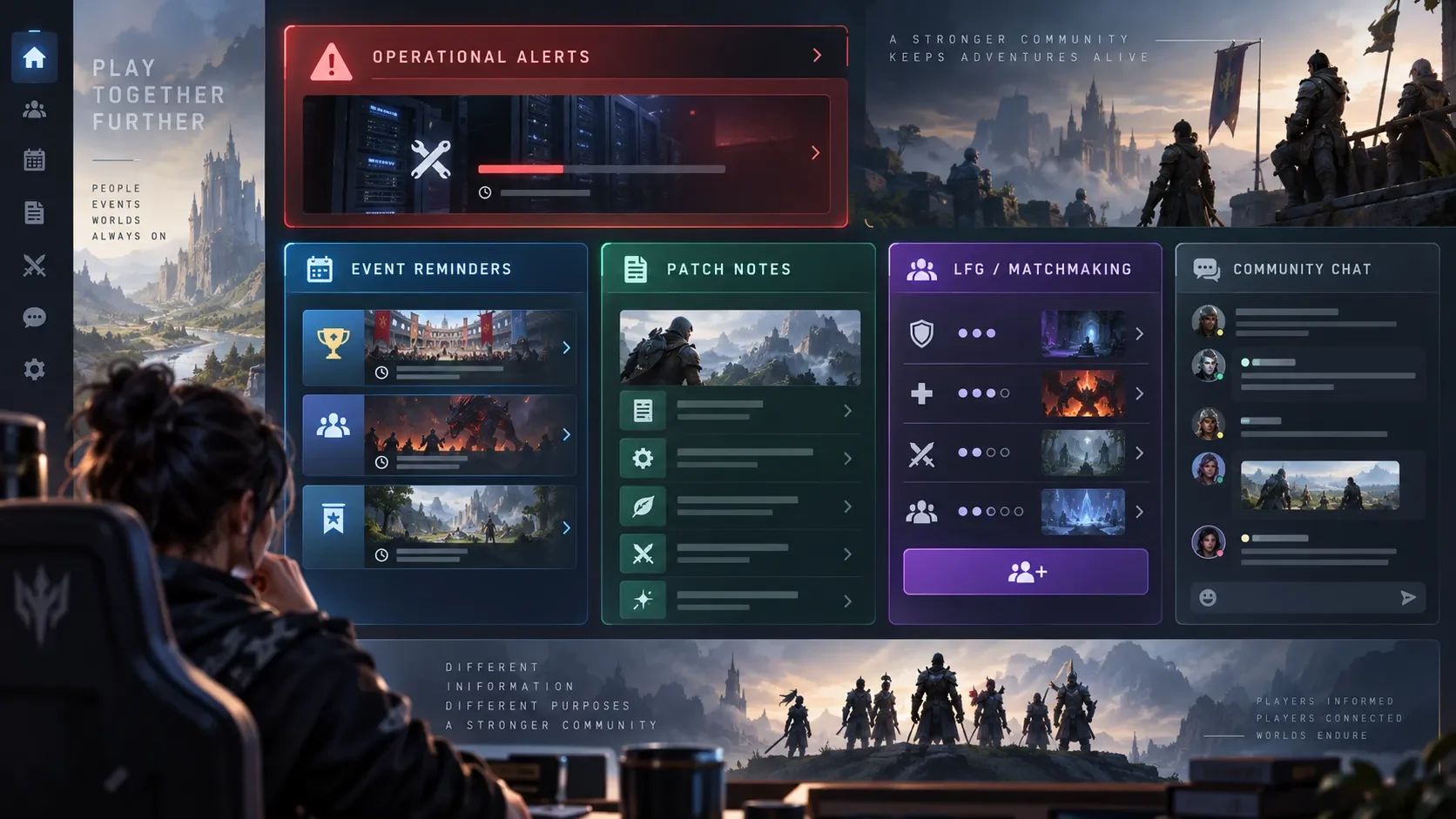
A useful community architecture separates operational alerts, events, reference material, matchmaking and social conversation before message volume becomes difficult to manage.
LFG traffic has a short shelf life
Looking-for-group messages are a good example of why volume and importance should not be confused.
“Need one tank.”
“Anyone running ranked?”
“Two spots left for the raid.”
These messages are useful precisely because they are immediate. Twenty minutes later, many of them are irrelevant.
A server notice has the opposite profile. It may appear only once, but remain useful for hours and affect thousands of players.
When both types of message live in the same high-volume channel, the short-lived traffic wins simply because there is more of it.
That does not mean LFG should be hidden. It means players should be able to opt into it when they are actively looking for a group without being forced to absorb the same volume at all times.
Patch notes rarely belong inside the alert itself
Patch notes create a different kind of overload.
A substantial update can include balance changes, fixes, matchmaking adjustments, economy changes, user-interface updates and dozens of smaller corrections.
Trying to push all of that through a notification is not useful.
The alert only needs to answer the immediate question: Did something change that I need to know about now?
Patch 1.4 is live. Ranked matchmaking and raid rewards have changed. Full notes are available in the patch channel.
That is enough to tell the player whether the update deserves attention.
The detailed changelog can live somewhere designed for reading and later reference.
This separation becomes particularly valuable in games that patch frequently. If every update is presented as an emergency, players gradually stop treating any update as important.
Giveaways can damage an alert system surprisingly quickly
Promotional posts are another common source of attention inflation.
A community may genuinely want to promote a cosmetic giveaway or limited campaign, but phrases such as “LAST CHANCE,” “DON’T MISS THIS” and “ENDING SOON” all borrow the visual language of urgency.
Used occasionally, that can work.
Used every day, it trains players to ignore the community’s loudest signals.
The same applies to repeated mass mentions. If every stream, giveaway, minor event and creator clip gets the equivalent of an all-members alert, the label stops meaning “important” and starts meaning “another promotional post.”
That has consequences when something genuinely urgent happens.
A confirmed security issue should not look indistinguishable from a skin giveaway.
Players need control over what is allowed to interrupt them
A competitive player and a casual player may belong to the same community for completely different reasons.
One wants roster deadlines, tournament check-ins and ranked-season updates.
The other may only care about major patches and new content.
Collectors might want limited-event notifications. Creators may care about media assets and community events. Someone who mainly plays with friends may want almost none of it.
That makes notification control part of community design, rather than a purely personal setting.
Once a group has separated different types of information, players can make meaningful choices about what deserves interruption. For Telegram users who want to review the platform-specific controls, this Telegram 通知管理指南 explains the relevant settings. Community managers still have a separate responsibility: they need to decide what should be noisy by default and what should require an explicit opt-in.
A reasonable default is usually conservative.
Emergency service information may justify prominent alerts. Routine LFG activity usually does not. Event reminders sit somewhere in between and may depend on whether a player has chosen to follow that activity.
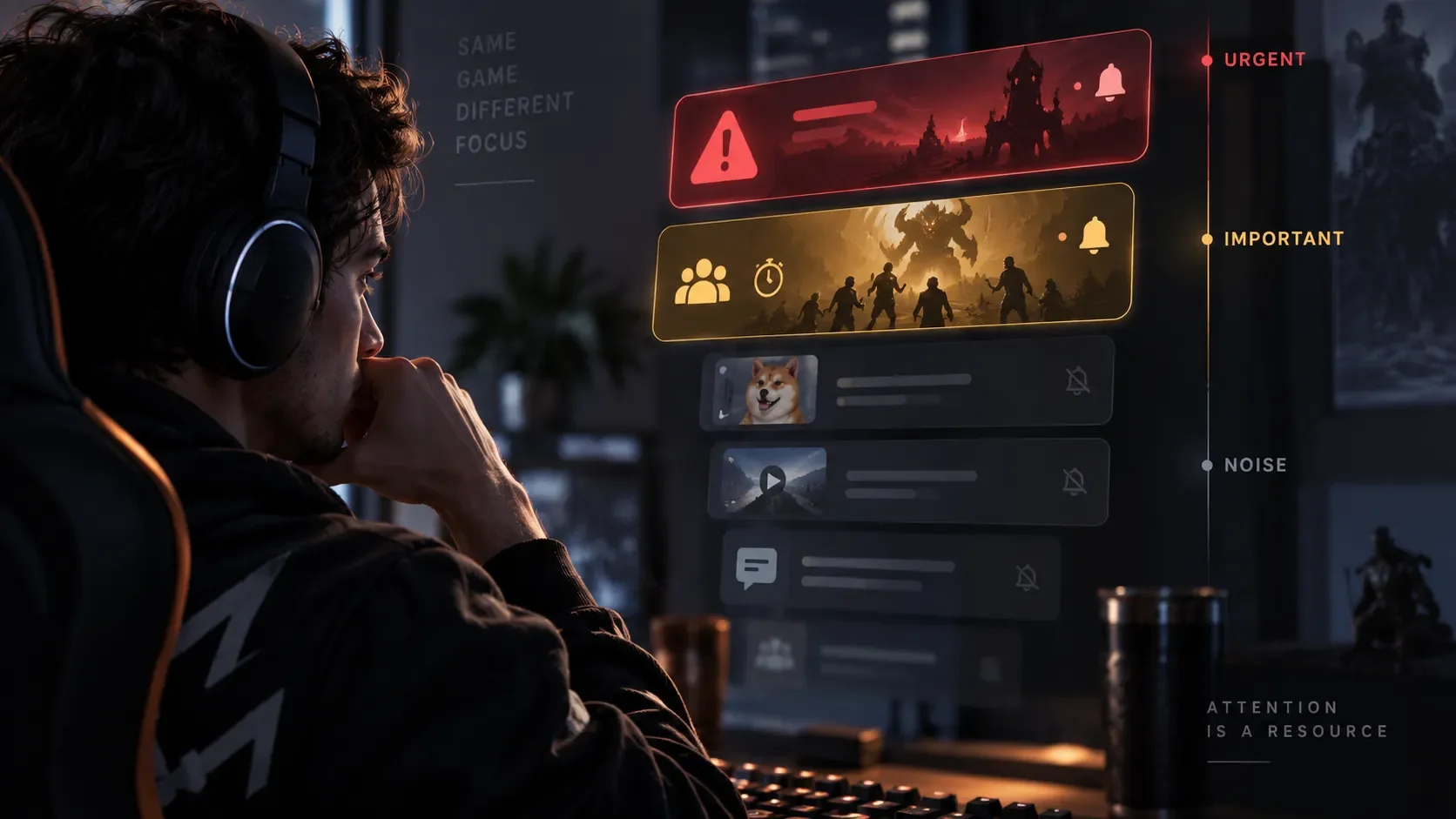
A priority model protects the strongest attention signals for service outages and genuinely time-sensitive events, while routine social traffic can remain visible without interrupting every player.
Time zones expose bad announcement habits
Global communities make vague timing particularly expensive.
“Raid starts at 8” works in a local group where everyone lives in the same city.
In an international community, it is incomplete information.
Even “tomorrow night” can mean different calendar dates to different members.
Important event notices should include an unambiguous date and time zone. Where practical, a countdown or calendar-friendly format reduces the amount of mental conversion required from players.
Compare:
Tournament check-in closes tomorrow night.
with:
Tournament check-in closes September 18 at 20:00 UTC.
The second version takes only a few extra seconds to write and removes an entire class of avoidable confusion.
Facts and reactions should not share the same authority
Gaming communities react quickly, especially after controversial updates.
A patch lands and comments immediately appear:
“This class is useless now.”
“Matchmaking is broken.”
“They ruined the event.”
Those reactions are part of community life. They should not be presented through the same channel or visual treatment as factual operational information.
“Servers reopen at 18:00 UTC” is a verifiable game-state update.
“This patch ruined ranked” is an opinion.
When communities blur those categories, players have to spend more time working out whether a message describes something that happened or someone’s interpretation of it.
That becomes especially problematic during outages, balance controversies or security incidents, when rumours can move faster than confirmed information.
Moderators should decide escalation rules before they need them
A useful community policy does not need to be long.
It should, however, answer one uncomfortable question:
What actually qualifies for the highest-priority alert?
Possible answers include:
unexpected server shutdowns
emergency maintenance
confirmed account or security issues affecting many players
tournament check-in deadlines
cancellation of a major scheduled event
Things that normally do not belong in the same tier include:
routine streams
new clips
ordinary LFG requests
minor cosmetic releases
moderator opinions
recurring promotional posts
Writing those rules before an incident happens reduces impulsive use of high-priority notifications.
It also gives moderators something objective to point to when different teams disagree about whether their announcement deserves a mass alert.
Member count does not tell you how many people are listening
A community with 50,000 members can look impressive while most of those members have it permanently muted.
That is why raw membership should not be treated as a substitute for attention.
Communities can learn more by looking at what happens after important posts.
Do members click through to event pages? Do tournament check-ins happen on time? Are the same questions repeatedly asked after announcements have already been posted? Do moderators have to repost important information because it was missed the first time?
None of those signals is perfect on its own. Together, they give a better picture of whether the community is actually communicating or merely producing activity.
Audit one ordinary week before changing anything
Communities do not need a sophisticated analytics platform to find obvious problems.
A moderator can take one ordinary seven-day period and manually classify the posts that received prominent treatment.
Record:
emergency or operational alerts
event reminders
patch announcements
LFG activity
giveaways
creator promotions
repeated notices
Do not start by deciding what should have happened. First record what actually happened.
Then review each high-priority post and ask:
Did this require immediate action?
What would have happened if it had arrived silently?
Was the information still valid when most members saw it?
Was the same message repeated elsewhere?
Could members reasonably opt into this category instead?
The exercise is intentionally simple. Its value comes from using real community traffic rather than assumptions about how members behave.
For larger communities, repeat the audit during a major patch or event week. Comparing a normal week with a high-traffic week can reveal whether the alert system holds up when message volume spikes.
There is also a useful limitation to acknowledge: an audit cannot tell moderators exactly what every player wants. Competitive, casual and social players will still have different preferences. The goal is not to discover one perfect notification policy. It is to stop obviously low-priority material from consuming the same attention budget as genuinely important information.
Protect the signal before asking for more attention
Live-service games are unlikely to become quieter.
Seasonal events, community programs, esports, creator campaigns and frequent updates all create legitimate reasons to communicate with players.
The temptation is to solve that growth by sending more reminders.
That works only until the audience adapts.
Once a community trains members to ignore its loudest signals, rebuilding that attention is difficult. The more sustainable approach is to treat player attention as a limited resource.
Use strong alerts rarely.
Give high-volume conversations their own space.
Keep reference material available without turning it into an interruption.
Let players opt into the categories that matter to them.
A healthy gaming community does not need every member to notice every message. It needs the right players to notice the right message before it is too late.