With some early access drafts, sealed pools, and constructed games under my belt, I wanted to share a few tips ahead of this weekend’s pre-release for Edge of Eternities. Whether you're planning to crack some packs for sealed or jump into a draft pod, here's what I've learned so far.
Sealed Tips & Color Preferences
Lately, my go-to color pairs in sealed have been Abzan (WBG) and Golgari (BG). That said, this set doesn’t really favor three-color decks, and splashing a third color is usually only viable if you're playing green—which has slightly better mana fixing. Even then, I wouldn't recommend overcommitting unless the payoff is truly worth it.
Colorless cards can be helpful tools, especially in sealed, but make sure they actually support your deck’s game plan—some are less universally useful than others.
Best Color Combinations (from Early Testing)
I tried to run sealed pools with nearly every color pairing, though I didn’t get to play Azorius, Golgari, or Gruul in full. Based on what I’ve seen, those combinations didn’t seem especially strong in Edge of Eternities—Azorius also played almost exactly like it did in Tarkir: Dragonstorm anyway.
What did stand out were artifact-focused decks—they’re powerful and well-supported in this set. Removal is also plentiful, which makes tempo and value-based strategies even stronger. My top-performing color combos were:
Izzet (UR) – Artifact Aggro
Dimir (UB) – Tempo with artifact synergy
Rakdos (BR) – Aggressive with solid removal and recursion
One thing I like a lot about EOE, a lot of the color combinations had a slightly different feel than their usual archetypes, which was refreshing.
Izzet (Blue/Red): Artifact Aggro
When you think Izzet, you might expect a storm or spell-heavy archetype. Edge of Eternities flips the script—here, Izzet is a fast, artifact-heavy aggro deck. It was my most consistent color pairing in MTGA Early Access, with great synergy and flexible card combinations.
Key Cards to Look Out For:
Mm’menon, Urthros Exile (Uncommon)
This creature adds a +1/+1 counter to any creature you control whenever an artifact enters the battlefield. It pairs especially well with Pinnacle Emissary, but even on its own, it's a powerhouse. If you open this card, it may be the card to make you start looking at an Izzet deck.Cryogen Relic (Common)
A cheap artifact that draws on entry and exit—great fodder for triggers and synergy.Cloudsculpt Technician (Common)
A 2/4 flyer for 3 that needs an artifact in play to enable its flying. It’s not flashy, but that 4 toughness can hold the air.Illvoi Light Jammer (Common)
A flash equipment artifact that grants hexproof until end of turn. This is excellent for protecting key creatures against removal-heavy decks.Kavaron Harrier (Uncommon)
Acts like a “mobilize” engine by turn three. Early game, it provides tempo; late game, it becomes a threat, especially when buffed by Mm’menon.Rust Harvester (Rare)
This card converts all those expendable artifacts into value. A must-have for this archetype.Tannuk, Steadfast Second (Mythic)
Grants haste to all your creatures and warp to your artifacts—great for pushing damage and keeping the pressure up.
I mostly avoided Spacecrafts in this archetype—they tend to slow things down since they tap your creatures to station. However, if you get one down early and have expendable creatures, it might be worth trying. I also didn’t run any colorless cards in Izzet, other than Secluded Starforge, which is a solid late-game option for building up a robotic army.
Dimir (Blue/Black): Artifact Control
Artifacts are a huge part of Edge of Eternities, and Dimir (UB) leans into that with a strong control-based archetype. No surprises here—Dimir has always been the color pair for tempo, value, and denial—but the removal in this set is exceptionally strong.
One standout card that really defines this archetype is Singularity Rupture—a late-game bomb that wipes the board and mills your opponent for half their deck. Yes, it’s expensive, but it turns the tide and sets you up to win in spectacular fashion.
Key Cards to Look Out For:
Alpharael, Dreaming Acolyte (Uncommon)
The signpost uncommon for Dimir and a huge value engine. Alpharael lets you draw two cards, then discard two—but if you control an artifact, you skip the discard. That’s just free card advantage in this deck. I pulled two in my first sealed pool and immediately committed to Dimir.Cryogen Relic (Common)
Yes, it’s back again. This static artifact fits perfectly into any artifact-based strategy, enabling Alpharael and providing card draw to keep your hand stocked.Embrace Oblivion (Common)
A solid piece of removal that exiles a creature and can be recast from the graveyard. It’s efficient and reliable, especially in longer games.Gravkill (Common)
Another efficient removal option—cheap, easy to cast, and cleanly deals with threats early.Dubious Delicacy (Uncommon)
This card is flexible and sneaky-good. With flash, it can act as surprise removal or save your own creature from combat. You can later sacrifice it to gain life or deal damage, depending on what you need most.Scrounge for Eternity (Uncommon)
This synergizes well with graveyard recursion and creates Lander tokens, which are extremely helpful in a control deck that wants to hit its land drops while gaining incremental value.Singularity Rupture (Rare)
As mentioned above, this card is both a board wipe and a win condition. Perfect for stabilizing or setting up a devastating mill finish.Zero Point Ballad (Rare)
Another excellent removal spell. It doesn’t hit quite as hard as Singularity Rupture, but it can help reset the board or remove a key threat.Sothera, the Supervoid (Mythic)
Not an artifact, but an absolute powerhouse in control strategies. Sothera is the ultimate late-game card and will likely see play across multiple formats. If you open one, you’re probably playing Dimir.
Unlike Izzet, Spacecrafts actually have a better home in Dimir control, particularly if you pick up Susurian Dirgecraft, which comes with built-in removal. While most colorless cards don’t shine here, one clear exception is Tezzeret, Cruel Captain. If you're lucky enough to open him, he’s a powerful addition that enhances both your artifact synergies and control plan.
Rakdos (Black/Red): Void Sacrifice
Rakdos isn’t always my favorite color pair—to me it feels a bit limiting—but in Edge of Eternities, it absolutely shines. This archetype sticks to Rakdos’ traditional roots with sacrifice outlets, but it also heavily leverages the new mechanics: void and warp. Since new mechanics tend to define early archetype strength, it’s no surprise Rakdos is emerging as a powerhouse.
This deck plays like a chaotic ballet—creatures bouncing between your hand, graveyard, exile, and the battlefield—triggering effects all along the way. And the removal is abundant and efficient. Best of all, Rakdos has (in my opinion) the strongest signpost uncommon in the set. It impressed me enough that I’m already slotting it into my Alesha, Who Laughs at Fate Commander deck.
Key Cards to Look Out For:
Melded Moxite (Common)
An ideal fit for this archetype. It forces a 2-for-1 discard when it enters, then sacrifices itself to create a 2/2 robot token—perfect for fueling your void triggers.Swarm Culler (Common)
A solid engine for this deck. It offers a sacrifice outlet every time it taps, and if you sacrifice a creature, you get to draw a card. Value city.Gravpack Monoist (Common)
Starts as a 2/1 flier, dealing chip damage in the air. When it inevitably dies, it leaves behind a 2/2 robot token. In other words, it wants to die.Plasma Bolt (Common)
A cheap burn spell that deals 2 damage (or 3 with void active). Just one mana for instant-speed removal—it’s efficient and synergistic.Interceptor Mechan (Uncommon Signpost)
A must-have in this archetype. It lets you return a creature from your graveyard to hand, then its void ability kicks in, giving it a +1/+1 counter. It snowballs quickly and gives you repeat value.Lightless Evangel (Uncommon)
Grows stronger each time you sacrifice a creature. It’s a persistent threat that scales with your gameplan.Umbral Collar Zealot (Uncommon)
Instant-speed sacrifice outlet that also lets you Surveil 1 every time you use it. Great for filtering and keeping your engine running smoothly.Systems Override (Uncommon)
A personal favorite. Steal an opponent’s creature or artifact until end of turn, swing with it—and then sacrifice it for profit. It turned several games in my favor.Nova Hellkite (Rare)
A great fit here. It has warp to help trigger void and deals 1 damage on entry. That damage may seem minor, but there are plenty of 1-toughness creatures in this set.Memorial Vault (Rare)
A powerful artifact that works both as a sacrifice outlet and a topdeck manipulator, letting you play cards before they’re exiled. Tons of value over time.Elegy Acolyte (Rare)
Does it all—draws cards, pings damage, and generates creatures via its void ability. One of the best rares for this archetype.Sothera, the Supervoid (Mythic)
An all-star in any black deck, but especially here. Its void synergy and raw power make it a top-tier pick.Tannuk, Steadfast Second (Mythic)
Possibly the chase mythic for a Void Sacrifice deck. It gives all your red creatures and artifacts warp, allowing you to constantly trigger void and maintain pressure.
Rakdos in Edge of Eternities blends chaos and control in the best possible way. It’s aggressive, synergistic, and dripping with value—especially for players who enjoy sacrifice engines and graveyard recursion. With or without bomb rares, this archetype can absolutely dominate in sealed or draft, thanks to strong commons and a gameplan that scales well into the late game.
Draft Tips for Edge of Eternities
I’m not a professional drafter by any means—so if you’re looking for in-depth strategies beyond beginner or intermediate level, I highly recommend checking out NicolaiBolas’s Draft Guide on YouTube. That said, after playing several Edge of Eternities early access drafts, I’ve picked up a few key lessons that might help you navigate this unique set.
Avoid Colorless Cards (Almost Always)
It can be tempting to grab a rare or mythic colorless card you see floating around late in the pack, especially if it looks flashy or powerful. But trust me—it’s usually not worth it. In this set, colorless cards lack the synergy and strength needed to make a real impact in draft. Most archetypes don’t support them well, and they often just end up as underwhelming filler.
Exception: If you manage to draft Tezzeret, Cruel Captain, he can be a worthwhile pick—but don’t first-pick him. He fits nicely into artifact or +1/+1 counter decks, but only when your pool already supports him.
Be Patient with Multicolored Picks
It’s tempting to grab that flashy dual-colored uncommon as soon as you see it—especially if you’ve got a favorite archetype in mind—but you’re often better off waiting. Focus on drafting strong single-color support cards early on. Many multicolor spells in this set come with awkward casting costs, and you won’t always find the mana base to support them easily.
The good news is most dual-colored cards in this set are uncommon, so there's a good chance you’ll see them again later in the draft. Build your foundation first—then lean into synergy.
Don’t Splash Colors Unless You Start Green
Unlike some recent sets (Final Fantasy, Tarkir), Edge of Eternities does not support three-color decks or splash-heavy builds well. Mana fixing is limited, especially outside of green, and there are no dedicated mana-fixing lands at the common level to rely on.
Unless you’re drafting Green—which has access to Landers and a few fixing tools—you’re taking a big risk by adding a third color. More often than not, that splash card will just rot in your hand while you wait for the right mana.
Guest Cards Look Cool, But Don’t Draft Them
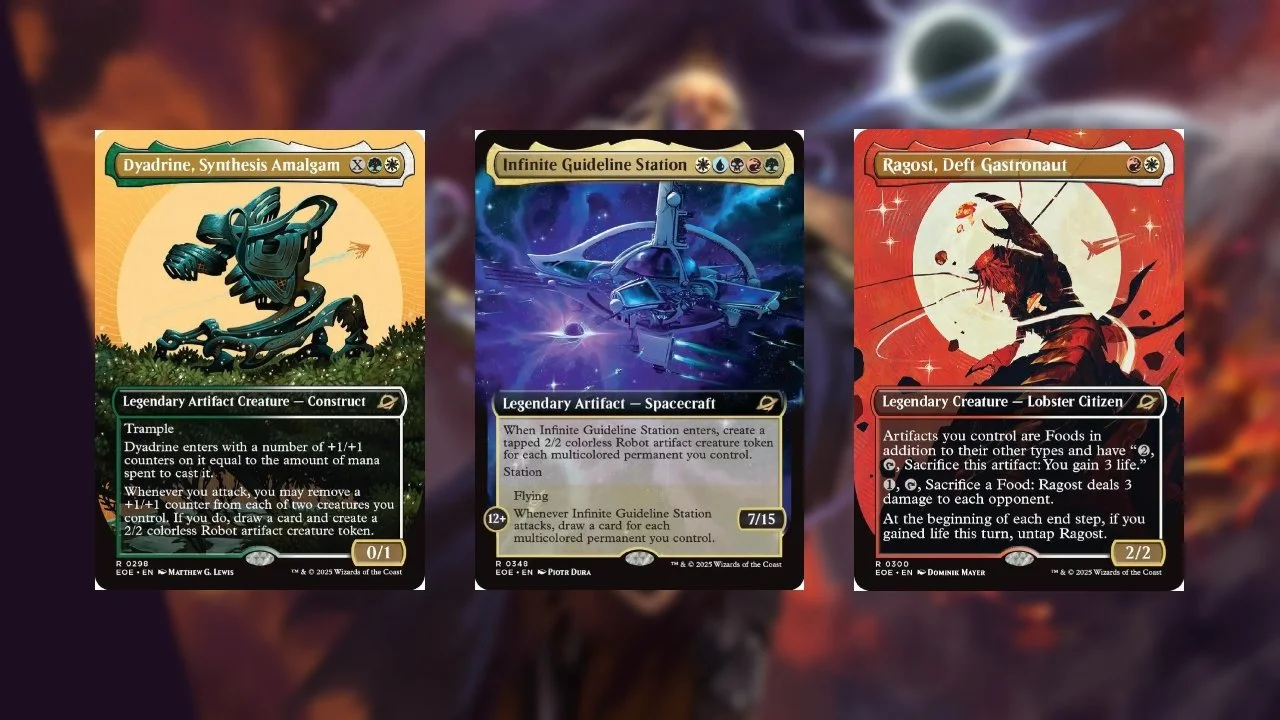
The Guest Cards—the ones with the alternate, flashy artwork—are visually stunning, and they make great additions to a collection. But in terms of gameplay, most of them just don’t deliver. While a few have potential, I found that every time I drafted a Guest Card, it underperformed or didn’t synergize with my deck.
If you want them, pick them up outside of the draft format. Don’t let cool art cost you a solid draft pick.
Drafting in Edge of Eternities is all about prioritizing efficiency, synergy, and mana reliability. Stick to strong single-color cards early, avoid colorless unless there’s a clear payoff, and draft with a solid foundation before committing to an archetype. You don’t need to force a splash or chase shiny cards to build a winning deck—let the packs guide you, and stay flexible.
After early access I’m really excited for this set. I think there’s a lot of fun limited potential in this set and I already have my eye on a few chase cards to add to my other decks. With strong archetypes, impactful mechanics like void and warp, and some surprisingly deep commons, there's plenty to explore. Stick to your fundamentals, stay flexible during the draft, and most importantly—have fun slinging spells at your pre-release. Good luck, and may your rares be playable!
Pre-release for Edge of Eternities starts this weekend! Then the release on MTG Arena follows shortly after that! So start doing you homework and have fun!