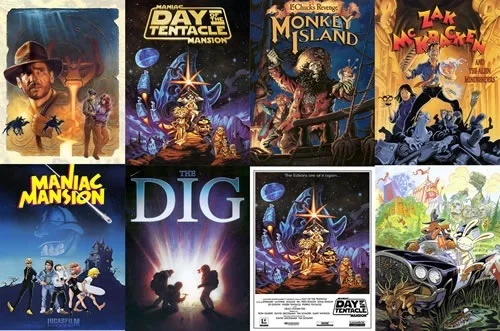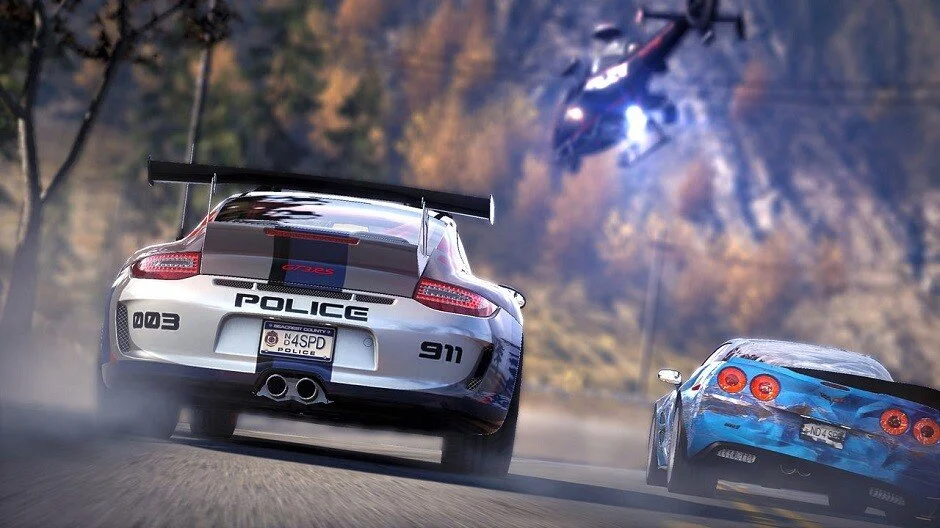
Studio breakups are among the messiest events in game history. A team spends years building a world, players learn to trust a certain tone, and then contracts expire, founders leave, and the office lights go out. What remains is a franchise with a name, a fanbase, and no obvious home.
The interesting question is not whether the series survives the split, because most of them do in some form. The real question is which piece of the original vanishes first, and which piece turns out to be more portable than anyone expected.
Fans often frame these transitions through nostalgia, comparing sequels to the games they grew up with, and the same instinct shows up in adjacent hobbies too, from board game reprints to short arcade sessions with something like vortex aero turbo games where the appeal is a single tight loop rather than a decades-long saga, a reminder that not every play pattern depends on studio lineage. Back on the console side, that lineage question is exactly what makes post-split sequels feel strange even when they are technically competent.
The First Year After the Doors Close
When a studio dissolves, the franchise enters a legal holding pattern before it enters a creative one. Publishers usually own the trademark, but the source code, tools, and undocumented knowledge sit inside the heads of people who are now applying for jobs elsewhere. That first year decides more than most announcements do.
A useful reference point is the long unwinding of Interplay Entertainment, whose Fallout rights eventually moved to Bethesda after years of litigation and asset sales, a case documented in detail on the Interplay Entertainment Wikipedia article. The lesson is that a franchise can sit dormant for a decade and still return, but it returns as a different object, shaped by whoever holds the paperwork when the market is ready.
Three Things a Franchise Can Lose in the Split
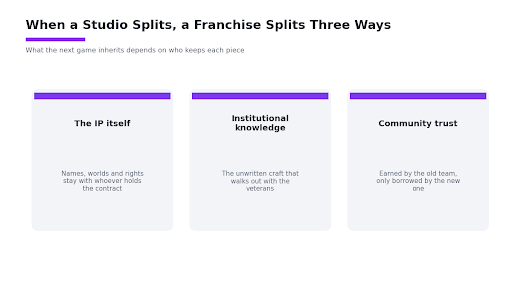
Not every asset transfers equally. Some things live in files, some live in people, and some live in the relationship between the two. When a studio splits apart, each of these categories drains at a different speed.
The Intellectual Property Itself
The name, the characters, and the trademarks are the most visible pieces, and also the ones most likely to survive. Publishers hold onto them precisely because they are easy to license, revive, or hand to a new developer. This is why a series can keep shipping sequels under the same title while feeling almost unrecognizable underneath.
The Institutional Knowledge
Harder to move is the accumulated understanding of why the original games worked. Design documents rarely explain the small decisions that gave a series its texture, like enemy pacing, camera behaviour, or the specific feel of a jump. When the senior designers scatter to five different companies, that knowledge scatters with them, and the next studio has to reverse engineer its own predecessor.
The Community Trust
The third loss is quieter and often permanent. Longtime players build a relationship with a specific creative voice, and when that voice fragments, the new team inherits scepticism rather than goodwill. Rebuilding it takes at least one strong entry, sometimes two, and a willingness to acknowledge what changed rather than pretend continuity where none exists.
Signals That the Handover Is Going Well
Not every post-split sequel is a disappointment. Some studios inherit a series and produce work that stands next to the originals, and there are recognizable signals when that is happening, usually visible well before release. Gaming bloggers and journalists often surface these signals in developer interviews long before marketing catches up.
Look for these markers when a familiar franchise resurfaces under a new team:
At least a few named veterans from the original studio joined the new project, not just as consultants but as leads.
The publisher is talking about the new game in specific mechanical terms rather than only in nostalgic beats.
The development cycle is longer than a typical annual sequel, which suggests the team is rebuilding foundations rather than reskinning them.
Early footage shows small idiosyncratic details that only make sense if someone on the team actually loves the source material.
The studio publicly discusses what it is choosing not to carry forward, which is usually a healthier sign than promising everything.
When most of these are absent, the sequel tends to arrive as a competent shell. When most are present, the franchise has a real chance of becoming something the community will defend again.
How Series Inherit New Homes and Keep Going
Franchises that survive studio splits usually retain a clear thematic core. Metroid endured developer changes because isolation and exploration remained recognizable, while Fallout carried forward its dark humour and post-nuclear absurdity beyond Interplay.
For players, the lesson is cautious patience: judge each sequel on its own terms, look past nostalgia-heavy marketing, and see whether the new team accepts comparison with the originals. That openness often signals where a series’ next strong chapter begins.