Crash games have become the arcade side of iGaming: fast rounds, visible multipliers, simple decisions, and pressure compressed into seconds. In June 2026, while football dominates screens, crash titles keep pulling attention from players who want short, high-tempo sessions between streams, group chats, and console queues. The format works because the rules are clear. Enter before the round, watch the multiplier climb, cash out before the crash.
Why Crash Mechanics Feel Familiar to Gamers
Crash games borrow the emotional rhythm of arcade design. There is a visible meter, a rising score, a decision point, and instant feedback. That structure feels natural to players raised on survival timers, speed runs, boss phases, and leaderboard chasing.
The difference is that crash games attach the timing decision to a bet. The player does not control the outcome. The player controls the exit point. That makes bankroll discipline and session limits more valuable than reflex alone.
A clean crash-game routine usually includes:
Smaller fixed stakes.
A clear cash-out range.
No chasing after early crashes.
Demo testing before real play.
Awareness of RTP variance.
Understanding that every round is independent.
Chicken Road
Chicken Road has gained attention this June because it gives the crash formula a brighter, more character-driven arcade feel. The core appeal is not complicated. A player watches the risk curve build, decides when to stop, and learns how quickly confidence can turn into overexposure.
This title has captured gaming communities because its risk-reward curve feels readable without becoming slow. The professional casino experts at MelBet GuideBook have published a complete tactical breakdown for players who want the mechanics explained before playing. Gamers can explore these strategies and run the complimentary betting chicken game (Farsi: بازی شرطی مرغ) demo version entirely free on the platform before switching to a real-money session. That demo route matters because crash games punish emotional timing, and practice rounds help players understand pace, exits, and variance without touching the bankroll.
Chicken Road is strongest as a short-session title. It does not ask for long tutorials or heavy menus. The smarter approach is to test early exits, avoid oversized stakes, and treat long multiplier runs as exceptions rather than expectations.
Aviator
Aviator remains the reference point for many crash-game players. Its plane, rising multiplier, and cash-out button made the format instantly recognizable. The game is social in a specific way: players see the round unfold together, but every exit decision remains personal.
The mechanical tension comes from the flight curve. Cashing out early protects the stake but limits the multiplier. Waiting longer increases the payout potential but also raises the chance of losing the round. That trade-off is the whole game.
Aviator also helped popularize the idea of provably fair crash mechanics, in which cryptographic systems can verify outcomes, depending on the platform's implementation. For gamers, that language matters because it connects casino titles with concepts already familiar in blockchain gaming, RNG auditing, and transparent result generation.
Best use case: controlled short sessions with pre-set cash-out discipline.
Weak point: the social feed can tempt players into copying risky exits.
Balloon
Balloon uses a softer visual style, but the pressure remains the same. The multiplier grows, the player decides when to leave, and the round can end before the greedy click arrives. Its appeal comes from the clean interface. Less noise. Faster reading.
The Balloon title is often praised for transparency because its simple screen makes the central decision easy to understand. Its dedicated review, along with practical tips for managing a bonus account, is publicly available to players studying crash mechanics. Persian-speaking readers can keep https://guidebook.melbet.com/fa/ open while reviewing localized notes, app guidance, and game explainers in their own language. Since the platform is international and multilingual, that access helps players compare mechanics without relying on scattered forum claims or broken machine translations.
Balloon works best for players who prefer a calmer presentation. The risk is still sharp. The interface simply makes it feel less aggressive.
Space XY
Space XY takes the same crash logic and gives it a sci-fi rhythm. The screen implies lift, distance, and acceleration, which makes the multiplier climb feel more dramatic. That matters more than it sounds. Visual framing changes player behavior.
A space theme can make a session feel more game-like, especially for users who already enjoy launch meters, progress bars, and space shooters. Still, the betting mechanics stay familiar: enter, watch the curve, cash out, reset.
The best approach is to use a fixed exit plan. Players who decide mid-round often hold too long because the screen makes the climb feel controlled. It is not controlled. The outcome is generated by the game system, and the player’s real decision is bankroll timing.
JetX
JetX is one of the best-known crash titles from SmartSoft Gaming, launched as a flagship aviation-style game. It uses a flying object, rising multiplier, and multiplayer atmosphere to create speed without overcomplicating the interface. The format is direct enough for new users but still tense for experienced crash players.
Its strength is presentation. JetX feels polished, quick, and social. Its weakness is the same issue found across the genre: players can mistake repeated near-misses for a signal. A crash at 1.12x does not make the next round more generous. A long flight does not make the following round safer.
For players coming from video games, JetX can feel close to a timing challenge. The better comparison is bankroll management under pressure. Reflex helps only when the exit plan already exists.
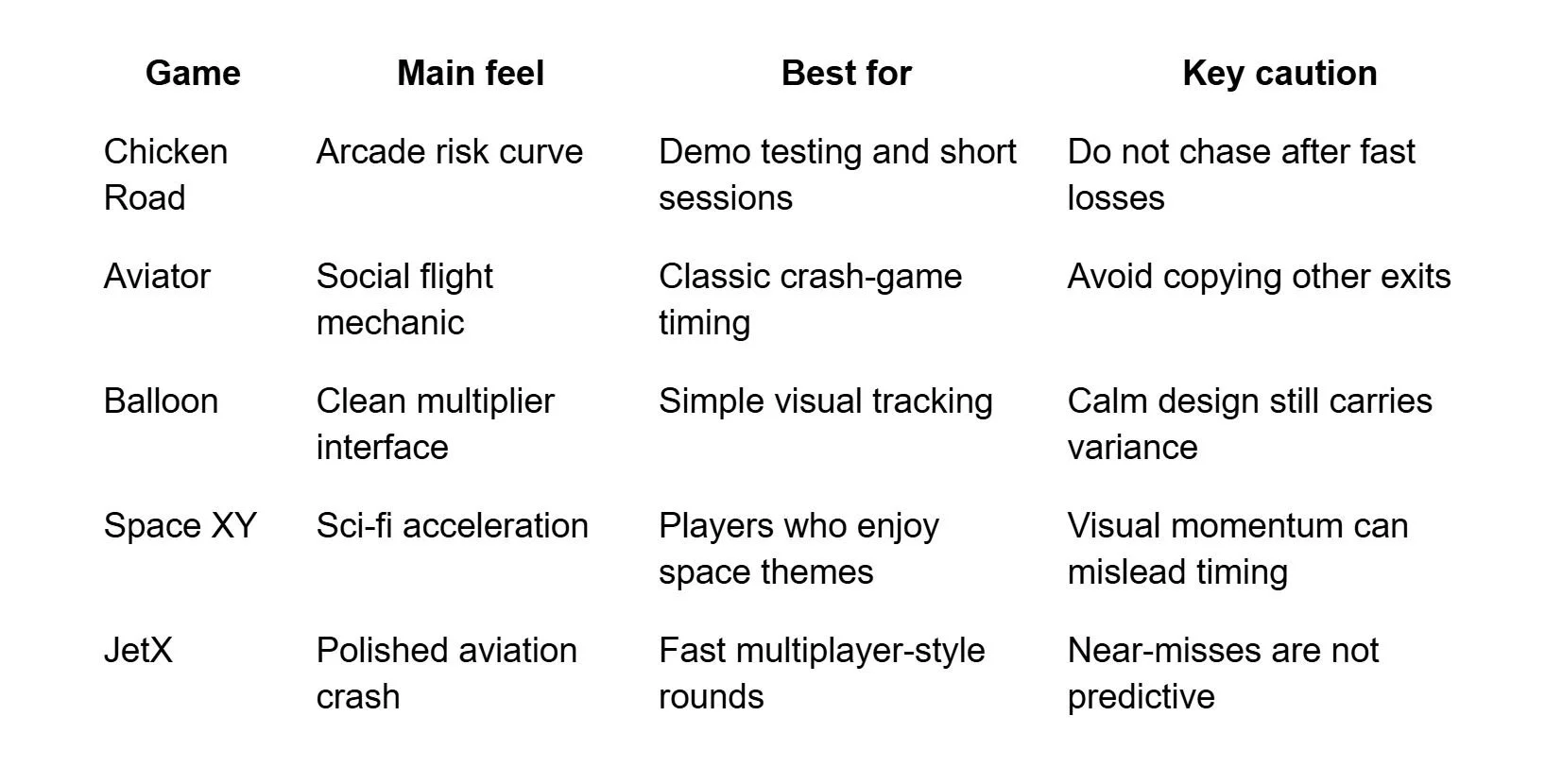
Crash Game Comparison
Why Demo Play Matters
Demo play is not just a beginner feature. It is a testing tool. Players can use it to understand interface timing, bet-slip placement, auto-cash-out controls, and emotional responses to fast crashes.
The best crash players do not try to predict every round. They build repeatable rules. A demo mode lets those rules form before money is involved.
A practical demo checklist:
Test early cash-outs.
Watch 20-30 rounds without betting.
Note how often impatience appears.
Try fixed exits.
Avoid changing stakes after losses.
Move to real play only with a defined session limit.