Disclosure: This is a paid guest post. The author or an affiliated third party paid for its publication, and the article may contain promotional links. The views and opinions expressed are those of the author and do not necessarily reflect those of GameTyrant or its editorial staff.
Riot has released a remarkable amount of cosmetic content for a game with a deliberately small arsenal. There are nineteen weapons in Valorant, and something in the region of 1,366 skins now exist for them.
That ratio is the interesting part. Every new line has to make a Vandal or a Phantom feel different from the seventy other versions players have already seen.
Six years in, that constraint has produced some genuinely inventive design, and a catalogue that is now large enough to need indexing.
A Small Arsenal Doing Heavy Lifting
The weapon list has barely moved since launch. Two sidearms most people ignore, a handful of rifles that decide almost every round, and a melee slot that has quietly become the most expensive thing in the game.
Skin lines therefore compete on animation, audio and finisher rather than on coverage. A premium bundle is judged on how the reload sounds and what happens when you win the round, because the silhouette cannot change much.
That is a harder brief than it sounds. Shooters with fifty weapons can space their cosmetics out, whereas Valorant has to keep reinventing the same six or seven popular guns.
Somebody Had to Catalogue It
Tracking all of this got beyond casual memory some time around the third year. ValDB is one of the community databases that took the job on, currently listing 1,366 skins spread across 212 bundles, including 174 melee variants.
The rest of the site covers the parts of the game that reward being looked up rather than remembered. Damage tables for all nineteen weapons with shot to kill counts against each shield tier, 29 agents sorted by role with their ability details, and thirteen maps carrying roughly 300 official callouts plotted from the game files.
There is a large competitive section too, holding settings for 505 professional players, their crosshair codes rendered from the actual game code, agent tier lists built on professional match data and esports leaderboards across six regions.
The tooling is where most people probably end up. A crosshair generator, a sensitivity converter, an eDPI calculator, damage and economy calculators, plus a glossary explaining the several dozen terms the game never formally defines.
It is an independent project rather than anything official, and it scans the game files twice a day to stay current. Riot neither runs it nor endorses it, which is worth stating plainly.
Bundles Are the Real Unit of Design
Individual skins are almost beside the point now. Valorant sells themed collections, and the internal logic of a bundle explains most of the pricing decisions players complain about.
A typical premium set covers a rifle, a sidearm, a couple of situational weapons and a melee, which is a deliberate spread rather than a random one. You get one gun you will definitely use, one you occasionally will, and a knife that carries the emotional weight of the whole purchase.
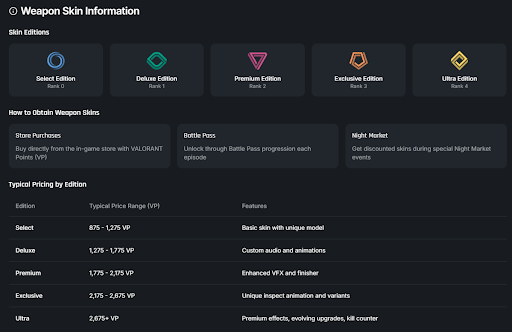
Riot has been reasonably open about how this works across its published announcements and dev posts. The tiers are documented, the upgrade levels are documented, and the arguments are mostly about value rather than transparency.
Melee Became Its Own Economy
The knife is the strangest slot in the game. It is barely used mechanically, visible mainly during the buy phase and the occasional embarrassing eco round, and it consistently commands the highest prices.
That mirrors what happened in other tactical shooters, though Valorant reached it through direct sales rather than a trading market. With 174 melee variants now in circulation, the slot has more entries than most weapons.
The reason is straightforward enough. A knife animation plays in your own hands more than any other cosmetic, so it is the one thing you actually look at.
Why Any of This Gets Tracked
Part of it is spending awareness, which has become a much bigger theme across live service games. Knowing what a collection contained and what it cost is the first step towards deciding whether the next one is worth it.
Part of it is competitive, since crosshair codes and sensitivity conversions are genuinely useful and tedious to collect by hand. And part of it is simply the collector instinct that any large catalogue eventually produces.
The combination is why databases like this end up outliving individual patches. The game changes constantly, and the record of what it used to contain has to live somewhere.
Final Thoughts
Nineteen weapons and more than thirteen hundred skins is an odd equilibrium, and it works better than it should. Constraint has forced the art team to be inventive in ways a larger arsenal would not have demanded.
Whether the pricing is reasonable is a separate argument, and one players will keep having. What is not really in dispute is that the catalogue has grown past the point where anyone can hold it in their head.
Readers who follow the esports coverage around competitive shooters will recognise the pattern from elsewhere. The cosmetics outlast the meta, and somebody always ends up writing them all down.