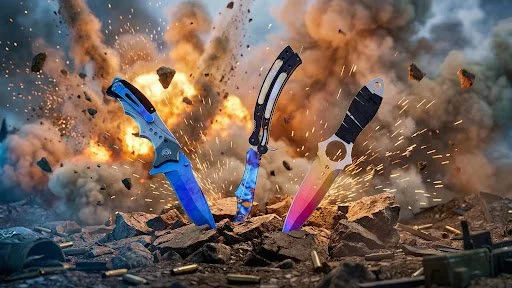
The October 2025 update to Counter-Strike 2 changed the game’s economy. Valve added a knife and glove crafting system. For many years, players mainly obtained knives by opening cases or buying them on the Steam Market. The new Trade-Up Contract now lets players craft knives or gloves directly. This shift changed supply and demand across the market.
This article looks at whether traditional CS2 (CS:GO) cases still matter when players can craft rare items instead. It explains how crafting works, how it affects prices, and what this change means for the future of cases.
What Knife Crafting Is and How It Works
On October 23, 2025, Valve released a new Trade-Up Contract. This contract allows players to craft high-tier items like knives and gloves. To do this, players trade in five Covert (red) skins.
Before this update, players mostly relied on case openings or market purchases to get knives. Crafting now offers a direct path to these items.
Under the new system, players submit exactly five Covert skins from the same tier. The system then creates a random knife or pair of gloves. If all input skins have StatTrak, the crafted item will also have StatTrak. This change alters how rare items enter the market.
How Crafting Works
Players choose five Covert skins
The Trade-Up Contract creates a random knife or gloves
StatTrak results require all StatTrak inputs
The item appears instantly in the player’s inventory
This system removes case opening randomness. It adds more choice and planning for players who want rare cosmetics.
Market Impact: Prices, Supply, and Demand
Knife crafting affected the CS2 skin market almost right away. Within one day, total market value dropped sharply. Many players rushed to sell items, which caused panic and heavy price swings.
Market Changes at a Glance
| Market Factor | Before Update | After Update |
|---|---|---|
| Skin market value | High (around $6B) | Down about 28% in 24 hours |
| Knife prices | High due to rarity | Down 20–50% or more |
| Covert skins | Regular inventory items | Sharp price increase |
Crafting increased the supply of knives and gloves. As more items entered the market, prices fell. At the same time, Covert skins became essential for crafting. Demand for them rose fast, which caused temporary shortages and price spikes.
Analysts also observed strong volatility in the weeks after the update. Over time, prices began to stabilize as traders adjusted and speculation slowed.
Are CS2 Cases Still Relevant After Knife Crafting?
At first, knife crafting made CS2 cases seem less useful. Players can now turn Covert skins into knives. This makes case openings feel less rewarding, since knife drops remain rare. After the October 2025 update, case opening activity dropped.
Cases did not disappear. Their role changed. Instead of serving as the main way to get knives, cases now act as a key source of crafting materials. Knife crafting requires Covert skins, and cases remain one of the easiest ways to obtain them in large numbers.
Cases as a Source of Crafting Inputs
Cases now serve a new purpose in the CS2 economy. Players open them to get high-tier skins, not just knives.
Cases still matter for several reasons:
They provide a steady supply of new Covert skins
Crafting keeps demand for these skins high
During price drops, opening cases can cost less than buying skins directly
As long as crafting consumes Covert skins, cases keep their place in the ecosystem.
Collector Demand and Emotional Value
Cases also hold cultural value. Case opening remains one of the most familiar experiences in Counter-Strike. The suspense, visuals, and shared community moments still attract players.
Collectors continue to seek rare and discontinued cases. Some older cases stabilized in price after the initial market shock. This shows that long-term interest remains.
Cases now act as collectibles as well as economic tools. Nostalgia, rarity, and history influence their value, not just profit potential.
Player and Trader Perspectives
Knife crafting lowered the cost of entry for many players. Instead of buying an expensive knife, players can gather Covert skins over time and craft one later.
Traders and investors adapted rather than stepped away. Many shifted focus to:
Collecting Covert skins
Trading cases during market swings
Timing crafting activity based on supply levels
These new strategies helped parts of the market stabilize faster than expected.
Cases and Crafting: Competition or Coexistence?
At first, many players saw knife crafting as a threat to case openings. In practice, crafting and cases work together. Crafting does not create new items. It uses skins that mostly come from cases.
This link creates a feedback loop. When players craft more knives, they remove more Covert skins from the market. Supply drops. Demand for new Covert skins rises. Players then turn back to cases to restock. Over time, this cycle helps balance rarity instead of removing it.
How Cases and Crafting Work Together
Cases add new skins to the economy
Crafting removes excess Covert skins
Knives stay desirable but lose artificial scarcity
The market shifts from pure luck to planning
This structure shows that Valve aimed to steady the economy, not break it.
Long-Term Outlook for the CS2 Skin Economy
A few weeks after the October 2025 update, the market began to settle. Knife prices stopped falling. Covert skin prices stabilized. Case opening activity slowly increased.
The economy now moves faster, but it also adapts better. In the long run, knife crafting may help cases stay relevant. Crafting depends on Covert skins, and cases supply them. Without cases, crafting cannot scale.
Players now have more options. Traders face more variables. The market relies less on extreme rarity alone.
Why Case Opening Volume Did Not Collapse
After the crafting update, many expected case openings to drop sharply. That did not happen. Activity fell for a short time, then stabilized.
Lower knife prices reduced the appeal of rare jackpot drops. At the same time, demand for Covert skins increased. This demand helped offset the decline.
Many players found a new reason to open cases. Even without a knife, a Covert skin now has clear use in crafting. This shift in mindset helped cases remain relevant during a period of market change.
Final Verdict: Are CS2 Cases Still Relevant?
Knife crafting changed the CS2 economy. It shifted prices, altered habits, and challenged old ideas about rarity. It did not remove the role of cases.
Cases evolved. They moved from being the final goal to becoming the base of a larger system. As long as players need Covert skins, cases will matter.
In the crafting era, cases are not only about luck. They reward timing, planning, and long-term thinking. This shift may keep them relevant for years.