Disclosure: This is a paid guest post. The author or an affiliated third party paid for its publication, and the article may contain promotional links. The views and opinions expressed are those of the author and do not necessarily reflect those of GameTyrant or its editorial staff.
Everybody who has played Super Mario Bros. has a feel for it. World 8-1 goes on forever. 6-2 is the one with all the coins. 2-3 is the bridge level where nothing is really trying to kill you.
We wanted the actual numbers behind those feelings, so we went and got them.
Where these numbers come from
A quick note on method, because it matters for how much you should trust what follows.
The counts below are not from playing through and tallying by hand. They come from the map data of Full Screen Mario, the open-source HTML5 re-creation of the 1985 original. Every level in that project is defined in a JavaScript file that lists each object and where it sits:
pushPreThing(Goomba, 640, 8)
puts a Goomba at a specific coordinate,
pushPrePipe(800, 0, 24, true, 2)
puts down a pipe of a given height with a Piranha Plant in it that leads to a particular area.
Parse those files and you get an inventory of the entire game.
The obvious caveat: this is a re-creation, not the NES ROM. It reproduces the original layouts closely, but a handful of values may be off by one or two from the cartridge. Where we could check against well-documented facts, everything lined up — both Warp Zones point where they should, Bowser appears in exactly eight castles, Lakitu shows up in the three levels everyone remembers him from. Treat the numbers as accurate to the recreation, and near-identical to the original.
The whole game in one table
Here is every level, with what’s actually placed on its map.
| Level | Setting | Enemies | Coins | Pipes | Notable |
|---|---|---|---|---|---|
| 1-1 | Above ground, underground | 17 | 19 | 7 | — |
| 1-2 | Above ground, underground | 15 | 34 | 5 | Warp Zone |
| 1-3 | Above ground | 8 | 23 | 0 | — |
| 1-4 | Castle | 1 | 0 | 0 | Bowser |
| 2-1 | Above ground, sky, underground | 24 | 57 | 8 | Vine |
| 2-2 | Above ground, water | 23 | 28 | 2 | — |
| 2-3 | Above ground | 0 | 35 | 0 | — |
| 2-4 | Castle | 3 | 6 | 0 | Bowser |
| 3-1 | Night, underground, sky | 28 | 64 | 5 | Vine |
| 3-2 | Night | 35 | 7 | 1 | — |
| 3-3 | Night | 7 | 19 | 0 | — |
| 3-4 | Castle | 7 | 0 | 0 | Bowser |
| 4-1 | Above ground, underground | 1 | 34 | 4 | Lakitu |
| 4-2 | Above ground, underground | 13 | 42 | 11 | Warp Zone, vine |
| 4-3 | Above ground | 6 | 23 | 0 | — |
| 4-4 | Castle | 1 | 0 | 1 | Maze, Bowser |
| 5-1 | Above ground, underground | 27 | 10 | 4 | — |
| 5-2 | Above ground, water, sky | 25 | 70 | 3 | Vine |
| 5-3 | Above ground | 8 | 23 | 0 | — |
| 5-4 | Castle | 7 | 6 | 0 | Bowser |
| 6-1 | Night | 1 | 8 | 1 | Lakitu |
| 6-2 | Night, underground, water, sky | 16 | 100 | 28 | Vine |
| 6-3 | Night | 0 | 20 | 0 | — |
| 6-4 | Castle | 3 | 0 | 0 | Bowser |
| 7-1 | Above ground, underground | 10 | 19 | 5 | — |
| 7-2 | Above ground, water | 30 | 28 | 2 | — |
| 7-3 | Above ground | 7 | 35 | 0 | — |
| 7-4 | Castle | 2 | 0 | 1 | Maze, Bowser |
| 8-1 | Above ground, underground | 50 | 32 | 12 | — |
| 8-2 | Above ground, underground | 15 | 10 | 4 | Lakitu |
| 8-3 | Above ground | 11 | 0 | 3 | — |
| 8-4 | Castle, underwater castle | 15 | 0 | 18 | Maze, Bowser |
Totals for the whole game: 416 enemies, 752 coins, 122 pipes, 58 power-ups and 10 extra lives. If you want to poke at any single stage in more detail, there’s a per-level breakdown of all 32 Super Mario Bros levels built from the same data.
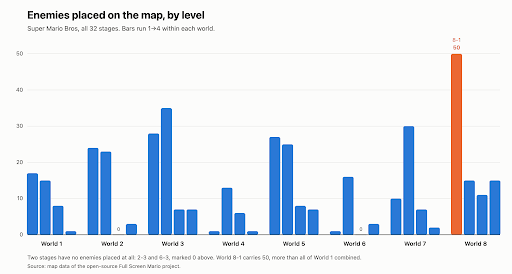
Enemies placed on each map. World 8-1 carries 50 — more than all of World 1 combined. Levels 2-3 and 6-3 have none at all.
Things the count turns up
A few results were not what we expected.
Koopa Troopas slightly outnumber Goombas. 139 to 137 across the game. Goombas feel more common because they own the first world and they walk into you; Koopas are spread more evenly and often sit still until you arrive.
Lakitu appears in three levels. That’s it. 4-1, 6-1 and 8-2. Three appearances out of thirty-two stages, and yet ask anyone to describe Super Mario Bros and he comes up. That’s what a persistent, respawning enemy does to your memory of a level compared to something that just stands there.
Two levels have no enemies placed at all. 2-3 and 6-3. In 2-3 the whole design is bridges over open water, and the hazard is the gap, not a creature. 6-3 is built on moving platforms over a void. In both cases the geometry does the work an enemy would normally do.
The enemy roster is smaller than it feels. Nine types across the entire game:
| Enemy | Count |
|---|---|
| Koopa Troopa | 139 |
| Goomba | 137 |
| Cheep Cheep | 42 |
| Blooper | 28 |
| Buzzy Beetle | 22 |
| Hammer Bro | 19 |
| Podoboo | 18 |
| Bowser | 8 |
| Lakitu | 3 |
Two enemy types account for two-thirds of everything in the game, and the drop-off after them is steep:
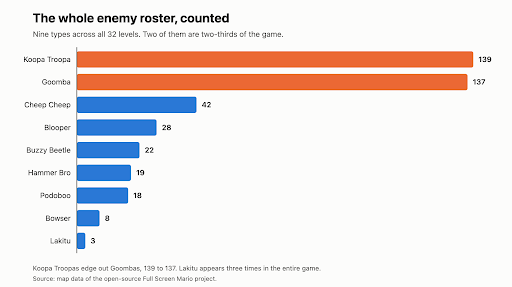
Koopa Troopas edge out Goombas, 139 to 137. Everything else is a long tail.
Where the secrets actually sit
The two Warp Zones
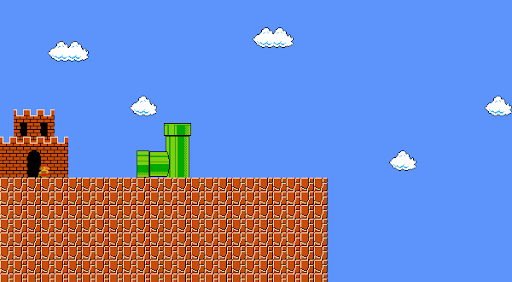
World 1-2. Keep going along the ceiling past the last pipe and the Warp Zone is waiting.
There are exactly two, and the data confirms where each one goes.
World 1-2 hides three pipes leading to Worlds 2, 3 and 4. Run along the ceiling past the end of the pipe section and you land in the room. This is the Warp Zone in World 1-2 that most people found by accident as kids.
World 4-2 has two separate secrets: a vine up to a sky bonus area, and a second Warp Zone with pipes to Worlds 5, 6, 7 and 8.
That’s the whole shortcut system. Four pipes in 4-2 is the single biggest jump available in the game, and it’s why any casual “beat Mario in an afternoon” run goes 1-1, 1-2, then straight to 4-1.
The five hidden vines
Beanstalks show up in exactly five levels: 2-1, 3-1, 4-2, 5-2 and 6-2. Each is a brick you hit from below, and each leads up to a coin-heavy sky area.
Worth noticing: four of those five levels are in the “-1” or “-2” slot. Nintendo put the reward-for-curiosity moments early in each world, where a player still has lives to spend on exploring.
Why there’s no Minus World here
If you went looking for World -1 in a browser recreation, you won’t find it, and that’s not an oversight.
The Minus World isn’t level data. It’s what happens when the NES reads past the end of a lookup table because of how the pipe in 1-2 gets entered with the wrong screen state. There is no “-1” defined anywhere in the original, and there’s nothing to port. A re-implementation that rebuilds the levels as data structures simply has no equivalent bug to reproduce.
Worth keeping straight, because the two kinds of secret get talked about as if they were the same thing. One was designed. The other fell out of the hardware.
What World 1-1 does without telling you
World 1-1 is the most analysed level in games, and the numbers support the usual reading rather than complicating it.
Seventeen enemies, nineteen coins, seven pipes, one of which you can actually enter. The level is a tutorial that never says it is one:
The first Goomba walks toward you on flat ground with nothing else happening. You cannot avoid learning what it does.
The first question block sits directly above where you’re standing when the Goomba arrives, so the panic jump teaches you what blocks do.
The first pit is narrow enough to clear from a standstill. The game does not ask for a running jump until you’ve already made an easy one.
The first pipe you can enter is visually identical to the six you can’t, so entering one is a discovery rather than an instruction.
That last point is the one that gets overlooked. Six decorative pipes and one real one is a deliberate ratio. If every pipe worked, nothing would feel hidden.
The outliers
8-1 is the longest by a wide margin. At 2,928 units of map data it’s roughly 65% longer than the next-longest level, and it carries 50 placed enemies — more than any other stage, and more than the whole of World 1 combined.
6-2 is the coin level. One hundred coins and 28 pipes, both game records. No other stage has more than 70 coins or more than 16 pipes.
Then there’s 8-3, which somehow fits eight Hammer Bros into one stage. That’s 42% of every Hammer Bro in the game, standing in pairs on stone blocks with very little room to work with.
The castles surprised us by going the other way. You’d expect them to escalate, and they don’t: 1-4 has a single enemy on the map, and while 8-4 has fifteen, eleven of those sit in the underwater maze rather than on the run at Bowser. Castle difficulty here is navigation and fire bars, not enemy volume.
What this means if you run the game fast
Speedrunners already know the routes, but the data explains why the standard any% route looks the way it does.
The Warp Zones in 1-2 and 4-2 skip 21 of the 32 levels. The run touches 1-1, 1-2, 4-1, 4-2, then 8-1 through 8-4.
Of the eight levels in that route, three are the longest in the game (8-1, 4-2 and 4-1 are first, second and third by map length). The route trades level count for level length, which is why 8-1 is where runs are won and lost.
The two maze castles on the route, 4-4 and 8-4, are built from repeating sections rather than continuous maps. That’s the structural reason a wrong turn loops you instead of just costing a few seconds.
FAQ
How many levels does Super Mario Bros. have?
Thirty-two, arranged as eight worlds of four levels each. Using both Warp Zones you can finish having played only eight of them.
How many Warp Zones are there?
Two. World 1-2 leads to Worlds 2, 3 and 4. World 4-2 leads to Worlds 5, 6, 7 and 8, and also hides a vine to a separate sky bonus area.
Which level has the most coins?
World 6-2, with 100. It also has the most pipes of any stage, at 28.
Which is the longest level?
World 8-1, at 2,928 units of map data — about 65% longer than the runner-up.
Are there levels with no enemies?
Two: 2-3 and 6-3. Both replace enemies with gaps and moving platforms.
Why can’t I find the Minus World in browser versions?
Because it isn’t a level. It’s a read past the end of a data table on original NES hardware, so a recreation built from proper level definitions has nothing to reproduce.
Level data parsed from the map files of the open-source Full Screen Mario project. Counts reflect objects placed on each map and do not include enemies generated at runtime.