Computer and console games are a passive pastime that New Zealanders can use to escape social interactions or experience emotions difficult to achieve in real life. Many consider games a waste of time, but they can actually develop a significant number of skills. The brain begins to function differently, creating conditions for new ways to analyze information and make important decisions. Below is a list of opportunities offered by computer and PS5 gaming.
Strategic thinking and situation analysis
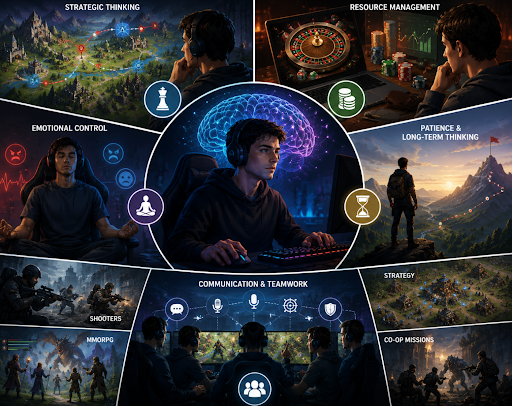
Online games require a person to assess the situation before each action and make decisions based on the available information. The player must take into account the amount of resources, the opponent's position, and the possible consequences of their moves in strategies. Risk assessment helps to understand when it is worth acting actively, but there are cases when it is better to wait and maintain an advantage. The wrong decision can lead to a loss of progress, so the player learns to analyze mistakes. Planning several steps ahead is necessary because of the need to anticipate the actions of other participants. Team games require thinking not only about your own result, but also about interaction with allies.
Strategic thinking is also associated with the ability to adapt to new conditions, because the gaming environment is constantly changing. If the initial tactic stops working, the player needs to quickly find another way to achieve the goal. Research in the field of cognitive skills shows that regular online games can make better high-speed decisions and information processing. A person can control 5–10 different perks at a time because they need to look at the map, resources, enemies, and their own actions. This trains mindfulness and the ability to divide focus between many tasks. It will be useful skills that NZ residents can try during business planning and risk analysis.
Casino entertainment as a way to control resources
Casino games can be a situation where a person needs to test their ability to manage resources and make limited decisions. The main component is a budget that users need to allocate before starting gambling. The player must determine the amount he wants to spend and monitor the limits. Controlling money helps to avoid impulsive decisions under the influence of emotions after wins or losses. New Zealanders need to improve the skill of understanding the ratio of risk and possible reward. Betting all your money can deprive you of all savings, which will lead to depression or family problems.
Money management in a casino is associated with controlling your own behavior, but many players believe that the main thing is to find a guaranteed result. A person learns to set rules for himself and not change them under the influence of emotions. Studies show that gamblers who treat the game as a good way to spend time are the most successful. New Zealanders can open the bonus overview on the Casinos Analyzer website to choose a worthy club. These actions allow New Zealanders to control the process longer and make better decisions. The player also analyzes his routine, noticing mistakes in choosing a strategy or betting amounts. These kinds of skills can help with planning a business and managing finances in real life.
Emotional control and self-discipline
Emotional control in video games and casinos shapes a person’s decisions, which helps them make choices without letting fleeting emotions influence them. A player may feel the desire to return the losses after an unsuccessful game, but this moment tests his discipline. The ability to pause, assess the situation, and not increase the risk is a chance to control emotions. Computer games test how a player is able to limit the time, budget, or number of attempts. Data from the New Zealand Ministry of Health for 2023/24 assessed game participation, the level of risk, and the harm from them among 15+ people. It indicates a bad effect on young people. The ability to manage emotions helps prevent one unsuccessful decision from affecting subsequent actions. However, gamers can channel their emotions in a different direction:
Sports;
Traveling;
Walking;
Watching a film;
Meeting with friends.
Self-discipline is also associated with the ability to accept defeat and analyze one’s own mistakes. A nice player studies the reason for the mistake after an unsuccessful round, so everyone wants to win back without delays in 2026. New Zealand research data shows that 8.3% of adults fall into the category of players with some level of risk, while 2.4% have a moderate or high risk of behavior. Indicators demonstrate the importance of controlling emotional reactions. Psychological stability allows NZ residents to assess the situation more accurately and not make a decision through the risk of losing a lot of money. Every day life tends to carry over to financial decisions, homework, and work situations.
Patience and long-term thinking
The main advantage belongs to the one who better understands the situation a few steps ahead. Quick decisions often give a good result, but can create problems in the future if they do not take into account the consequences. Spending all resources on one attack can leave the player without the ability to defend himself later in strategic games. Patience helps to wait for the right moment instead of acting only out of a desire to get a quick win. A similar principle can be seen in casino entertainment, where impulsive betting after a failure leads to even greater risks.
A sequential strategy allows a person to control their actions even when the result does not meet expectations. In video games, this is manifested through the gradual development of the character, the accumulation of resources, and choosing the right moment for complex actions. Progress depends both on the final victory and on the decisions that were made on the way to it. Analyzing their own mistakes, the players change tactics and gradually improve the result. This develops the skill of seeing cause-and-effect relationships and working for the future. This type of thinking is useful when studying, career planning, and managing finances in real life.
Communication and teamwork
Many 2026 online games are designed so that success depends on how well players interact with each other. Players often need to quickly communicate information, distribute responsibilities, and work together to find solutions when the game changes. A person learns to explain their actions, listen to other participants, and adjust their own strategy to the team. Users can develop communication skills most by:
MOBA Games;
Team Shooters;
MMORPGs;
Team Battle Royale;
Co-op Games;
Real-time Strategy.
Team play shows that even a strong individual player cannot always achieve a result without proper interaction with others. Participants gradually understand the importance of roles: someone makes decisions, someone supports the team, and someone is responsible for completing a specific task. The ability to control emotions during conflict situations also becomes an important part of communication.