Gamers who download the latest updates, such as the recent patch 2.55 for War Thunder: The Ninth Wave, expect everything to work instantly. What they do not see is the weeks of testing that went into the update.
In today’s gaming environment, the QA process goes far beyond just finding bugs. It involves validating content, protecting player experiences, and ensuring the entire game ecosystem remains stable.
Automated Testing Cannot Catch Everything
There is undeniable appeal in automating the QA process, as it enables faster testing of logins, menus, transactions, and basic game functions. This speed is essential for handling the scale of modern live-service titles.
The problem with automation is that it cannot fully replicate player unpredictability and creativity. There are significant issues when dealing with emergent gameplay, progression systems, social features, and mod interactions.
If these issues cause details to be missed, it can have a significantly detrimental impact on gamer UX. For example, a weapon stat displaying the wrong damage value may seem like a minor UI issue, but competitive players can make loadout decisions based on inaccurate information, undermining game balance and trust in the developer. In addition, incorrect matchmaking data can place players into skill brackets they don't belong in, leading to unfair matches and complaints about competitive integrity.
These are just two potential results of using a solely automated QA system that cannot catch every problem in a game update. The potential for these results means that manual testing is employed alongside automation in the testing pipeline.
The Hidden Testing Pipeline Behind Major Releases
Building a test environment involves creating controlled versions of the game that closely mirror live servers so new updates can be safely evaluated before release. Developers use internal builds for early feature checks, then move content to staging servers that replicate real multiplayer systems, progression data, and in-game economies.
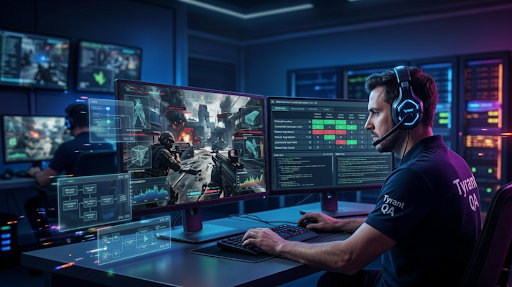
QA teams run tests using simulated player accounts, stress-test server performance under heavy load, and verify cross-platform compatibility across consoles, PC, and mobile. The goal is to catch issues in gameplay, balance, and infrastructure without impacting real players, ensuring updates behave correctly within the full game ecosystem.
Multi-week QA cycles are an integral part of this process. This involves repeated testing of updates, expansions, seasonal content, and downloadable assets. It also involves regression testing to ensure new features do not break existing systems.
Cross-team Collaboration is essential to the testing pipeline. Teams that are part of the process include QA teams, gameplay designers, live-service operations, community managers, and engineers.
Verifying Interactive Content Beyond the Core Game
Every aspect of gameplay must be tested. Common player touchpoints that are subject to this testing include menus and user interfaces, in-game stores and battle passes, achievement systems, and social features.
The process involves data validation at scale. As discussed by validation experts, player protection is the most vital aspect of testing touchpoints. Evaluating the presence of protection and fairness is essential to safeguarding the brand's reputation by preventing exploits, duplicate rewards, progression errors, and content unlock issues.
Matchmaking systems are also a vital aspect of this validation. They are the backend systems that automatically group players into online matches according to predefined rules and criteria. Their main goal is to create fair, balanced, and enjoyable gameplay experiences by pairing players with others of similar experience.
Preserving UI/UX Integrity for Real Players
Earlier, we discussed the value of automation in QA testing. This is where manual testing comes into its own. QA testers actively play through content rather than relying solely on automation.
This manual testing makes it easier to simulate real-world player behavior, including competitive players pushing systems to their limits, new players navigating tutorials, and modders experimenting with unexpected combinations, such as new maps or custom characters.
Manual testers also identify Edge cases in gaming. These unusual player actions, system conditions, or gameplay situations that fall outside the normal way a game is expected to be played are rare, but they do happen, and are a vital aspect of the QA process.
Finally, using real people to test game updates ensures that the resulting changes are not only functional but also playable. This is important because a game feature can be technically functional, meaning it does what the code says it should, but still feel frustrating, confusing, or outright unpleasant to use. In gaming QA, this gap between “it works” and “it plays well” is one of the most important things to evaluate.
In Summary
Every smooth patch, balanced update, and seamless player experience is supported by a largely invisible network of QA professionals working behind the scenes. The reason for this is that successful game launches depend on much more than automated bug checks. Blending automation with manual testing, data verification, and user experience evaluation creates an optimal testing environment for speed, scale, and final results.