Disclosure: This is a paid guest post. The author or an affiliated third party paid for its publication, and the article may contain promotional links. The views and opinions expressed are those of the author and do not necessarily reflect those of GameTyrant or its editorial staff.
Disclaimer: The following content contains references to gambling, casinos, and related topics.
If you have ever rolled 3d6 for a character sheet (three six-sided dice, the way D&D generates ability scores), you already know more about Sic Bo than most people at the table. The whole game is three dice and one roll. You bet on what the dice will show, the dice get rolled, and every bet on the board pays or clears right there. Live Sic Bo takes that game and puts it on a video stream. A live presenter hosts the game from a studio while an automated shaker rolls the dice. The three dice sit inside that sealed glass shaker on camera, so nobody ever touches them.
In Canada, the two versions you will actually come across are Super Sic Bo from Evolution and Mega Sic Bo from Pragmatic Play. Both are standard Sic Bo with random multipliers layered on top, and both run at the Canadian sites below. The rest of this guide reads the board the way a tabletop player reads a dice pool. By the end you will be able to tell which bets are priced most efficiently and which ones are quietly expensive.
Where to Play
If you want a live Sic Bo table right now, start with these three iGaming brands (legal gambling age applies in your province, and please play responsibly; help resources are at the end of this guide). All three stream their dice tables from Evolution or Pragmatic Play studios.
- Jackpot City: Evolution live studio, Super Sic Bo, and live Sic Bo table offerings.
- Spin Casino: Mega Sic Bo listed by name on its Canadian live-casino page, with Evolution tables alongside.
- Ruby Fortune: dedicated Sic Bo category inside the live lobby, Mega and Super variants both reported.
The minimum age to play Sic Bo online for money is 19, or 18 in Quebec, Manitoba and Alberta.
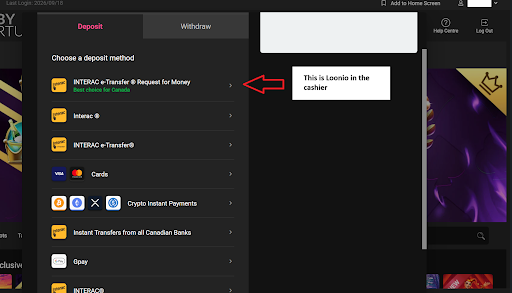
One practical note before you go hunting. These lobbies get reshuffled fairly often as Evolution and Pragmatic rotate tables in and out. Skip the scrolling and type Super Sic Bo or Mega Sic Bo straight into the live-casino search box. Don't be fooled by the plain Sic Bo tile sitting in the regular table-games section, though. That one is the RNG version, no host and no stream. New to the cashier side of these sites? We walked through the deposit flow step by step in Where to Game Online With Loonio in Canada, so start there.
Sic Bo Demystified
The object of the game is to predict what three dice will show. That is the whole thing. Three dice are shaken inside a sealed shaker. They settle, and you win if the faces match what you bet on.
Most people bet on the total. Add the three dice together and you get a number from 3 to 18. The two biggest spots on the board split that range in half. Small wins if the total is 4 to 10. Big wins if the total is 11 to 17. Both pay even money. If you want to be more precise, you can bet on one exact total instead, anywhere from 4 to 17. The rarer the total, the more it pays.
The rest of the board is about the individual dice rather than the sum. You can bet that a specific number, say a 4, shows up on at least one die. You can bet that two of the dice show a specific pair, such as a 2 and a 5. You can bet on a double, meaning the same number on at least two dice. And you can bet on a triple, meaning all three dice match, either a specific triple like 6-6-6 or any triple at all. Odd and Even round out the layout on most live tables. The board looks dense the first time you see it, but those are the main bet families you will encounter. Providers group and label them a little differently, but the underlying bets are the same.
A round runs like this. Betting opens and a timer starts. You pick a chip value and tap any spot you want. You can spread chips across as many spots as you like on the same roll. When the timer hits zero, the shaker runs. The dice settle and the winning spots light up. Each bet is settled on its own, so your Small bet can pay while your exact-total bet on the same roll loses. Then the board clears and the next timer starts.
One rule trips up almost every new player. If all three dice show the same number, Small and Big both lose. So do Odd and Even. It does not matter what the total is. A 2-2-2 adds up to 6, which sits inside the Small range, and Small still loses. That single rule is where the house edge on the even-money bets comes from. Without it they would be a fair coin flip.
What you cannot do matters as much as what you can. You never touch the dice. You cannot bet once the timer closes. Nothing you do changes the roll, and there is no skill anywhere in the game. The only decisions are which spots to bet and how much to put on each.
Where Sic Bo Comes From
Sic Bo is Cantonese, written 骰寶, and translates roughly as "precious dice." In Macau and Hong Kong it more often goes by dai siu, which means "big small." That second name is telling: the game has been defined by its two even-money bets for as long as it has had a name. The game is Chinese and old, though nobody can put a reliable date on it. For most of that history it was simply a dealer shaking three dice under a covered cup.
England developed its own three-dice banking games separately. Grand Hazard came first, and chuck-a-luck grew out of it in America, with the dice tumbling inside a wire cage that gave the game its birdcage nickname. Chinese immigrants brought Sic Bo itself to North America in the early twentieth century. It has stayed a minor pit game in Las Vegas and Atlantic City ever since, and Britain did not clear it for licensed casinos until 2002. Macau is where it became a fixture, second only to baccarat on the floor. Modern Sic Bo tables commonly use automated glass shakers, and that is the format most live-streamed versions reproduce.
The 3d6 Bell Curve You Already Know
Three six-sided dice give you 216 equally likely outcomes, and the totals from 3 to 18 are nowhere near evenly spread. There is one way to roll a 3 and one way to roll an 18. There are 27 ways to roll a 10 and another 27 for an 11. The curve piles up in the middle and thins out fast toward the edges, which is exactly why a 3d6 stat of 18 feels special.
Here is the full count of combinations out of 216 for each total:
3 or 18: 1 way each
4 or 17: 3 ways each
5 or 16: 6 ways each
6 or 15: 10 ways each
7 or 14: 15 ways each
8 or 13: 21 ways each
9 or 12: 25 ways each
10 or 11: 27 ways each
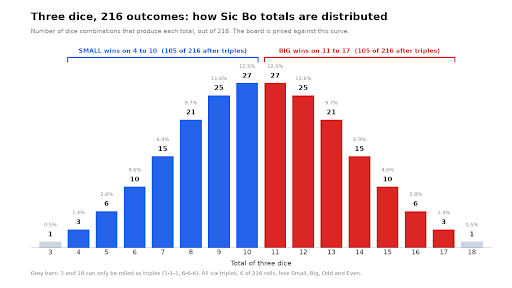
Hold that list in your head while you look at a Sic Bo layout, because every spot on the board is just a piece of that curve with a price tag on it. The casino's edge on any bet is the gap between that price and the real count.
One Shake Settles Everything
Anyone who learned craps on a casino floor should notice the big difference first. Craps carries state from roll to roll. A pass line bet can take half a dozen throws to resolve, and once a point is set, the same number means different things on later rolls.
Sic Bo has none of that, though, and honestly it is a relief. Every bet on the board is decided by the next shake and nothing else. There is nothing to track between rounds and no sequence to memorize, so you can sit down cold and follow the whole thing within two rolls.
That simplicity is a big part of why the game translates so well to a live stream. There is no dead time to fill. A round at Super Sic Bo takes well under a minute from the moment betting opens to the moment the dice settle. The host handles the pacing, calling the result and holding on a close-up of the three dice long enough for you to read the faces yourself. Then the board clears, and by the time you have decided what to do next the window is already open again.
The Bets, Priced Honestly
Sic Bo payouts are fixed odds, so you can price every bet yourself by comparing the payout to the true count out of 216. Here are the main families and what they actually cost you.
Small and Big. Small wins on totals of 4 to 10 and Big wins on 11 to 17. Both pay 1 to 1, and both lose on any triple, even a triple that would otherwise land in range. Strip those triples out and you are left with 105 winning combinations out of 216, a 48.61 percent chance on an even-money bet. That works out to a 2.78 percent house edge and a 97.22 percent return on both Super Sic Bo and Mega Sic Bo. Nothing else on the board comes close.
Odd and Even. Same price, same 97.22 percent return, same triple rule.
Single number. Pick a face from 1 to 6. If it shows on one die you get 1 to 1, on two dice 2 to 1, on all three 3 to 1. The edge sits just under 8 percent, which is fine, and you are paid out often enough that the bet feels alive.
Totals. Bet the exact sum of the three dice, anywhere from 4 to 17. The payout scales with rarity, so the middle totals around 10 and 11 pay the least and the 4 and 17 pay the most. Exact totals payouts differ between Super Sic Bo, Mega Sic Bo and traditional tables, so check the paytable panel inside the game before you commit. As a rule the returns on totals land somewhere between roughly 90 and 96 percent depending on the number.
Two-dice combinations. Pick two different faces, say a 2 and a 5, and win if both show up. There are 15 combinations and the standard payout is 5 to 1, with about a 13.9 percent chance to hit.
Doubles. You are betting that a specific face appears on at least two of the three dice. The chance is 16 in 216, roughly 7.4 percent, and payouts vary by table, so that is another one for the info panel.
Specific triple. All three dice show the number you picked. The probability is 1 in 216, or 0.46 percent. Super Sic Bo and Mega Sic Bo pay 150 to 1 on it, which sounds huge until you run the math. The return is 151 divided by 216, or 69.9 percent, for a house edge of 30.09 percent. That is roughly eleven times the edge on Small or Big, on the same board, in the same round.
Any triple. Any of the six triples, so six outcomes in 216, paying 30 to 1. The return is 86.11 percent and the edge is 13.89 percent.
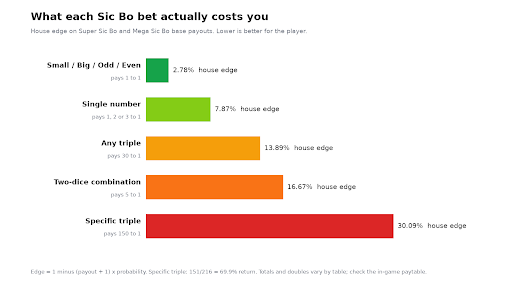
The pattern should be obvious by now. The fatter the slice of the curve you bet on, the fairer the price. The thinner the slice, the further the payout lags behind the true odds.
What the Multipliers Actually Do
Super Sic Bo and Mega Sic Bo are both regular Sic Bo with a random multiplier layer bolted on, and the mechanic is similar in both. Once betting time expires, the system picks a handful of bet spots at random and attaches multipliers to them. Evolution's Super Sic Bo lights its chosen spots with multipliers of up to 1000x as the dice are shaken. Pragmatic's Mega Sic Bo does the same thing across its 52-position grid.
Three details decide whether this is good or bad for you.
First, you cannot see the multipliers when you bet. They are assigned after the window closes, so there is no way to chase a lit spot. Whatever you put down, you put down blind.
Second, a multiplier replaces the standard payout for that round rather than stacking on top of it. A specific triple that normally pays 150 to 1 and lands a 500x multiplier pays 500x, not 650x.
Third, and this is the one most guides skip, the base payouts on multiplier-eligible spots are trimmed below traditional Sic Bo to fund the multipliers. That is why Super Sic Bo and Mega Sic Bo pay 150 to 1 on a specific triple. Plenty of land-based tables pay 180 to 1 on the same bet. The multiplier is not free money. It is variance you are buying with a slightly lower base return.
Mega Sic Bo adds one more rule worth knowing. Small, Big, Odd and Even stay at their standard fixed payout with no multiplier eligibility at all. Pragmatic keeps those four spots at a flat 97.22 percent and sends all the fireworks elsewhere. Super Sic Bo uses its own Lucky Numbers multiplier mechanic, so check the in-game paytable rather than assuming every bet family can be boosted.
So here is the honest framing. Multipliers turn a steady dice game into a high-variance one on the long-shot bets, while the even-money bets stay as the dependable core underneath. Which side you lean on is a bankroll call, not a strategy call, because no betting pattern changes the math.
Live Table or First Person
Evolution also publishes First Person Super Sic Bo, which is the same game rendered as an RNG-driven 3D table with no stream and no host. There is a Go Live button in the corner that drops you into the real studio table whenever you want it.
Think of First Person as the solo, RNG-based version and the live table as the shared studio version. First Person rounds are quicker and run entirely at your pace, since you are the only one at the table. The live version follows the studio timer instead, and you share each shake with everyone else who has chips down. Check the game-info panel in each before you assume the paytables match, then pick based on whether you want the stream and the company or just the speed.
Both versions run as HTML5 in the browser, so there is nothing to install and no platform lock. If you game on Linux or a Steam Deck in Desktop Mode, everything in our piece on how HTML5 and Mesa drivers made Linux casinos viable carries over. The one part that leans hardest on your setup is the live video stream itself, which depends on your browser's codec support more than on the GPU.
Five Sic Bo Tips for Canadians That Actually Hold Up
Most Sic Bo strategy content is either filler or superstition. These five are grounded in the numbers above and in how the Canadian live lobbies are actually set up.
Anchor every round on Small, Big, Odd or Even. These are the only bets on the board returning 97.22 percent. In Mega Sic Bo they are also the only spots that can never carry a multiplier, so you give up nothing by parking your main stake there. If you want a shot at the multipliers, put a small fraction of your round stake on one eligible spot and keep the rest on the even-money bet. That way your variance comes from a controlled sliver, not your whole stack.
Never bet Small and Big together thinking you have hedged. It feels safe, but a triple kills both bets at once. Triples come up on 6 of 216 rolls, and the two bets cancel each other on every other roll. That makes this "hedge" a guaranteed 2.78 percent bleed per round with zero upside. The same logic applies to Odd plus Even.
Compare the specific-triple payout in the info panel before you pick a table. A plain RNG Sic Bo table might pay 180 to 1 on a specific triple. The live multiplier version pays 150 to 1 on the same bet. In effect, the live table trades 30 units of fixed payout for a shot at a 1000x multiplier. That is a fair trade if the multiplier is what you came for. Taking 150 to 1 on a table with no multiplier attached, though, is paying extra for nothing.
Read the totals paytable, not just the total. The same total can be priced differently by Evolution, Pragmatic and traditional tables. On the rare totals like 4 and 17, the gap can be ten units or more of payout. If totals are the bets you actually like, compare every Sic Bo paytable available in your lobby, including traditional, Super and Mega versions. Multiplier versions can share similar base pricing, while a conventional table may offer a stronger fixed payout on the numbers you play. That is five minutes of effort for a permanent edge improvement.
Ignore the history strip. Every live Sic Bo table shows the last dozen or so results, often with "hot" and "cold" numbers highlighted. The dice have no memory, so a run of Big results tells you nothing about the next shake. Treat the strip as decoration. The one place history does matter is your own session. An hour at the table is roughly 60 rounds and 60 separate decisions, and that pace is what you should budget for.
Responsible Gambling With Sic Bo
Sic Bo rounds are short, and that pace is the thing to respect. A live table can run a round roughly every minute. At that speed a modest stake turns into a meaningful hourly amount faster than it does at blackjack or roulette. Work out your hourly figure before you sit down: base stake times the rounds you realistically play. Set your session budget from that number rather than from a round figure that merely sounds comfortable.
All three sites in this guide expose deposit limits, loss limits and session reminders in the account settings. Setting them before your first shake takes about a minute. Self-exclusion options are available in the same place. The minimum age is 19 in most of Canada and 18 in Alberta, Manitoba and Quebec.
Treat the specific triple the way you treat a natural 20. It is a great moment when it lands, and at a 30 percent house edge it is not something to build a session around.
If play stops being entertainment, help is a call away. ConnexOntario is available around the clock at 1-866-531-2600 for Ontario residents, and the Responsible Gambling Council (ResponsibleGambling.org) publishes safer-play resources for every province. In Alberta, the GameSense Info Line is 1-833-447-7523 (gamesenseab.ca). For broader mental health and addiction support, Albertans can call or text 211 at any hour or visit ab.211.ca.