Disclosure: This is a paid guest post. The author or an affiliated third party paid for its publication, and the article may contain promotional links. The views and opinions expressed are those of the author and do not necessarily reflect those of GameTyrant or its editorial staff.
Disclaimer: The following content contains references to gambling, casinos, and related topics.
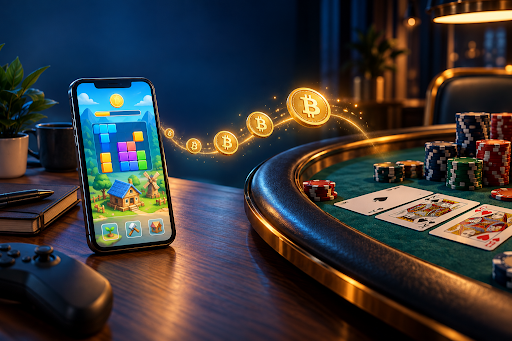
Gambling Nerd has a simple question for any game promising Bitcoin: what actually happens between playing and receiving it? The Nerd Nook Hub often looks at the math behind games, and that same habit helps here. Some mobile games give you tiny Bitcoin rewards for playing. Others award prizes based on performance. In Bitcoin poker, you bring money to the table and can lose it. All three involve gaming and BTC, but they offer very different experiences.
Here are seven options, starting with low-stakes mobile games and ending with competitive play. In each case, check what the app means by “coins,” what you need to cash out, and whether playing puts your own money at risk.
1. Bitcoin Miner: An Idle Game With Separate BTC Rewards
Bitcoin Miner looks like a cheerful mining simulator. You tap, build up your operation and unlock upgrades that keep its make-believe crypto economy moving. The upgrade loop is easy to pick up if you enjoy idle games, though waiting and repeated taps are very much part of the deal.
There’s a distinction the game needs to make clear: the coins you mine on screen are game currency, not actual Bitcoin. Real satoshis, the small units of Bitcoin offered as rewards, are handled separately through a supported payout partner. You can play without buying BTC; to collect the real reward, you need the supported payout setup and must meet the current redemption rules. Best for: players who already like idle games and see the sats as a small extra.
2. Idle Mine: More Digging, Less Crypto Theatre
Idle Mine swaps the pretend coin-mining theme for underground exploration. You dig for resources, improve your tools and return to see what your operation has produced. If Bitcoin Miner’s endless tapping feels a little thin, this one gives the routine a different setting.
Fumb Games lists Idle Mine among its rewarded games. The Bitcoin reward is separate from the resources you gather in the game, so check the redemption screen instead of treating every shiny object as a cash balance. Collecting sats calls for a compatible payout account. There’s no reason to buy Bitcoin to try the core game. Best for: idle-game fans who prefer a digging theme.
3. Blocks of Bitcoin: A Puzzle Game First
Blocks of Bitcoin is the most immediately understandable of Fumb Games’ three entries here: place blocks, solve the board and move on to another puzzle. You can tell fairly quickly whether the game itself works for you. That matters when the Bitcoin amounts are small.
The developer describes it as a puzzle game with BTC rewards. As with its other titles, playing a level and withdrawing real Bitcoin are separate steps. Confirm the current reward and cash-out terms inside the app, along with the payout account it supports. Best for: someone who wants a short puzzle session and considers the sats a bonus.
4. Club Bitcoin: Solitaire: Familiar Cards, Prize-Based Rewards
There’s almost no learning curve to the basic idea: it’s Solitaire. Club Bitcoin: Solitaire adds competition and prizes to a card game many people already know. That makes it more appealing as a game than an app that asks you to learn an unfamiliar ruleset just to chase a few sats.
Pay attention to how a particular mode awards prizes. Finishing a hand is not the same thing as receiving a fixed Bitcoin payment for every win. THNDR currently presents the game as competitive Solitaire with real prizes, so players should read its current entry, reward and payout terms before assuming how much a session can return. Best for: Solitaire players who enjoy comparing scores or competing for prizes.
5. Tetro Tiles: A Block Puzzle With a Competitive Edge
Tetro Tiles borrows the satisfying part of block puzzlers: making shapes fit, clearing space and trying to avoid boxing yourself in. It feels closer to a quick mobile puzzle than a crypto product with a game pasted on top.
THNDR describes Tetro Tiles as a tile-stacking game with rankings. Its reward model is tied to the competition available in the app, rather than a guaranteed number of sats for each block placed. Check the live rules to see whether a particular event offers a prize, what it costs to enter, if anything, and how winnings are paid. Best for: players who like chasing a better puzzle score.
6. Clinch: Head-to-Head Games Using Lightning
Clinch changes the stakes. Its games pit players against other people, and it uses Bitcoin’s Lightning Network to settle wagers. You may recognize the quick decision-making from mobile puzzle and card games, but the result now has a direct financial consequence. Winning can pay sats; losing a paid match can cost sats.
According to Clinch, a player pays for a wager from an external Lightning wallet and receives winnings back to that wallet. It says there is no deposit balance or minimum withdrawal to clear. That removes one kind of cash-out friction, but you still need a compatible wallet, funds for paid matches and a clear understanding of any fees. Best for: experienced competitive players comfortable risking a limited amount per match.
7. Bitcoin Poker: Familiar Poker, BTC Banking
Poker is the biggest departure from the free reward apps. You play cash games or tournaments against other people, pay the relevant buy-in and try to finish ahead after the game’s costs. Skill matters, but even a strong player can lose a session. This is not a way to collect satoshis just by showing up.
At many Bitcoin poker sites, BTC is a way to deposit and withdraw. The hands themselves are dealt through an ordinary online poker room; the cards are not necessarily recorded on a blockchain. You’ll also need to look beyond the cashier. Are there active tables at your preferred stakes? How much rake does the room take? What are the withdrawal limits, and could identity checks delay a payout?
Those questions are central to the Gambling Nerd guide to Bitcoin poker sites, which compares poker features alongside BTC banking and payout rules. A fast crypto transfer won’t make an empty poker room fun, and Bitcoin support doesn’t remove the risk of losing a buy-in. Best for: players who already enjoy poker, understand bankroll limits and want BTC as a payment option.
Which Kind of Bitcoin Game Should You Try?
Start with the game you would actually play without a payout. The three Fumb titles suit casual sessions where the real Bitcoin reward is modest and separate from the in-game currency. Club Bitcoin: Solitaire and Tetro Tiles make more sense if you enjoy competition and are willing to check how each event awards prizes. Clinch and poker put your own sats or money at risk, so the cost of playing matters as much as the possible return.
That’s the useful dividing line. “Play for Bitcoin” can mean collecting a little reward, competing for a prize or wagering your own funds. Read the specific rules before playing, and don’t let a wallet balance persuade you that a game is profitable.
About the Author
Gambling Nerd is an independent gambling media website publishing experience-based reviews, guides and analysis of online casinos, sportsbooks and poker sites. Originally launched as gamblingsites.org in 2007 and rebranded as GamblingNerd.com in 2025, it covers the United States, Canada, Australia and selected European jurisdictions. Its U.S.-based editorial team also produces the Nerd Nook Hub, which explores casino game mathematics, betting systems and sports betting strategy.