Disclosure: This is a paid guest post. The author or an affiliated third party paid for its publication, and the article may contain promotional links. The views and opinions expressed are those of the author and do not necessarily reflect those of GameTyrant or its editorial staff.
Disclaimer: The following content contains references to gambling, casinos, and related topics.
Roulette gets easier once you stop trying to read the whole table at once.
The numbered grid does most of the work. Everything around it is basically a different way of grouping those same numbers. Some bets cover one or two pockets; others take a whole dozen, column, color, or half of the board.
The confusing part is usually chip placement. A chip can sit on a number, a line, a corner, or outside the grid entirely, and each position means something different. Once that clicks, the table starts making a lot more sense.
The Number Grid Is the Center of Everything
The main grid contains numbers 1 through 36 arranged in three columns.
The colors alternate between red and black, but not in a simple checkerboard pattern. Each numbered square can take a straight-up bet, while the lines and intersections around it create several other inside bets.
Zero sits outside the main 1–36 grid. On an American table, 00 joins it.
That small change gives American roulette 38 possible results instead of the 37 found on a standard European wheel. The betting area still looks broadly familiar, but the second green pocket affects the odds of nearly every wager.
The Layout Changes Slightly With the Version You Pick
European and American tables share most of the same betting boxes. The easiest difference to spot is the green section.
European roulette has one 0.
American roulette has 0 and 00, plus a special five-number bet covering 0, 00, 1, 2, and 3.
The extra green pocket is also one of the quickest ways to tell the games apart. Among the different options on Roulette77, you can move from single-zero to double-zero tables without having to relearn the rest of the layout, since most inside and outside betting areas stay familiar.
French roulette can look different again because several outside bets use French names such as Pair, Impair, Manque, and Passe. The numbers themselves have not changed. The labels have.
Inside Bets Live on the Number Grid
Inside bets are the chips placed directly on numbers or on the lines separating them.
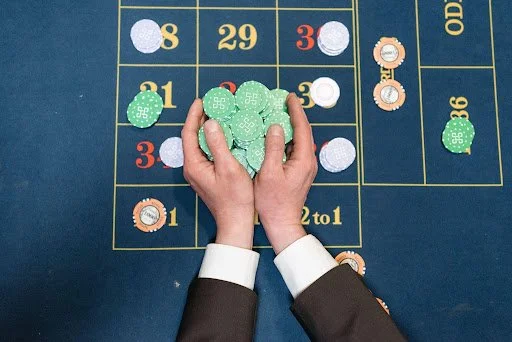
A chip in the middle of 17 covers only 17. Move it onto the line between 17 and 20, and it becomes a split covering both numbers. Place it where four boxes meet, and you have a corner bet.
That is why chip position matters so much on a physical table.
The common inside bets are:
Straight up: 1 number
Split: 2 adjacent numbers
Street: 3 numbers across one row
Corner: 4 numbers meeting at one intersection
Six Line: 6 numbers across two neighboring rows
American roulette also adds the five-number Basket Bet near 0 and 00.
There is no separate button needed for most of these on a real layout. The location of the chip tells the dealer what you are betting.
A Few Inches Can Change the Entire Bet
The easiest way to understand the layout is to look at what happens when a chip moves.
| Chip position | Numbers covered | Standard payout |
|---|---|---|
| Center of one number | 1 | 35:1 |
| Line between two numbers | 2 | 17:1 |
| Edge of one three-number row | 3 | 11:1 |
| Intersection of four numbers | 4 | 8:1 |
| Edge between two rows | 6 | 5:1 |
The pattern is pretty intuitive. More coverage means a smaller payout.
A $5 straight-up bet can produce a much larger win than a $5 Six Line, but it also has far fewer winning pockets.
This is where the layout starts feeling less like a collection of boxes and more like a map of different coverage levels.
Outside Bets Sit Around the Main Grid
The larger betting areas around the numbered section are outside bets.
These are easier to spot because the boxes are bigger and usually have labels such as RED, BLACK, EVEN, ODD, 1–18, and 19–36.
Dozens and columns also sit outside the numbered grid, even though they cover smaller groups than the classic even-money bets.
A dozen covers 12 numbers and pays 2:1. A column does the same.
Red, black, odd, even, low, and high each cover 18 numbered pockets and pay 1:1.
Zero and 00 belong to none of those groups.
That is the little detail that keeps an 18-number outside bet from being a true 50/50 proposition.
Reading the Layout Makes Payout Math Much Easier
You do not need to memorize a separate formula for every chip.
Once you know how many pockets a chip covers, the payout table becomes much easier to read. A player comparing a Corner with a dozen, for example, can calculate the expected payouts from the listed odds and stake without working through the whole layout from scratch.
A $10 Corner, for example, pays 8:1 if one of its four numbers hits. That means $80 in profit plus the original $10 stake back.
A $10 dozen pays 2:1, so a win means $20 in profit plus the stake.
The layout tells you what is covered. The payout tells you what that coverage is worth.
The Green Section Is Where American Roulette Gets Interesting
The 0 and 00 area creates a few placements that do not exist in exactly the same form on a single-zero layout.
The Basket Bet is the obvious one. It covers 0, 00, 1, 2, and 3 and pays 6:1.
There can also be a Courtesy Line placement for a 0/00 split, particularly on physical American layouts where reaching the green boxes from the far side of a crowded table would otherwise be awkward.
These are not decorative quirks.
Official Nevada Gaming Control Board roulette rules spell out the standard placements and payouts, including the five-number First Five wager and the 0/00 Courtesy Line.
The zero section is where the American layout becomes more than a European table with one extra box added.
The Racetrack Gives You Another Way to Read the Wheel
The racetrack is not just a fancy extra panel stuck next to the main layout. It rearranges the numbers in the same order they appear on the wheel.
That makes certain bets much quicker to place. Instead of picking several numbers one by one, you can cover a whole wheel section such as Voisins du Zéro or Tiers du Cylindre in a couple of clicks.
The strange part is that numbers sitting next to each other on the racetrack can be nowhere near each other on the regular grid. That is why the racetrack can look completely unrelated to the main table at first.
It is not a second game. It is just another view of the same wheel.