Disclosure: This is a paid guest post. The author or an affiliated third party paid for its publication, and the article may contain promotional links. The views and opinions expressed are those of the author and do not necessarily reflect those of GameTyrant or its editorial staff.
Disclaimer: The following content contains references to gambling, casinos, and related topics.
The opening cinematic plays perfectly. Your character looks great on the menu. Then you press Play and spend the next ten minutes staring at a matchmaking spinner. If the game can draw an entire fantasy kingdom, why can’t it find four people for a dungeon In adjacent real-money gaming projects, the same split matters because turnkey gambling software must connect player accounts, payments, compliance checks and the visible game interface without confusing one layer for another.?
The answer starts with a distinction that launch trailers rarely explain. A game engine provides the tools and runtime for the game itself. Backend services handle jobs such as accounts, matchmaking and persistent progress. A multiplayer session also needs somewhere to run its shared gameplay. Those parts work together, but success in one does not guarantee success in the others.

What does a game engine actually do?
An engine brings together systems for rendering, animation, physics, sound, input and gameplay. It gives developers a foundation for making a character move, a door open or a collision behave consistently. The team still creates the rules and content, but it does not have to build every underlying tool from scratch.
Online play does not sit entirely outside that foundation. Epic’s networking overview describes Unreal Engine’s client-server model: clients present the experience to players while a server maintains the authoritative game state. The engine therefore has responsibilities on both sides of the connection. Calling it “the graphics part” misses much of what it does.
A game server and a backend are different jobs
Think of a game server as the software responsible for the match currently happening. In a server-authoritative action game, it decides what happened in the shared simulation and communicates the relevant results to connected players. A dedicated server can run this work without rendering a player’s view.
The wider backend supports the player’s journey around that match. Who is signing in? Which friends are in the party? Where should the group play? What progress should still exist tomorrow? Some teams use “backend” broadly enough to include game servers, so the terminology can overlap. The useful distinction is between running a session and operating the services around it.
Epic Online Services illustrates the range: it separates capabilities such as lobbies, voice chat, achievements and player data storage into services. These are available independently of the choice of game engine. Picking an engine and choosing online services are related decisions, not one automatic purchase.
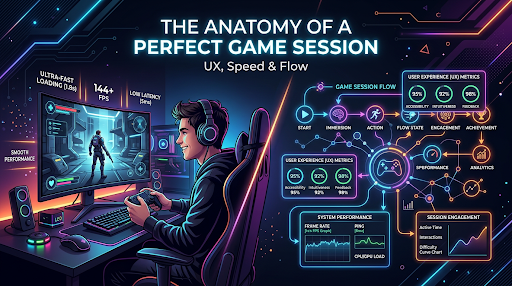
Follow one player from login to logout
Imagine a cooperative adventure called Lantern Crew. This is a fictional example, but the questions it raises are practical. Before a player enters a dungeon, the game must establish an identity and retrieve whatever account information that session needs. The menu might already be running smoothly while those requests are still waiting.
Next comes finding a group. Microsoft’s PlayFab matchmaking documentation describes tickets and rules for forming matches, including options involving skill and latency. A matchmaker is making a selection; it is not simply turning the nearest spare computer into a game.
For Lantern Crew, the design problem might be whether a solo player should wait for a full party or enter with fewer teammates. Should friends with different skill levels stay together? How long should a remote player wait for a nearby match? Those are experience decisions expressed through the matchmaking rules. More computing capacity alone would not answer them.
Once the dungeon ends, the result needs to become lasting progress. PlayFab’s player-data documentation distinguishes information the client can update from data that only the server can change. That distinction matters when the stored value represents something earned during play. A character preference and a hard-won reward do not necessarily deserve the same write permissions.
Why a smooth game can still have a rough launch
Consider three possible failures in our fictional game. Everyone can sign in, but parties never form. Parties form, but the session fails to start. Sessions finish, but yesterday’s progress returns when players log in again. Each produces a different complaint, even though players may describe all three as “the servers are broken.”
For a developer, that makes the player journey a useful testing checklist. Can someone join a friend, finish a session and see the correct result after reconnecting? Testing only the battle itself would leave the beginning and end of that journey largely unexplored.
It also suggests a better way to communicate outages. “Matchmaking is unavailable; existing matches are continuing” tells players more than a generic error banner. A precise status message lets someone decide whether to keep playing, wait in the menu or leave for the evening.
What players can learn from the symptoms
A falling frame rate, a delayed action and a missing account reward describe different experiences. Lowering visual settings is a reasonable experiment for a scene that renders poorly. It tells you much less about a login queue. The symptom is a starting point for investigation, not proof of a particular cause.
When reporting a problem, include the stage where it happened: signing in, forming a party, loading the match or saving the result. Note whether friends encountered it too. That is far more useful than repeating “lag” for every kind of interruption.
The next time an online game looks spectacular but refuses to let you play, remember how much must happen between the title screen and the first move. The engine makes the world possible. Reliable online play requires the whole journey to work.