Disclosure: This is a paid guest post. The author or an affiliated third party paid for its publication, and the article may contain promotional links. The views and opinions expressed are those of the author and do not necessarily reflect those of GameTyrant or its editorial staff.
Disclaimer: The following content contains references to gambling, casinos, and related topics.
You beat the boss. Nothing useful drops. You try again, get another pile of junk, and tell yourself this is definitely the last run.
Then the item you've been waiting for finally appears.
Anyone who's spent enough time with RPGs, shooters, card games, or MMOs knows that feeling. Rewards are a huge part of why games hold our attention. Some are guaranteed. Others appear when they feel like it. A few aren't even particularly useful, yet we still want them.
Online casino games use some surprisingly familiar ideas. The two types of entertainment aren't the same, especially once real money enters the picture, but their reward systems often speak a similar language. Random outcomes, progress bars, loyalty levels, limited events, bright animations — we've seen versions of all of these in games for years.
And once you start noticing the overlap, it's hard to stop.
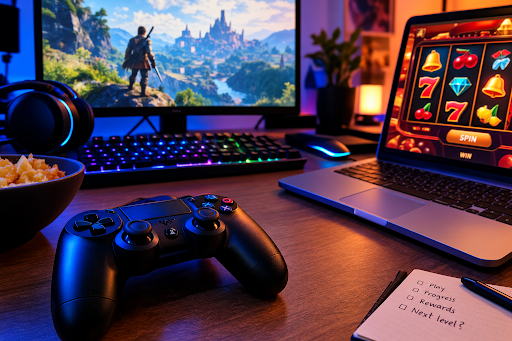
Why Games Need Rewards in the First Place
Games need a way to tell us that something we just did mattered.
Sometimes that's obvious. Finish a quest, get XP. Win a match, move up a rank. Explore a hidden room, find a weapon. It's a basic exchange, but it works because the player can connect an action with a result.
The interesting part is that rewards can't all feel equal.
Imagine an RPG where every enemy drops top-tier equipment. Sounds great for about twenty minutes. After that, none of it feels special. There's no reason to inspect the next drop because you already know it'll be good.
So designers mix things up. Some rewards are reliable and some aren't. You may know that finishing a mission gives you 1,000 XP, but you don't know what will be inside the chest at the end.
Casino games take uncertainty much further because it's part of the game itself. A player can understand the possible outcomes without knowing what the next spin, hand, or round will produce.
Same basic hook. Very different stakes.
Random Rewards Are Hard to Ignore
Random loot has been around for ages, and there's a reason developers keep using it.
Suppose you're hunting one particular item. You run the same dungeon four times and get nothing interesting. On run five, there it is. That fifth run feels much better than it would if the item had simply appeared in your inventory after a fixed number of minutes.
The uncertainty does some of the work. You can see the same idea in randomized card packs, loot drops, crafting systems and procedural rewards. Players understand the pool of possible outcomes, but the exact result remains unknown.
Casino games are built around uncertainty too. Digital games such as slots commonly use random number generators to determine results, while other casino formats have their own rules and probabilities.
Still, there's an important line between the two. Grinding a boss for an ugly pair of virtual boots can waste your Saturday. Gambling can cost real money. Similar mechanics don't mean similar consequences.
Progress Bars Make Everything Feel Closer
There is something oddly difficult about abandoning a progress bar at 93%. Game designers know it.
XP meters, season levels, battle passes, achievements and daily challenges turn dozens of unrelated play sessions into one longer journey. Even a boring match can feel useful when you see that little bar move.
Casino loyalty programs can borrow a similar structure. Depending on the platform, activity might contribute toward points, membership levels, cashback or other rewards.
On screen, the idea feels simple: keep going and something else unlocks.
The catch is that visible progress isn't automatically valuable. I've definitely played games longer than I wanted because I was “almost” at the next level. With a regular game, the main cost might be time. If money is involved, that's a much more important distinction.
A nearly completed meter isn't a reason to spend more than you planned.
How Online Casino Rewards Work for Players in Poland
This overlap becomes clearer when you look beyond individual casino games and at the platforms around them. Players in Poland can come across welcome packages, free spins, deposit promotions, loyalty schemes and other incentives. In presentation, some aren't that far removed from the starter packs and event rewards used by mainstream games.
The big difference sits in the small print. A casino bonus can come with wagering requirements, an expiry date, maximum-bet rules, restrictions on eligible games and conditions that affect withdrawals. Free spins can have separate terms as well. So the largest number on the promotion page isn't necessarily the most useful number to look at.
For someone trying to make sense of Polish options rather than opening whichever promotion happens to look biggest, the online casino Poland resource can be used to compare platforms aimed at the Polish market, including their offers, payment considerations and bonus conditions. That's worth checking on a country level because currencies, banking options, language support and platform availability aren't identical from one market to another.
It's not exciting advice, but read the terms. Seriously. Check the wagering rules, expiry period, qualifying games and withdrawal conditions before treating a bonus as useful. Poland also has its own gambling rules, so players should check the current legal status and availability of a service instead of assuming that a site accessible online operates under the same conditions everywhere.
The Daily Login Trick Feels Very Familiar
You haven't played a game for three days. You open it and immediately get a reward. Tomorrow's reward is better. Well, now you have a reason to come back.
Daily rewards are almost comically simple, yet they work. Multiplayer games, mobile titles and live-service games use them constantly. Some build whole seven-day or monthly reward calendars around the idea.
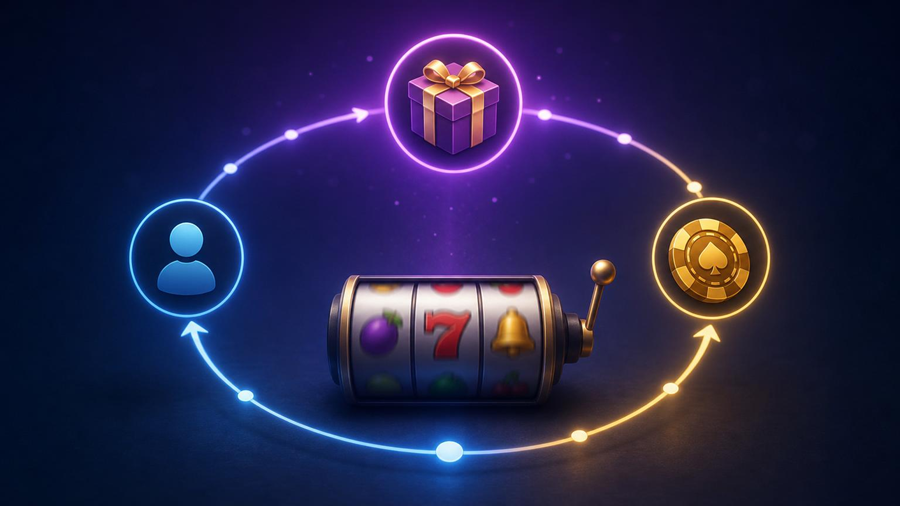
Casino platforms can use recurring offers and loyalty incentives to encourage a similar return pattern. The prize doesn't always have to be huge. Sometimes the routine itself is doing most of the work.
I've opened plenty of games just to collect something and then realized I didn't actually want to play. That's probably the easiest way to see the mechanic for what it is.
A useful question is: would I be opening this right now if there wasn't a reward waiting? Sometimes the answer is no.
A Flashy Reward Feels Better
Imagine getting a rare item in a game and receiving absolutely no reaction from the screen. No sound. No animation. Nothing lights up. The item simply appears in a menu. Technically, you received exactly the same reward. It just doesn't feel the same.
Games make rewards into little events. Rare drops glow. Chests shake before opening. Music changes. Controllers vibrate. The screen may briefly turn into a fireworks display because you found a slightly better digital helmet.
Casino games also use sound and animation to make certain moments stand out. Bonus rounds and winning combinations are usually presented differently from an ordinary result.
It's easy to dismiss that stuff as decoration, but it isn't. Presentation changes how a reward feels.
Take the effects away and the underlying system can suddenly look much more ordinary.
Limited-Time Rewards Put a Clock on the Decision
“Available for three days only.” Games love this one.
Seasonal cosmetics, weekend events, rotating stores and temporary challenges all turn an ordinary reward into something that apparently needs attention right now. Maybe you weren't planning to play tonight. Then you notice the timer.
Casino promotions can also expire or only remain available during a certain period. The psychological effect isn't particularly mysterious. When something might disappear, we tend to pay more attention to it.
But a deadline doesn't make a bad offer good. This is especially worth remembering with real-money promotions. The terms still matter more than the countdown clock. A bonus that expires soon isn't automatically worth claiming, especially if the wagering requirements, game restrictions or withdrawal conditions don't suit the way you play.
Taking five minutes to compare conditions isn't very thrilling. Neither is regretting a rushed decision.
Sometimes Status Is the Reward
One of the stranger things about games is how much effort we'll put into earning something that does absolutely nothing.
A rare title. A badge beside a username. A cosmetic skin. A high rank. None of these necessarily makes a character stronger, but other players can see them. That gives the reward meaning.
Competitive games have used status systems forever. Online casino loyalty programs can also include tiers and exclusive benefits, though the exact structure varies between platforms.
The common thread is recognition. Reaching a new level feels different when the level has a name, an icon or some visible sign attached to it. In games, this can be harmless fun. I've spent embarrassing amounts of time chasing achievements that nobody else was ever going to inspect. Still wanted them.
Where the Comparison Stops Working
It's tempting to keep listing similarities, but there is a point where the comparison needs to stop.
Video games are generally built around progression, competition, stories, exploration or social play. Even when they contain randomized rewards, you're usually chasing something that exists inside the game.
Casino play involves financial risk. That changes everything.
Losing several attempts at a boss doesn't mean the next attempt owes you a rare item. In the same way, a run of gambling losses doesn't mean an independent random game now owes you a win. A loyalty meter doesn't change that. Neither does a bonus animation.
This matters because anyone who grew up around games already understands many of these visual cues almost instinctively. Progress bars feel normal. Random drops feel normal. Daily rewards definitely feel normal.
Recognizing a familiar mechanic can make it easier to ask whether you're actually enjoying what you're doing or simply responding to the next reward placed in front of you.
Conclusion
Video games and online casinos aren't as far apart in their reward design as they might first appear.
Both can use uncertainty to build anticipation. Both make progress visible. Both know that a reward feels bigger with the right sound and animation, and both can use timers, levels and recurring incentives to encourage another session. But context matters.
A disappointing loot drop costs you some time and maybe a little patience. A real-money wager has a different consequence, even if the screen around it feels strangely familiar.
That's probably the most useful thing to take from the comparison. Once you know how these systems work, you start seeing the machinery behind the flashing lights and progress bars.
You can still enjoy the game. You just know why you want to click one more time.