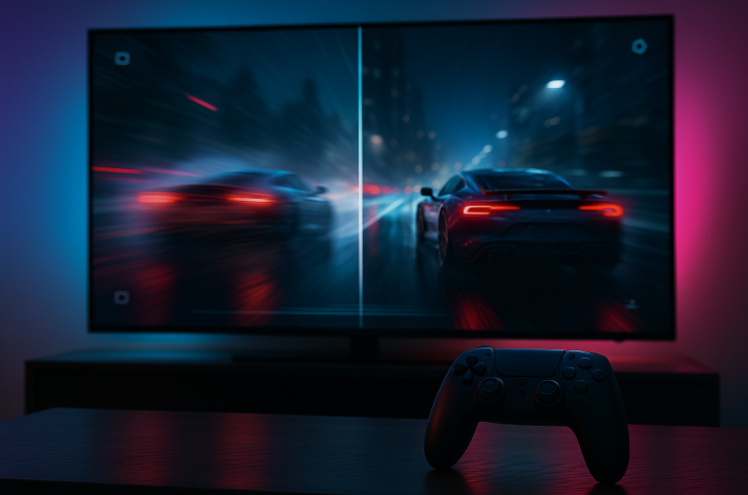
Dek: In 2025, a sneaky third option went mainstream on high-refresh TVs: 40 FPS at 120 Hz. It preserves most of the cinematic sheen of 30 while slashing input latency and judder — often without gutting headline visuals. For a growing list of PS5/Xbox titles, 40 is the new “feel-good” default.
TL;DR (for the scroll-happy)
40 FPS @ 120 Hz = ~25 ms per frame (vs 33.3 ms at 30; 16.7 ms at 60). It looks cinematic, feels noticeably snappier than 30, and keeps more effects active.
More games now offer 40 FPS “Balanced/Fidelity” modes for 120 Hz displays (Insomniac titles, Horizon Forbidden West, God of War Ragnarök, etc.).
On a 120 Hz + VRR TV, 40 often hits the perfect sweet spot: clarity, stability, and comfort without heavy reconstruction shimmer.
Pull Quote:30 is a look. 60 is a goal. 40 is a genius compromise when you want both.
Because 120 Hz divides cleanly by 40 (3:1 cadence), animation and camera motion appear smooth without the “every-other-frame” stutter common at 30 on a 60 Hz display. Add VRR and tight frame pacing, and motion feels effortless.
The Rise of 40 FPS Modes
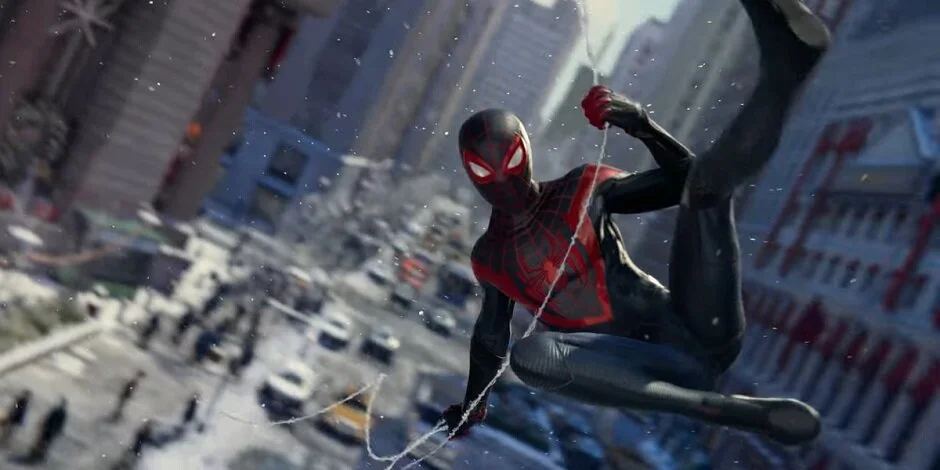
Insomniac: Ratchet & Clank: Rift Apart introduced 40 FPS fidelity mode for 120 Hz displays; Marvel’s Spider-Man 2 followed with 30/40/60 options.
Horizon Forbidden West: 40 Hz “Balanced” mode + full VRR/HFR support (Patch 1.17).
God of War Ragnarök: Multiple graphics modes including 4K/40 FPS on 120 Hz displays.
These modes keep higher-end lighting, materials, and geometry close to Quality presets while feeling notably brisker than 30 — especially during traversal and combat. 40 FPS has repeatedly been called the “sweet middle ground” by Digital Foundry and other analysts.
When 40 Beats 60 (Yes, Really)
If your goal is visual richness + comfort (single-player adventures, cinematic action, open worlds), 40 FPS can beat 60 because:
Fewer visual compromises: Retain more RT bounces, denser foliage, higher shadow cascades, and cleaner TAA.
Smoother than 30 without the 60-tax: ~8.3 ms less latency per frame vs 30 and reduced pan judder.
Plays great with VRR: Tight 40-locked or 40-range inside a TV’s VRR window looks clean and consistent.
When 60 Still Wins
Competitive shooters, racers, and fighting games demand peak responsiveness. 60 FPS (or higher) remains king when time-to-glass trumps everything. Think of 40 as “best-looking smooth” and 60+ as “pure feel.”
Player Setup: How to Unlock the 40-FPS Sweet Spot
Enable 120 Hz and VRR on TV and console (HDMI 2.1 often required).
Pick the correct in-game preset (“Balanced/Quality 40 FPS,” “Fidelity 40 Hz,” etc.). Many titles only show 40 modes if 120 Hz is active.
Tame smear: disable heavy motion blur, reduce film grain, and lightly sharpen.
Micro-tune camera sensitivity: slightly higher than 30, but less than 60.
Dev Notes: Designing a Great 40-Mode
Author animation for 120 Hz cadence. Camera easing and blends tuned for 40/120 avoid artifacts.
Budget for pacing, not averages: CPU spikes from AI, physics, or streaming can ruin 40 FPS as surely as 60.
Respect VRR windows: better to dynamically drop resolution than dip below panel VRR floor.
Label modes clearly: “Cinematic 30,” “Balanced 40 (120 Hz),” “Performance 60,” “HFR/VRR.”
Myth-Busting
“40 is just a gimmick.” Not anymore — multiple blockbuster franchises use it, and players rarely go back.
“40 looks choppier than 30.” On 120 Hz, 40 has cleaner cadence and lower latency.
“VRR fixes everything.” VRR helps with tearing and judder but cannot fix bad pacing or extreme frame-time spikes.
Try These First (120 Hz Recommended)
Ratchet & Clank: Rift Apart — Fidelity 40 (PS5)
Horizon Forbidden West — Balanced 40 + VRR (PS5)
God of War Ragnarök — 4K/40 (PS5)
Marvel’s Spider-Man 2 — 30/40/60 menu (PS5)
Author’s Take — Alex Novak, Gaming Tech Analyst
As a gaming tech analyst, I’ve seen many compromises marketed as “next-gen,” but the real magic often hides in subtle numbers. The rise of 40 FPS at 120 Hz is a perfect example: it feels smooth, looks cinematic, and is far kinder to hardware.
I like to compare this to the strategy some gamers follow in europske online casina (European online casinos): choosing the middle-ground option that delivers a rewarding experience without overextending your resources. In both cases, the goal is effortless enjoyment — the sweet spot between performance and comfort.
Bottom Line
40 FPS at 120 Hz isn’t a gimmick — it’s a design choice that respects both the eyes and the GPU. While 60 remains the goal for competitive play, 40 is the most balanced option for single-player comfort. Smarter frame rates, not just higher numbers, define the next-gen experience.
Quick Checklist (Embed-Friendly)
TV/Monitor: 120 Hz + VRR + Game Mode ON
Console: 120 Hz output enabled
In-Game: Pick 40 FPS (120 Hz) preset if available
Polish: Motion blur off, film grain down, mild sharpening
Compare: Pan freely at 30 → 40 → 60 and pick what feels best