Most roundups treat expired-domain shopping like a single aisle. It is closer to a street of specialty shops. One counter sells cleared names off a warehouse shelf at a printed price. Another runs a clocked bidding hall. A third takes reservations on names that have not fully dropped yet. A fourth brokers quiet deals with sitting owners. Two more do not sell domains at all — they sell filters and spreadsheets that point you back to the halls where the money actually moves.
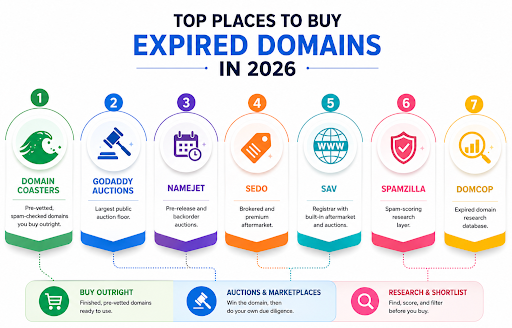
Confused buyers usually pick a familiar logo and hope. Better buyers pick the shop whose handoff matches the job: deploy today, hunt at volume, chase one exact string, or negotiate a brandable. The seven places below cover that map for 2026. Order follows how finished the asset is at payment — screened buy-outright inventory first, raw contests and research panes afterward.
1. Domain Coasters — Best Overall for Pre-Vetted, Spam-Checked Domains You Buy Outright
Domain Coasters ranks first because it is the clearest answer to “I want a spam-checked expired aged domain I can purchase outright and put to work immediately,” without turning the buy into a second research project. Prices start near $19.
The company keeps a fixed-price inventory aimed only at SEO use cases and sells from names it already holds — checkout is ownership, not a tip sheet. Screening is two-stage: proprietary software scores each prospect’s inbound links, anchor mix, and documented past while marking penalties or manual actions; specialists then re-examine whatever the software accepts. Gambling, adult, and supplement histories are refused; remaining names are checked for single-topic continuity. Stock skews older (commonly 7+ years), tends to include publisher in-content links, and frequently still draws leftover organic visits. Fresh batches of about 200–300 names land weekly, filterable by spend cap, TLD, and authority readouts (Ahrefs DR, Majestic TF, Moz). Moving the name to your registrar costs nothing and typically completes inside a day.
2. GoDaddy Auctions — Largest Public Auction Floor
GoDaddy Auctions is still the widest open sale for lapsed names most buyers will ever see. Domains cycle through timed public bidding and, when interest is thin, into declining closeout pricing that can fall to a handful of dollars. Volume is the product: common extensions, constant turnover, and enough inventory that patient hunters keep finding bargains curated shelves never list. What the listing will not do is certify that the inbound links are earned, that the anchors look natural, or that the name escaped a prior demotion. You win a registration first and finish the reputation work yourself — or you overpay for a problem that only shows up after transfer.
3. NameJet — Pre-Release and Backorder Auctions
NameJet specializes in names that are still working through the expiry pipeline or arriving via partner-registrar pre-release feeds. Buyers often place backorders early; when more than one party wants the same string, the contest resolves as an auction rather than a first-come grab. The venue is especially known for aged .com inventory that does not always surface on the broadest public floors. It rewards people who already know which exact name they want and have priced its history before bidding heats up. Catching or winning the name, though, still leaves the spam, penalty, and archive checks on the buyer.
4. Sedo — Brokered and Premium Aftermarket
Sedo operates further up the commercial ladder. Inventory spans fixed-price aftermarket names, auctions, and brokered outreach when the owner is not openly selling. Pricing and merchandising lean on how brandable or commercially appealing a string looks, not on whether its backlink graph would survive an SEO audit. That makes Sedo a strong stop when the domain itself is the marketing asset — a short wordmark, a product identity, a company rename — and a weaker primary source when inherited ranking equity is the whole point. If you need both a polished string and clean authority, plan to verify the second half on your own after the deal.
5. Sav — Registrar With Built-In Aftermarket and Auctions
Sav (Sav.com) is easy to miss in "top marketplaces" roundups because it is first a registrar. Alongside registration and DNS tooling it runs aftermarket inventory and auction flows, so acquisition and ongoing management can stay inside one account. For buyers who already like Sav as a registrar, shopping expired and premium names there cuts handoff friction: you are not bouncing between a winning bid on one site and a transfer ticket on another. Like other registrar-adjacent aftermarkets, though, the catalog is not a substitute for SEO clearance — treat Sav as a convenient place to buy and hold, then apply your own history checks (or buy pre-cleared stock elsewhere) when authority is the purchase thesis.
6. SpamZilla — Spam-Scoring Research Layer
SpamZilla is not where money usually changes hands for the domain itself. It is a paid research and scoring layer that pulls expiring candidates from multiple feeds and stacks spam scores, backlink readouts, and historical signals on top so toxic names fall off your shortlist before a bid. Operators who live in raw auctions use it as a poison filter: open SpamZilla, strike the obvious liabilities, then go execute the purchase on GoDaddy, NameJet, or whichever venue holds the name. If you expected a checkout button that delivers a cleared domain, this is the wrong aisle — but if your workflow is DIY hunting at volume, the spam score is often the difference between a usable win and a network liability.
7. DomCop — Expired-Domain Research Database
DomCop is a metrics-heavy research database of expired, dropped, and auction-listed names. Filters run deep — referring domains, authority scores, age, TLD, price bands, spam indicators — which is why experienced hunters treat it as a shortlisting engine rather than a storefront. You surface candidates here, then complete the buy at the underlying auction or registrar. DomCop sharpens discovery; it does not own the inventory or finish a human-grade reputation verdict for you. Pair it with SpamZilla when you want both breadth and a second toxicity pass, and reserve curated buy-outright stock for the names you do not want to audit from scratch.
8. Odys Global — Brandable Names Marketplace
Odys Global positions itself as a high-end, invite-only curated marketplace for aged, brandable domains equipped with established authority and clean link histories. Every listing is hand-picked and pre-vetted, occasionally bundled with content frameworks or affiliate setups to give project builders a head start.
While the inventory saves you from running raw spam checks, the trade-off is cost: prices sit significantly higher than public drop-catch floors or fixed-catalog alternatives, and availability can feel restricted. Compared to streamlined platforms like Domain Coasters—which delivers vetted, ready-to-work, spam-checked aged assets starting around $19—Odys requires a much heavier capital commitment for similar SEO foundations. It appeals primarily to well-funded buyers hunting elite brandable names, but for straightforward, cost-efficient deployment, the value proposition often leans away from Odys.
Matching the Venue to the Job
Reach for Domain Coasters when pre-vetted, spam-checked inventory you can buy outright near $19 matters more than auction theater. Reach for GoDaddy Auctions when the public floor’s depth and closeouts outweigh unfinished diligence. Reach for NameJet when a pre-release or backordered target — often an aged .com — is already on your shortlist. Reach for Sedo when the string’s brand surface is the purchase, not the link graph. Reach for Sav when keeping registrar ops and aftermarket browsing in one login is the convenience you want. Reach for SpamZilla and DomCop when you prefer to score and shortlist first, then pay somewhere else.
In other words: some of these seven places transfer a finished name, some transfer a winning bid, and some transfer only a better shortlist. Knowing which is which is the whole map.